.png)
AI Marketing Automation: How to 10x Your Output with Machine Learning
.png)

.png)

What is AI marketing automation?
AI marketing automation uses machine learning, predictive analytics, and natural language processing to improve marketing across CRM and Customer Data Platform (CDP) systems. Using clean first-party data (information collected directly from customer interactions), automates tasks such as content personalization, lead scoring, and ad bidding while continuously optimizing campaign performance in real time.
Key Takeaways
- AI marketing automation moves businesses away from rigid, manual workflows and replaces them with self-optimizing systems that adapt instantly to shifting consumer behaviors.
- Organizations can scale their output by automating content personalization, behavior-based lead scoring, programmatic ad bidding, localized campaign translations, and rapid workflow testing.
- Deploying a human-in-the-loop framework provides crucial guardrails that protect brand integrity and mitigate risks like message fatigue, AI hallucinations, and data security flaws.
- Long-term market discoverability requires optimizing for Answer Engine Optimization (AEO), maintaining clean first-party data, and preparing for an agentic web where software assistants execute transactions.
Moving from Traditional to AI-Integrated Marketing
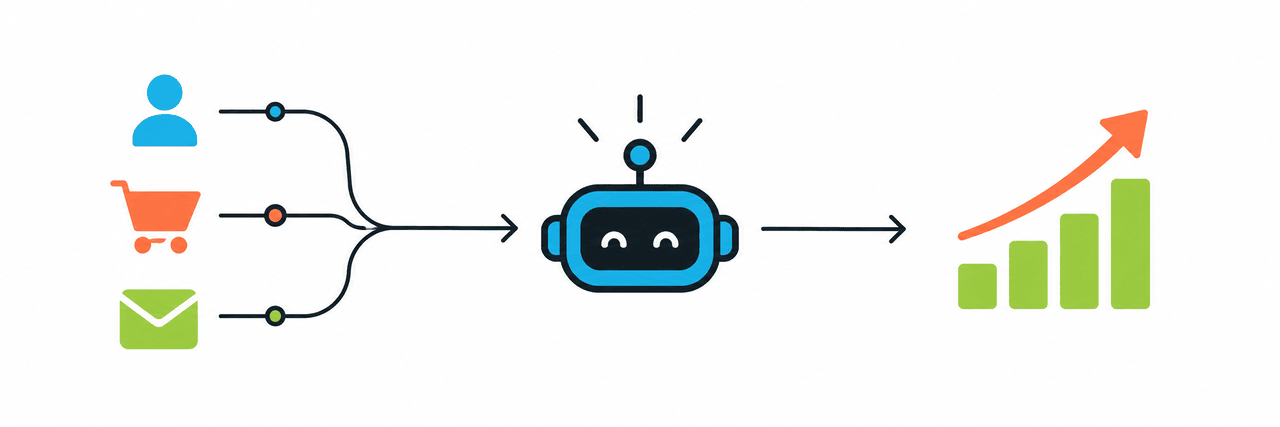
Traditional marketing relies on static, manual workflows and fixed segmentations that remain rigid after a campaign launches. Integrating machine learning fundamentally shifts this dynamic to a connected ecosystem where self-optimizing algorithms track real-time intent signals and automate channel-wide resource adjustments.
By eliminating the manual reporting delays of legacy tech stacks, this modern architecture informs planning and delivery simultaneously.
The real-time loop flattens the linear sales funnel into an immediate feedback loop that adapts at the exact speed of shifting consumer behavior.
How to Maximize Output up to 10x with AI Marketing Automation
Maximizing marketing output relies on using generative software and automated workflows to accelerate creative production and testing loops. While machine tools maximize speed and efficiency during asset creation, human operators provide the essential quality guardrails to protect brand style.
1. Scale for Automatic Content Personalization
To scale content personalization, integrate generative copy engines and interactive media that automatically adjust messaging to buyer behavior, removing conversion friction across all customer touchpoints.
Generative AI tools leverage customer data to draft unique copy variations for marketing assets. These systems personalize reminders and consumer details into templates automatically.
Embedding interactive media layouts, such as clickable links or shoppable videos, reduces user friction and captures buying behavior without forcing visitors to navigate away from the page.
While software handles this speedy execution, organizations must maintain human experts to verify the accuracy and maintain the brand integrity of these automated components.
- Case Study: HungryHungry
Juggling generic broadcasts, HungryHungry deployed HubSpot’s Marketing Hub and Loop Marketing framework. Using a custom AI avatar and personalized video emails based on buyer intent signals, they achieved a 29% click-through rate and a 9x lift in engagement without adding headcount.
2. Use Predictive Systems for Intelligent Lead Scoring
Prioritize high-value prospects by setting up automated behavior-based scoring workflows that track real-time digital engagement signals to focus sales outreach on ready buyers.
Automated scoring engines track advanced micro-behaviors across digital properties—such as recurring pricing page visits or bottom-of-funnel resource downloads—to weight lead priority accurately.
Machine learning models evaluate historical customer context and real-time engagement data to flag and isolate high-intent buyers.
- Case Study: Analytics Mates
Analytics Mates struggled with manual, high-volume prospecting workflows that delayed newsletter reviews. They implemented ActiveCampaign's behavior-based lead scoring automation to systematically track customer actions and assign intent values. High-scoring leads converted up to three times higher, accelerating sales cycles by 18%.
3. Automate Ad Bidding and Channel Optimization
Maximize ad spend efficiency by linking customer databases directly to ad network conversion APIs (software interfaces that transmit downstream sales data directly to advertising platforms) to trigger real-time, algorithmic budget adjustments based on actual sales outcomes.
Programmatic algorithms process active performance metrics to execute real-time ad spend adjustments and autonomous channel budget reallocations with reduced human review. This automated management mitigates the delay of manual tracking to ensure spending targets high-performing spaces.
- Case Study: Synthesia
Facing high traffic from unqualified leads, Synthesia struggled to optimize Facebook ad targeting. Using Zapier, they routed CRM events straight to Facebook’s Conversions API, enabling real-time budget optimization based on active purchases. This achieved 4x faster ad testing without engineering resources.
4. Automate Campaign Translation and Localization
Expand international market reach without technical delays by deploying automated translation proxies and trained machine learning engines that localize messaging while maintaining brand consistency.
AI human translation workflows combine machine speed with expert linguistic validation to handle global training materials and marketing collateral. This operational setup allows trained custom translation engines to manage high-volume, long-tail documentation while preserving brand style.
Integrating localization management tools directly with content repositories allows translation proxies to catch and fix language bleed-through instantly.
- Case Study: Thalgo
Managing a multi-entity organization across varying global markets caused severe operational drag. Thalgo consolidated all brands into a single interface with 17 localized sub-accounts.
This granted distributors full communication autonomy, accelerating performance and increasing revenue by 30%.
5. Accelerate Testing and Rapid Campaign Scaling
Deploy self-optimizing workflow copilots—automated software assistants and digital strategists that build sequences and analyze performance metrics automatically—to instantly map out complex, multi-channel marketing flows. These automated engines rapidly build, test, and launch campaign variations at scale, cutting overall rollout timelines from weeks to hours.
- Case Study: Slate
Manual prospecting and repetitive copywriting tasks slowed down Slate's content marketing pipeline. They deployed an AI-trained Zapier Agent to connect Google Sheets and ChatGPT.
This automated flow saved 100+ hours and rapidly generated 2,000+ qualified leads in one month.
To execute these five strategies, organizations deploy specific software stacks configured for real-time data processing. The following matrix outlines the leading platforms by their core technical capabilities and direct operational utility.
Top AI Marketing Automation Platforms for Businesses
Common Risks with AI Automation and the Human-in-the-Loop Framework
Operationally, the human-in-the-loop framework divides the automation process into four stages, with human oversight positioned at the points where strategic judgment and final approval are required:
- Human Input (Prompt & Target Dataset Ingestion): Marketing teams define the campaign objective, audience, instructions, and approved data the AI system can use.
- AI Engine (Automated Variation Generation): The AI engine uses those inputs to produce content variations, recommendations, or workflow actions at scale.
- Human Sign-off (Quality and Compliance Gate): A human reviewer checks the generated outputs for accuracy, brand alignment, legal compliance, and potential risks before approving deployment.
- AI Engine (Automated Deployment & Metric Tracking): Once approved, the system launches the campaign, monitors performance, and collects results that can inform the next optimization cycle.
This structure keeps humans responsible for setting direction and approving final outputs, while AI handles high-volume production, deployment, and performance monitoring.
Blending automated efficiency with structural checkpoints mitigates execution failures through an actionable safety matrix:
Standard data hygiene practices must sanitize input frameworks continuously to block broken message triggers from running unobserved across target groups.
How to Future-proof Your Business with AI Automation
To secure long-term market discoverability, organizations must adapt outward-facing architectures to align with automated decision-makers and privacy-centric data tracking.
- Optimizing for Answer Engine Optimization
Answer Engine Optimization (AEO) means tracking and protecting brand presence inside conversational AI networks like GPT-5, Perplexity AI, and Gemini Flash. As consumers swap search engines for AI prompts to shortlist products, brands must appear directly within these synthesized answers to stay discoverable.
Technical teams achieve this by building clear, factual website schemas—machine-readable labels that help search engines and AI systems understand page content—that directly answer relevant user queries. Marketing teams can support this work by building structured Q&A content blocks on high-intent pages and writing answers in direct noun-verb sentence structures that large language models can index without having to interpret complex layouts.
- Training Systems with Clean First-Party Datasets
First-party data consists of verified customer interactions collected directly by your organization, such as purchase records. Tightening data privacy laws like the EU’s GDPR and EEA frameworks make these permission-based records necessary to maintain legal compliance.
This transition to a first-party data model requires deploying server-side tracking infrastructure, ensuring conversion signals feed directly from your database to machine learning models without relying on unstable browser-side scripts.
Transitioning away from tracking cookies to zero-party data—information buyers share intentionally through quizzes or preference centers—also prevents automation engines from miscalculating intent.
- Transitioning to Agentic Web Dynamics
Agentic web dynamics describe a digital landscape where automated software assistants research choices and execute transactions for human buyers. Traditional strategies assume humans as the sole decision-makers, with the risk of facing outdated input.
Adapting requires deploying structured metadata profiles (machine-readable records that describe details such as product specifications, pricing, availability, and purchasing requirements) and clear data exposure rules, meaning permissions that specify which information external software agents may access and use. Keeping product catalogs open and machine-readable ensures those agents can instantly evaluate and purchase your offerings.
Final Thoughts
To successfully leverage AI marketing automation, organizations should consider the following actionable next steps:
- Implement a structured human-in-the-loop safety matrix where automated engines generate raw variations, but human specialists handle final deployment.
- Continuously audit and clean first-party and zero-party data collections to comply with evolving privacy laws and prevent automation engines from miscalculating intent.
- Upgrade digital properties with structured metadata profiles and open product catalogs so external software agents can instantly evaluate and purchase offerings.
Frequently Asked Questions (FAQs)
What is AI marketing automation?
It is a system that unifies machine learning, predictive analytics, and natural language processing across CRM and CDP environments to replace static instructions with self-optimizing customer workflows.
Why is human oversight still necessary if the system is automated?
Human operators act as essential guardrails to verify content accuracy, protect brand style, monitor data security, and prevent automated message fatigue.
How do brands optimize for conversational AI answer engines?
Technical teams must construct clear, factual website schemas that directly answer tracking queries, ensuring the brand remains visible when consumers use AI prompts to shortlist products.
Read These Next
What Is Marketing Automation and Why Every Business Needs It?