.png)

Benefits of Marketing Automation: 10 Reasons Why It’s Your Best Investment in 2026
.png)

.png)

Marketing automation streamlines revenue generation by replacing manual data entry with trigger-based workflows. Key benefits include faster lead response times, personalized multi-channel customer journeys, lower customer acquisition costs (CAC), and seamless CRM integration (e.g., HubSpot CRM or Salesforce Service Cloud). In 2026, it serves as the core infrastructure enabling AI-driven predictive lead scoring and lifecycle optimization at scale.
Introduction
Marketing teams operate in a significantly more complex environment than they did even two years ago.
Customer journeys now span search engines, social platforms, email, websites, marketplaces, CRM systems, and offline interactions before a conversion occurs. At the same time, GDPR, CCPA, and Apple’s App Tracking Transparency (ATT) framework have reduced the tracking signals available to marketers, which is known as signal loss. AI-driven campaign optimization has also raised the bar for personalization, and fragmented attribution has made manual campaign management increasingly difficult.
Marketing automation helps businesses manage this complexity by connecting customer data, communication channels, and operational workflows into a unified system.
The value extends beyond saving time. Modern marketing automation platforms — including HubSpot, Salesforce Marketing Cloud, Marketo Engage, and ActiveCampaign — support lead nurturing, customer segmentation, lifecycle marketing, reporting, attribution, and sales alignment. As organizations scale, these capabilities increasingly influence how efficiently revenue is generated and measured.
What This Guide Covers
This guide explains the most important benefits of marketing automation and how those benefits affect business performance in 2026. It covers:
- The operational advantages of automation
- How automation improves lead generation and conversion
- The relationship between AI and marketing automation in 2026
- Realistic performance benchmarks
- Common limitations and implementation challenges
- How businesses should evaluate automation investments
- When automation is worth scaling
Why Are More Businesses Investing in Marketing Automation?
Marketing automation has evolved from an email marketing tool into a business operating system.
Modern platforms connect acquisition, lead management, customer communication, sales workflows, and reporting. This allows organizations to coordinate activities across multiple channels while maintaining consistency and visibility.
The following 10 benefits explain why marketing automation continues to be one of the most widely adopted technologies across growing businesses — and why its role has expanded significantly in 2026.
1. Marketing Automation Improves Operational Efficiency
Marketing automation reduces repetitive manual work across the customer lifecycle.
Tasks such as lead routing, email sequences, audience segmentation, CRM updates, reporting, and customer onboarding can be automated once workflows are established. In HubSpot, for example, Custom Objects allow teams to automate actions tied to any data type — not just contacts and deals — while Salesforce Service Cloud’s Flow Builder handles complex multi-step operational sequences without developer involvement.
This allows teams to spend more time on strategy, optimization, and customer experience rather than data entry and manual follow-up.
In our experience reviewing mid-market automation setups, teams that consolidate these manual processes into a single platform typically reclaim 8–12 hours per week per marketer within the first 90 days. Efficiency gains vary by organization and starting point, but the reduction in administrative workload is consistently one of the first measurable benefits.
2. Marketing Automation Increases Lead Conversion Rates
Automation helps businesses engage prospects faster and more consistently.
Lead response time remains one of the most critical factors influencing conversion rates. Research consistently shows that responding to a lead within five minutes is significantly more effective than responding within 30 minutes. Automated workflows built on JSON webhooks or REST API triggers allow businesses to deliver a relevant message within seconds of a prospect taking action — regardless of time zone or business hours.
Platforms like Marketo Engage use Predictive Lead Scoring Models that analyze historical conversion data to prioritize which leads receive immediate outreach versus which enter a longer nurture track. This creates a more structured process and reduces the chance of leads going cold before sales engagement occurs.
Note: conversion rate improvements vary by industry, lead quality, sales cycle length, and how well the automation is configured. These are directional benefits, not guaranteed outcomes.
3. Marketing Automation Enables Personalized Customer Journeys at Scale
Personalization becomes increasingly difficult as customer volumes grow. What works for 100 contacts breaks down at 10,000.
Marketing automation allows businesses to tailor communication based on customer behavior, purchase history, engagement patterns, and lifecycle stage. Modern platforms use Dynamic Content Optimization (DCO) — where email subject lines, body copy, and CTAs adapt automatically based on segment or behavioral data — instead of sending one static message to every contact.
In 2026, platforms including HubSpot and Adobe Marketo increasingly use Large Language Model (LLM) agents to generate personalized content variations at scale, reducing the manual content production bottleneck that previously limited how granular personalization could get.
This improves relevance while maintaining operational efficiency — meaning your team isn’t writing 50 different email variants manually.
4. Marketing Automation Improves Sales and Marketing Alignment
One of the most valuable — and underrated — benefits of automation is improved coordination between sales and marketing teams.
Automation platforms connect directly with CRM systems like HubSpot CRM and Salesforce Service Cloud, allowing both teams to operate from the same contact record. Lead scores, engagement history, qualification criteria, and interaction timelines become visible across departments in real time — rather than living in separate spreadsheets or platform dashboards that only one team can see.
In our experience working with B2B clients, the biggest friction point between sales and marketing isn’t strategy — it’s data visibility. When sales can see exactly which content a lead consumed before the first call, conversation quality improves immediately. This reduces communication gaps and creates a more consistent handoff process from marketing-qualified lead to sales conversation.
5. Marketing Automation Reduces Customer Acquisition Costs
Automation can improve acquisition efficiency by helping businesses generate more value from existing traffic and leads.
Rather than continuously increasing advertising spend to grow revenue, organizations can use automation to improve follow-up processes, lead nurturing, retargeting sequences, and conversion optimization — effectively getting more pipeline from the same traffic volume.
This often lowers effective customer acquisition costs (CAC) over time. However, it’s important to note that automation typically increases upfront costs before it reduces them. Platform licences, CRM integration work, workflow development, and data migration all represent real investment. The efficiency gains tend to emerge after three to six months once the system has enough data to optimize against.
Automation does not replace strong acquisition strategies. Traffic quality, creative performance, and the value of your promotion, pricing, or overall offer still influence results significantly. Automation amplifies what’s already working — it doesn’t fix a weak offer.
6. Marketing Automation Improves Reporting and Attribution Visibility
Many businesses struggle with fragmented reporting — where Google Ads, Meta, your CRM, and your email platform all show different numbers for the same campaign.
Marketing automation helps centralize customer activity and campaign data into a more unified reporting environment. Platforms like HubSpot and Salesforce connect ad platform data, CRM pipeline stages, and email engagement into a single view, reducing the time spent reconciling conflicting numbers across tools.
This improves visibility into:
- Lead sources and first-touch attribution
- Funnel conversion rates by stage
- Revenue attribution across channels
- Customer retention and lifecycle trends
In 2026, GDPR, CCPA, and Apple’s ATT framework have made perfect attribution impossible — cross-device journeys and consent-based tracking gaps mean some touchpoints will always be invisible. Automation doesn’t solve this, but it generally improves decision-making by reducing reporting fragmentation and giving teams a more consistent data foundation to work from.
7. Marketing Automation Helps Businesses Scale Without Growing Headcount at the Same Rate
Growth often creates operational challenges before it creates revenue challenges. A team managing 500 leads per month manually hits a ceiling — adding 2,000 leads per month doesn’t mean hiring four times as many people.
Marketing automation allows businesses to handle larger contact volumes without increasing administrative workload proportionally. Trigger-based workflows, dynamic segmentation, and automated CRM updates handle the operational layer — freeing the team to focus on strategy, content, and optimization rather than data management.
This scalability becomes increasingly valuable as organizations expand into new markets, add product lines, or move upmarket to larger deal sizes that require more complex nurture sequences.
8. Marketing Automation Strengthens Customer Retention and Lifecycle Marketing
Most businesses focus heavily on acquisition while underinvesting in retention — despite the fact that retaining an existing customer typically costs significantly less than acquiring a new one.
Marketing automation supports post-purchase communication at scale: customer onboarding sequences, re-engagement campaigns for lapsed customers, renewal reminders for SaaS and subscription businesses, loyalty initiatives, and post-purchase cross-sell or upsell workflows.
Platforms like Klaviyo (for e-commerce) and Salesforce Marketing Cloud (for enterprise) use purchase event triggers and usage signals to fire these sequences automatically — so a customer who hasn’t logged in for 30 days receives a re-engagement email without anyone on the team manually identifying and emailing them.
These activities help maintain customer relationships beyond the initial transaction and directly influence net revenue retention (NRR) — one of the most important metrics for any subscription or recurring revenue business.
9. Marketing Automation Makes AI More Effective — and in 2026, AI Is Driving Automation
In 2026, AI is no longer simply enhancing marketing automation — it is increasingly driving it.
Traditional automation relies on predefined rules and branching logic. If a customer downloads an ebook, they enter a fixed email sequence. Modern AI-powered systems go much further: Predictive Lead Scoring Models analyze intent signals, engagement patterns, purchase history, and contextual data in real time to determine the next best action for each contact — without a human defining every possible path in advance.
Instead of following rigid workflows, AI-driven systems like those in HubSpot’s AI features and Salesforce Einstein dynamically adjust messaging, content recommendations, channel selection, and send timing based on each customer’s behavior. Large Language Model (LLM) agents can now generate personalized email copy, subject line variants, and follow-up sequences automatically based on CRM data — reducing reliance on static templates.
The most effective marketing operations in 2026 combine three layers:
- Automation for execution and orchestration — triggers, sequences, CRM updates, routing
- AI for decision-making, prediction, and optimization — scoring, content generation, Dynamic Content Optimization (DCO)
- Human oversight for strategy, governance, and quality control
AI can identify high-intent prospects, personalize content at scale, optimize send times, predict churn risk, and recommend next actions that improve conversion rates. However, its effectiveness still depends on accurate first-party data, clear objectives, and a well-structured marketing foundation. AI built on dirty CRM data or misconfigured workflows produces worse outcomes faster — not better ones.
As privacy restrictions tighten and third-party signals continue to decline, first-party data strategies — consent-captured behavioral events, CRM enrichment, and server-side tracking — are becoming the primary input for AI-driven automation. Organizations that invest in their data infrastructure now will have a material advantage as these systems become more capable.
10. Marketing Automation Creates a More Connected Revenue System
The most important benefit of marketing automation is often the least discussed.
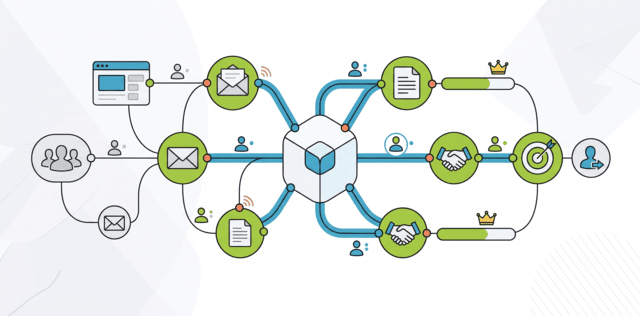
Marketing performance depends on how traffic generation, lead capture, sales processes, customer communication, and measurement systems interact with each other. Automation helps connect these components into a unified operating model rather than a collection of disconnected tools.
Rather than treating channels as isolated activities, businesses can manage the customer journey as an integrated system:
- Paid media generates top-of-funnel traffic
- Automation captures intent signals and routes contacts into the right nurture track
- CRM systems like HubSpot or Salesforce route opportunities to sales with full engagement context
- Nurture workflows support conversion with stage-appropriate content
- Customer onboarding sequences improve activation and reduce early churn
- Reporting systems measure outcomes and feed back into optimization
Performance emerges from how these components work together — not from automation alone.
How Do These Benefits Work Together Operationally?
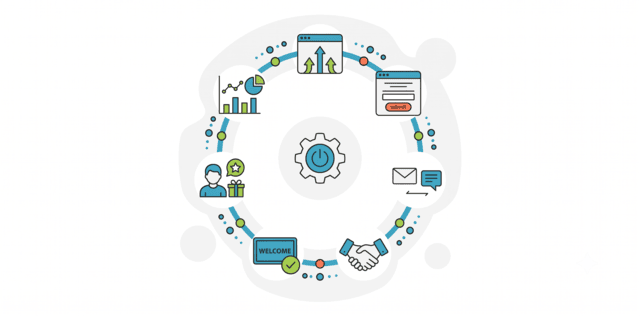
Marketing automation works best when viewed as part of a larger business system, not as a standalone tool.
Traffic generation, lead capture, nurturing, sales engagement, customer onboarding, retention, and reporting all influence each other. Improvements in one area affect performance elsewhere. A faster lead response time (Point 2) only matters if the CRM routing is accurate (Point 4) and the nurture content is relevant (Point 3). These benefits compound — but only when the underlying data infrastructure is clean and connected.
What Limitations Affect Marketing Automation Performance?
No marketing automation platform eliminates operational challenges entirely.
Data Quality Issues
Automation amplifies whatever data quality already exists in your CRM. Duplicate contact records, incomplete fields, and inconsistent lifecycle stage labelling cause workflows to misfire at scale. In our experience, this is the most common reason automation underperforms in the first 90 days — the platform is configured correctly, but the data underneath it isn’t clean enough for the triggers to fire accurately.
Attribution Gaps
GDPR, CCPA, Apple’s ATT framework, and the deprecation of third-party cookies continue to create measurement challenges. Cross-device customer journeys and consent-based tracking gaps mean some touchpoints will always be invisible to the platform. Cookieless attribution models, server-side tracking, and Marketing Mix Modelling (MMM) are increasingly used to fill these gaps — but none of them fully replace deterministic tracking.
Workflow Complexity
As organizations grow, automation systems can become increasingly difficult to manage. New workflows get added without deactivating old ones, contacts end up enrolled in conflicting sequences, and the logic becomes too complex for any one person to audit. Quarterly workflow reviews and strict enrolment governance are essential once a programme passes 15–20 active workflows.
Platform Bias
Marketing platforms — including HubSpot, Salesforce, and Meta — use attribution models that tend to over-credit their own inventory. Always cross-reference platform-reported performance against CRM pipeline data and actual closed revenue before making budget decisions.
When Is Marketing Automation Worth the Investment?
Marketing automation typically becomes valuable when operational complexity exceeds a team’s ability to manage processes manually.
Organizations generally achieve stronger results when automation supports an existing strategy rather than attempting to replace one. In our experience, teams that invest in data infrastructure — clean CRM records, server-side tracking, and consent capture — before building workflows see significantly faster time-to-value than those that build on top of incomplete data.
Conclusion
Marketing automation is often described as a productivity tool, but its real value is much broader.
The strongest implementations connect customer acquisition, lead nurturing, sales workflows, retention efforts, and reporting into a coordinated operating system. This creates greater efficiency, stronger visibility, and improved scalability across the customer lifecycle.
In 2026, the landscape has shifted materially. AI-driven Predictive Lead Scoring Models, LLM-powered content generation, and intent-based dynamic workflows are no longer experimental — they are available in mainstream platforms like HubSpot, Salesforce, and Marketo. At the same time, GDPR, CCPA, and Apple’s ATT framework have made first-party data strategies and privacy-compliant tracking infrastructure a prerequisite rather than a nice-to-have.
Organizations that treat automation as infrastructure — and invest in the data foundation underneath it — typically achieve more sustainable long-term results than those that buy a platform and expect it to solve strategy problems on its own.
FAQs
What are the main benefits of marketing automation?
The primary benefits include improved operational efficiency, faster lead response times, better customer segmentation, stronger reporting visibility, improved retention, and greater scalability. In 2026, the integration of AI-driven Predictive Lead Scoring and Dynamic Content Optimization (DCO) has added significant capability on top of these fundamentals.
Is marketing automation worth it for small businesses?
Yes — with the caveat that the data foundation needs to be in place first. Small businesses benefit most from automation by reducing manual follow-up workload and creating more consistent customer communication. Platforms like HubSpot and ActiveCampaign offer accessible entry points without requiring enterprise infrastructure.
How much can marketing automation improve lead conversion rates?
Results vary significantly by industry, lead quality, and implementation quality. The most consistent improvement comes from reducing lead response time — automated follow-up within minutes of a form fill outperforms manual follow-up hours later in virtually every context we’ve observed.
Can AI replace marketing automation software?
No — they serve different functions. Automation executes workflows, manages data flows, and handles operational orchestration. AI optimizes decisions within those workflows. In 2026, the two are increasingly integrated, with LLM agents and Predictive Lead Scoring operating inside automation platforms rather than alongside them.
What is the biggest mistake businesses make with marketing automation?
Automating before the data foundation is ready. Automation amplifies whatever data quality exists in your CRM — if contact records are incomplete, consent data is missing, or lifecycle stages are inconsistently applied, the workflows will produce irrelevant messages at scale. Building on clean data from the start is faster and less expensive than diagnosing why a high-volume workflow isn’t converting.
Related Content
Read These Next
E-commerce Marketing Automation: How to Increase Sales on Autopilot in 2026