Retention Marketing Tactics: 10 Proven Ways to Stop Your Customers from Leaving



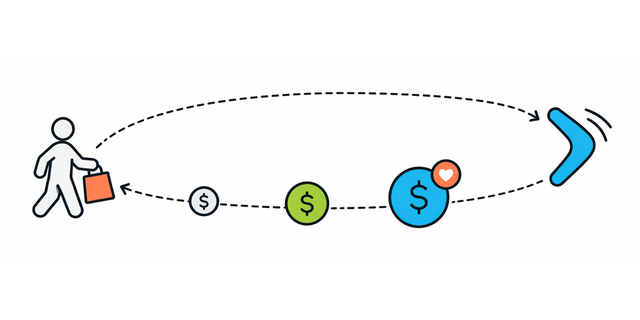
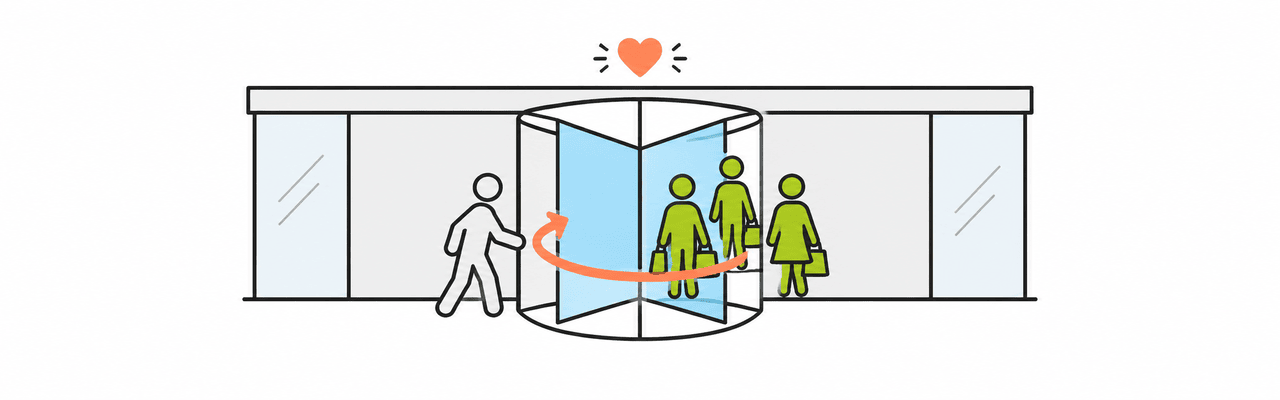
Retention marketing is a system of automated behavioral triggers, lifecycle communications, and data-driven customer segments designed to reduce churn, lower customer acquisition costs (CAC), and increase customer lifetime value (LTV). It focuses on turning existing single-purchase buyers into habitual, repeat consumers.
Snapshot
Retention marketing tactics are the specific actions and automated programs that reduce churn, increase repeat purchase rates, and extend customer lifetime value. The most effective tactics combine behavioral triggers, lifecycle segmentation, and multi-channel delivery into a connected system. No single tactic works in isolation — performance depends on how well these components are coordinated.
Introduction
Customer churn is one of the most expensive problems a growing business can have. The cost is not just the lost revenue from the departing customer — it is the acquisition spend that produced them, the onboarding resources invested in them, and the opportunity cost of replacing them from scratch.
Most businesses understand this but continue to underinvest in the systems that prevent it. What fails most often is execution: campaigns sent at the wrong time, to the wrong segment, through the wrong channel, without a clear next step.
AI-driven automation now enables behavioral triggers that respond to real-time activity, predictive models that identify at-risk customers before they go inactive, and personalization at a scale previously available only to large enterprises. The tools exist. The gap is whether the underlying system is structured correctly.

What This Guide Covers
This guide explains ten retention marketing tactics that reduce churn and increase customer lifetime value, with context on how each works, what it costs, and where it breaks.
It covers:
- Tactics that address early-stage churn versus late-stage disengagement
- How each tactic fits into a broader retention system
- Realistic performance benchmarks for each approach
- Implementation priorities and when to deploy each tactic
- Common failure modes and what to account for
1. Structured Post-Purchase Onboarding
The period immediately after a first purchase is when churn risk is highest. A customer who does not experience early value is unlikely to return. Structured onboarding reduces early churn by setting expectations, guiding first use, and creating a reason to come back.
Post-purchase onboarding is a sequence designed to move the customer from transaction to habit:
- For physical products: usage guidance, cross-sell recommendations, and a prompt to join a loyalty program
- For software or subscriptions: feature activation, milestone tracking, and check-ins aligned to the customer's use pattern
Onboarding sequences spanning three to five touchpoints over the first 14 days consistently outperform single-email programs. The improvement in 30-day retention typically ranges from 10 to 25 percentage points versus no onboarding, varying by product category.
The most common failure is treating all new customers identically. Segmenting onboarding by acquisition source and purchase intent produces stronger results than a single universal flow.
2. Behavioral Trigger Campaigns
Behavioral triggers are automated messages sent in response to a specific customer action or inaction — cart abandonment, browse abandonment, post-purchase upsell, or re-engagement when activity drops below a threshold. The message fires because something happened, not because a calendar date arrived. This makes triggered campaigns significantly more relevant than broadcast sends.
Common triggers and typical performance:
- Cart abandonment (three messages across 24 to 72 hours): recovery rates of 5 to 15% of abandoned carts, depending on category and whether an incentive is included
- Browse abandonment (products viewed but not added to cart): converts at 1 to 5%, but operates on higher volume
The constraint is data quality. A trigger firing on incomplete session data sends the wrong message to the wrong person.
Three foundational requirements before behavioral programs can run reliably:
- Deduplication — ensuring each customer has one unified record, not multiple duplicates across systems
- Session tracking accuracy — correctly capturing what each visitor does on-site, including page views, add-to-cart actions, and purchases
- Consent compliance — confirming the customer has opted in to receive marketing communications, as required by GDPR (Europe), CCPA/CPRA (California), and Privacy Act 1988 (Australia)
Platforms like Klaviyo, HubSpot, and Braze handle these behavioral triggers natively and integrate with e-commerce platforms to keep customer records unified.
3. Predictive Churn Intervention
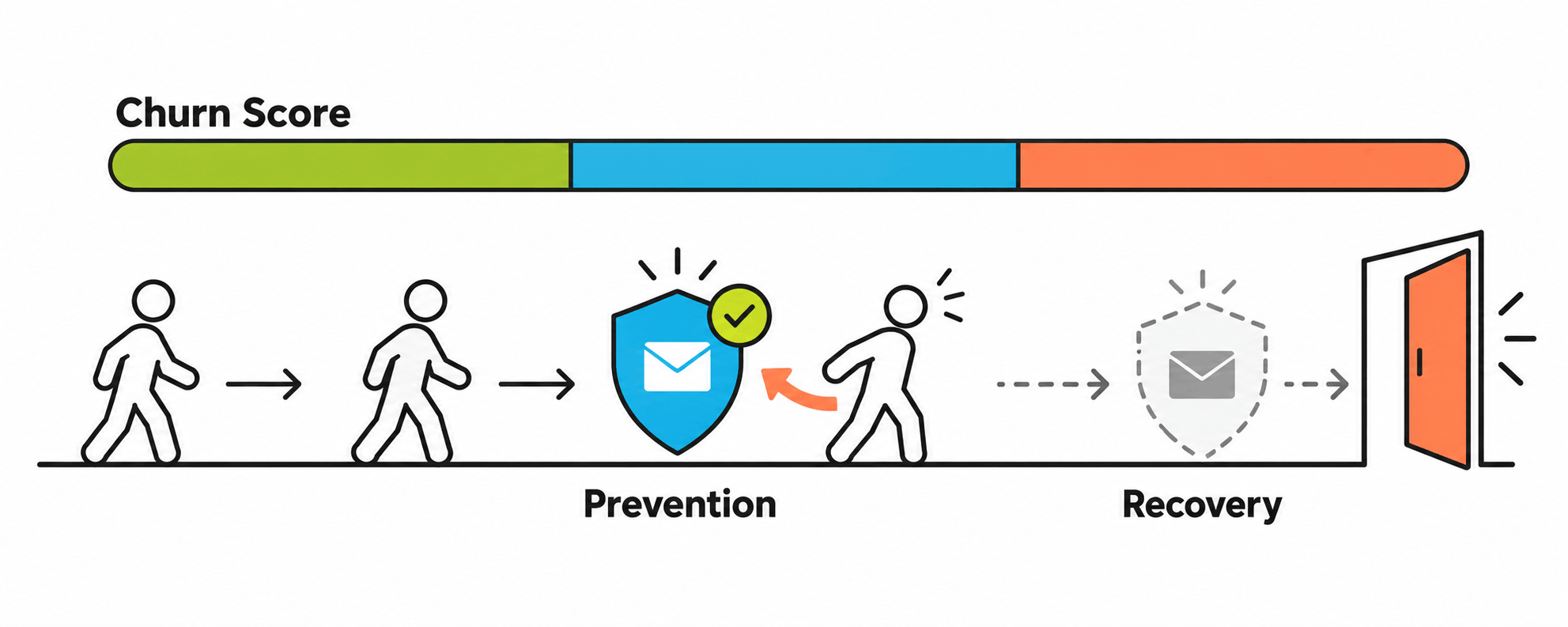
Predictive churn models assign each customer a score indicating how likely they are to become inactive within a defined window — typically 30, 60, or 90 days. Customers above a threshold are automatically enrolled in re-engagement sequences before they churn rather than after. This shifts the intervention point from recovery to prevention.
Signals commonly used: purchase recency, session frequency, email engagement decline, support ticket volume, and time since last interaction relative to the customer's historical average.
Most enterprise customer engagement platforms — including Salesforce Data Cloud and Braze — include pre-built churn scoring models. Smaller businesses without dedicated data science resources can use predictive RFM (Recency, Frequency, Monetary) modeling as an approximation. RFM segments customers based on how recently they bought, how often they buy, and how much they spend — no machine learning required. Customer Data Platforms (CDPs) like Segment or Tealium help centralize this data across touchpoints.
Predictive models are only as accurate as the behavioral data behind them. Brands with incomplete tracking or poor CRM hygiene will produce noisy scores — triggering interventions for customers who were not at risk, and missing those who were.
4. Segmented Win-Back Campaigns
Win-back campaigns target customers who have gone inactive. Timing depends on purchase frequency: for a brand with a 30-day repurchase cycle, a customer inactive for 75 days may be at risk. For a 90-day cycle, the threshold is different.
A sequenced approach outperforms a single re-engagement email:
- First message: acknowledge the gap without over-apologising
- Second message: offer a tangible reason to return — a relevant recommendation, time-limited offer, or early access
- Third message (if needed): final attempt before moving to a suppression list
Win-back rates for well-segmented campaigns typically range from 5 to 15% of the lapsed segment. Campaigns treating all lapsed customers identically perform at the lower end. One limitation: win-back campaigns cannot recover customers who left because of a product or service quality issue.
5. Loyalty Programs with Structural Incentives
Loyalty programs improve retention when the rewards are meaningful relative to purchase frequency and when the first reward is achievable within a reasonable timeframe. Programs that take too long to reach the first milestone do not change behavior because the incentive is too distant.
The most effective loyalty structures: tiered programs where each tier provides a visible upgrade in benefits, points programs with a short redemption cycle, and engagement rewards for reviews, referrals, or profile completion.
The risk is training customers to wait for rewards before purchasing, compressing margins over time. Evaluate loyalty programs not just on repeat purchase rate, but on whether incremental revenue from retained customers exceeds the cost of rewards.
6. Post-Purchase Feedback and Closed-Loop Resolution
Post-purchase feedback — through NPS surveys, satisfaction surveys, or product review requests — creates an opportunity to identify dissatisfied customers before they churn quietly. The tactic is not the survey itself. It is what happens after.
A customer who submits a negative response and receives no follow-up has been made aware their feedback was ignored. Closed-loop resolution, where negative responses trigger outreach from a customer success team or automated escalation, converts detractors into retained customers at a measurable rate.
Response rates for post-purchase surveys sent within 24 to 48 hours of delivery typically range from 10 to 30%. As order counts scale, manual closed-loop resolution becomes expensive — automation handles initial outreach, but complex resolution requires human involvement.
7. Lifecycle Email Sequences Beyond the First Purchase
Most email programs are acquisition-heavy. Post-purchase lifecycle communication — the emails designed to deepen the relationship after the first transaction — is often underdeveloped.
A structured post-purchase email lifecycle includes product usage guidance, replenishment reminders calibrated to average consumption rate, complementary product recommendations, and milestone communications acknowledging the customer's relationship with the brand.
Email remains the highest-volume channel for retention due to low incremental cost and strong segmentation capability. The limitation is deliverability. Regular list hygiene — identifying and removing unengaged or invalid email addresses while suppressing (excluding) them from future campaigns — is a maintenance requirement. Suppressing contacts with no engagement in the past 90 to 180 days protects inbox placement rates for the customers most likely to respond.
8. SMS for High-Intent Retention Moments
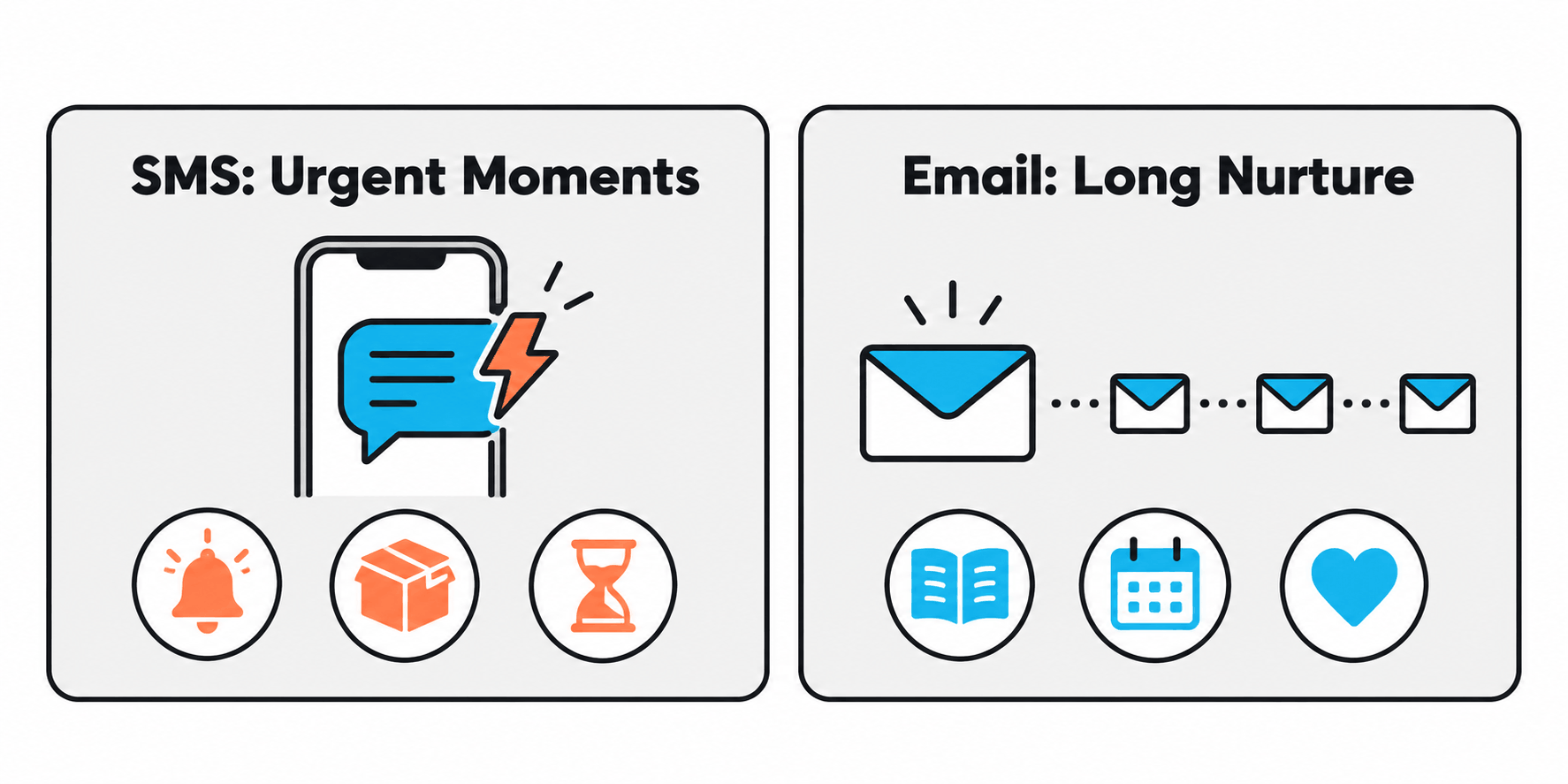
SMS is most effective for high-urgency, high-relevance moments where timing is critical: abandonment recovery, flash sale notifications for high-frequency buyers, restock alerts, and loyalty reward expiration reminders.
SMS achieves open rates above 90% because messages are delivered directly to the device and read within minutes. The tradeoff: customers are more sensitive to irrelevant or excessive SMS than email, and opt-out rates increase quickly when frequency or relevance thresholds are exceeded.
Use SMS for moments where timing materially affects the outcome. Use email for longer nurture sequences where timing is less critical.
9. Personalized Product and Content Recommendations
Personalized recommendations increase the probability of a second purchase by reducing the friction of discovery. A returning customer presented with products relevant to their purchase history and browsing behavior is more likely to convert than one who sees a generic catalog.
Recommendation engines range from simple rule-based logic ("customers who bought X also bought Y") to AI-driven models incorporating real-time behavioral signals and predicted affinity. Studies across e-commerce consistently find 10 to 30% higher conversion rates for personalized recommendations versus non-personalized ones.
The constraint is data recency. A recommendation engine trained on data 30 to 60 days old may surface products the customer has already rejected. Real-time session-level data improves relevance significantly. Brands without real-time infrastructure can improve recommendation quality through manual segmentation rules as an intermediate step.
10. Suppression and List Hygiene as a Retention Lever
Suppression means excluding specific contacts from future campaigns — typically because they have unsubscribed, not engaged in a defined window, or been flagged as invalid addresses. List hygiene is the broader practice of keeping the contact database clean: removing duplicates, correcting errors, and ensuring only valid, opted-in contacts receive communications.
Sending retention campaigns to contacts who have not engaged in 6 to 12 months does not recover them. It degrades deliverability, increases unsubscribe rates, and reduces the engagement signals inbox providers use to assess sender reputation.
The decision of when to suppress versus when to attempt one final re-engagement requires a defined rule set:
- Recency of last engagement
- Engagement score across channels
- Customer lifetime value
High-value customers warrant more attempts. Low-value, never-engaged contacts should be removed earlier.
How Do These Tactics Work as a System?
No single tactic produces sustainable retention in isolation. They are most effective as a connected system where each tactic handles a different lifecycle stage.
How customers move between stages:
- A new customer who completes a second purchase within 30 days moves from "New" to "Active," triggering the lifecycle email sequence and pausing the onboarding flow
- An active customer whose email engagement drops below a defined threshold for 21 consecutive days moves to "At-Risk," enrolling them in predictive churn intervention
- An at-risk customer who does not respond within 30 days moves to "Lapsed," triggering the win-back sequence
These transitions are rule-based in simpler systems and AI-predicted in platforms like Braze or Salesforce Marketing Cloud.
Performance across stages is interdependent. A strong onboarding program reduces the volume of customers who reach the at-risk stage. A well-maintained list improves deliverability for every campaign that follows.
What Are the Realistic Limits of Retention Marketing Tactics?
Retention tactics fail in predictable ways:
- Misaligned timing — win-back campaigns sent too early treat engaged customers as if they have churned; sent too late, they miss customers who have permanently moved on. Trigger thresholds should be calibrated to actual purchase frequency data, not industry defaults.
- Poor segmentation — a single sequence sent to all customers regardless of lifecycle stage will underperform. Segmenting a win-back campaign by customer value tier alone typically improves recovery rate by 15 to 30%.
- Attribution errors — last-touch attribution over-credits the final email before a purchase. Multi-touch attribution models produce more accurate signals but require more complex measurement infrastructure.
- Tactic limitations — retention programs cannot recover customers who left because of product or service dissatisfaction. They address timing, relevance, and communication quality — not structural reasons customers choose to leave.
FAQs
Which retention tactic delivers the fastest results?
Behavioral trigger campaigns — particularly cart and browse abandonment sequences — act on existing purchase intent. Brands without any abandonment program commonly see a 5 to 10% recovery rate within the first 30 days of deployment.
How many retention tactics should a business implement at once?
Start with two or three addressing the highest-volume churn points. For most e-commerce businesses: structured onboarding, cart abandonment recovery, and a basic win-back campaign. Adding tactics before foundational programs are working creates complexity without proportional return.
How do you measure whether a retention tactic is working?
Primary metric: retention rate change within the targeted segment. Secondary metrics: repeat purchase rate, average order value for retained customers, cost per retained customer. Measuring against a control group produces more accurate results than measuring against the overall customer base.
What is the difference between a retention tactic and a retention strategy?
A tactic is a specific action: an abandonment sequence, a loyalty program, a win-back campaign. A strategy determines which tactics to use, in what order, for which segments, and how to measure their combined effect.
Do retention tactics work differently for B2B versus B2C?
Yes. B2B involves longer sales cycles, multiple decision makers, and higher-value relationships requiring more personalized communication. B2C operates at higher volume with more automation and shorter intervention windows. Principles are the same — execution cadence and channel mix differ substantially.
How does privacy regulation affect retention marketing tactics?
All retention communications must be sent to customers who have provided consent. Key frameworks:
- GDPR (Europe) — explicit consent, governs data retention
- CCPA/CPRA (California) — opt-out rights and data transparency
- Privacy Act 1988 (Australia) — governs collection, use, and storage of personal information
Sending to unconsented contacts damages deliverability and creates legal exposure. First-party opt-in data is both the most compliant and highest-performing foundation for retention programs.
Conclusion
Retention marketing tactics are not complicated to understand. Post-purchase onboarding, behavioral triggers, win-back campaigns, and loyalty programs have been effective for years. The reason most brands underperform is not a lack of available tactics — it is a lack of system thinking.
Each tactic addresses a specific lifecycle stage. Performance depends on whether the right tactic reaches the right customer at the right time. As AI-driven automation makes execution more accessible and privacy regulations make third-party data less reliable, the competitive advantage belongs to businesses that have built clean first-party data infrastructure and connected their tactics into a coherent lifecycle system.
Read These Next
Marketing Attribution Models: The Complete 2026 Guide