.png)
Types of Programmatic Advertising: Which Format Is Right for Your Marketing Goals?
.png)

.png)

What Is Programmatic Advertising?
Programmatic advertising is not one advertising channel. It is an automated system for buying ads across formats like display, video, streaming TV, audio, and digital billboards — each reaching audiences differently and suited to different marketing goals.
Snapshot
Programmatic advertising runs across six primary formats: display, video, connected TV, audio, native, and digital out-of-home. Each reaches audiences differently, operates at different funnel stages, and produces different results depending on the campaign objective. No single format works for every goal, and most effective programmatic strategies combine formats rather than relying on one. Programmatic now accounts for 91.5% of all digital display ad spending globally in 2026 (eMarketer).
Introduction
Programmatic advertising is an automated system for buying ads across formats like display, video, streaming TV, audio, and digital billboards. The format determines where an ad appears, how users encounter it, and which stage of the buying journey it can realistically influence.
This distinction matters more as digital media becomes increasingly fragmented. Consumer attention is distributed across publisher websites, streaming platforms, podcasts, mobile apps, and physical screens. A campaign optimised for one format without accounting for how it interacts with others will capture only part of the journey. Video, audio, connected TV, and digital out-of-home have all moved into the same automated buying infrastructure — creating both more options and more decisions for advertisers.
For C-level executives and marketing decision-makers at SMEs and mid-market businesses across APAC, the US, and Australia, the practical question is not which format is best in the abstract — it is which format aligns with a specific campaign objective, audience behaviour, and measurement capability at a given budget level.
How to Build a Programmatic Advertising Strategy by Format
This guide explains how each programmatic advertising format works and how to match format selection to campaign goals. It covers:
- How the six main programmatic ad formats work
- What each format is best suited for at different funnel stages
- How formats interact as a connected system
- Realistic performance benchmarks by format
- Where each format breaks down in practice
- How to choose the right format based on objective and budget
What Are the Main Types of Programmatic Advertising?
The six primary programmatic formats all transact through demand-side platforms (DSPs) — the technology that automates the buying of digital ad inventory across publishers in real time. Common DSPs used by mid-market buyers include The Trade Desk, Google Display & Video 360 (DV360), and Yahoo DSP. Each format, however, reaches audiences through entirely different surfaces and contexts.
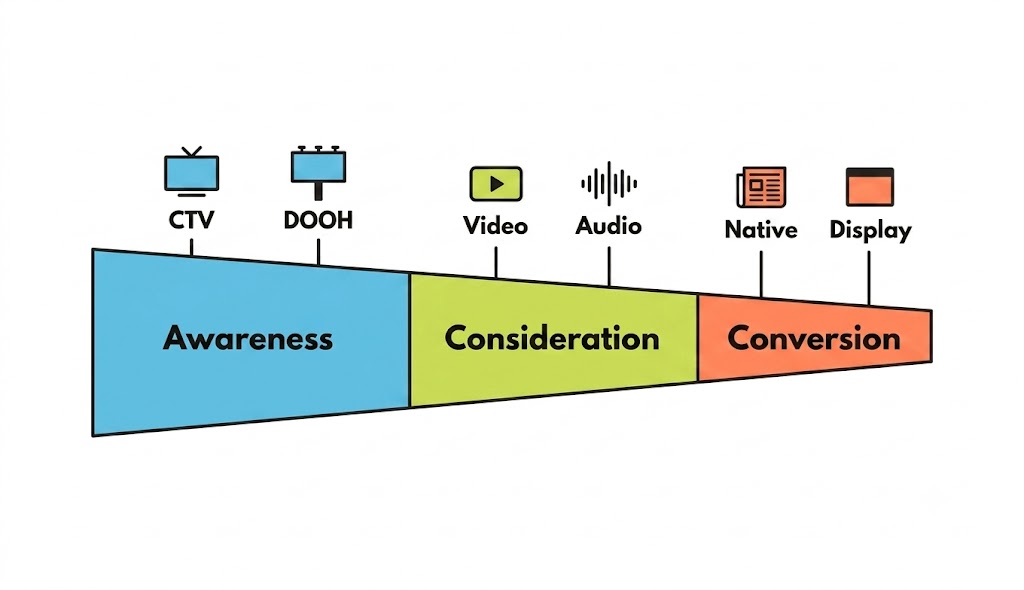
Format selection determines which part of the customer journey a campaign influences and how performance will be measured. Choosing the wrong format for a goal produces weak results — not because the campaign was poorly executed, but because the format was not designed for that outcome.
How Does Programmatic Display Advertising Work?
Display advertising is the most widely used programmatic format. It delivers visual banner placements across websites and apps through automated auctions — bought through open exchanges, private marketplace (PMP) deals, or programmatic guaranteed arrangements via DSPs like The Trade Desk, DV360, or Choozle.
The format performs best for two distinct objectives: broad prospecting at scale before intent is established, and retargeting to re-engage users who have already visited a website or engaged with a brand.
According to industry benchmarks from Google and The Trade Desk, retargeting campaigns typically generate two to three times higher conversion rates than prospecting campaigns — reflecting existing intent, though results vary by category and attribution model.
The primary limitation is attention quality. Industry benchmarks place average display viewability at 50–70%, depending on placement and publisher quality. Open exchange inventory frequently includes low-quality made-for-advertising (MFA) sites that inflate impression counts without producing genuine user exposure.
According to the ANA's Programmatic Media Supply Chain Transparency Study, invalid traffic on open web programmatic ranges from 10–25% of served impressions. Managing placement quality through allowlists, private marketplaces, and third-party verification tools like IAS or DoubleVerify is operationally necessary at any meaningful scale.
Display CPMs on open exchange typically range from $0.50 to $5 for consumer audiences, and $8 to $20 for B2B and high-intent segments. Retargeting campaigns commonly deliver ROAS of 3x to 6x on direct-response objectives when conversion tracking is functioning accurately.
How Does Programmatic Video Advertising Work?
Programmatic video delivers promotional content across publisher websites, mobile apps, and streaming platforms. It is the highest-engagement paid format for awareness and brand recall — the combination of movement, audio, and visual storytelling creates stronger memory encoding than static formats.
Video formats vary by placement type: in-stream (pre/mid/post-roll), out-stream (within editorial text), and in-feed (within social or publisher feeds). In-stream pre-roll on premium publishers typically achieves completion rates of 60–80% for non-skippable formats. Skippable formats see completion rates of 20–40%, as most users skip after the five-second threshold.
The creative constraint matters more here than in any other format. Users decide within the first three to five seconds whether to continue watching. Campaigns that front-load the key message consistently outperform those structured around a narrative build.
Pre-roll CPMs on premium publishers typically range from $15 to $35 — justified for awareness objectives, but not for direct-response campaigns where display or paid search converts more efficiently at lower cost.
What Is Connected TV Advertising and How Does It Work Programmatically?
Connected TV (CTV) delivers ads through streaming platforms accessed on internet-connected television screens. It transacts programmatically like display and video but reaches audiences in a fundamentally different environment — a large screen, often shared with household members, in a lean-back viewing context where completion rates consistently exceed 95%.
CTV inventory includes ad-supported tiers on platforms including Netflix, Disney+, Amazon Prime Video, Hulu, Tubi, and Peacock. US CTV programmatic ad spend is projected to reach approximately $42 billion for full-year 2026 — a 38% increase over the prior year — making it the fastest-growing programmatic segment (eMarketer US Digital Video Advertising Forecast, 2026 edition). In Australia, CTV ad spend is projected to reach $1.19 billion in 2026.
The measurement infrastructure for CTV varies significantly depending on where the inventory is purchased. Walled garden environments — buying directly through Netflix, Amazon, or Hulu — offer proprietary attribution within their ecosystem but limited cross-platform visibility.
Open DSPs like The Trade Desk or DV360 provide greater cross-channel flexibility but rely on probabilistic identity matching and Marketing Mix Modelling (MMM) to estimate CTV's contribution. Neither approach delivers the deterministic attribution available in lower-funnel channels.
Attribution is the primary operational challenge. Most viewers do not convert on a television screen, meaning last-touch attribution cannot observe CTV's contribution to eventual purchases.
Incrementality testing, multi-touch attribution, and MMM are required to measure CTV's actual pipeline contribution — and these are more resource-intensive than standard platform reporting. CTV CPMs typically range from $25 to $50 in the US and Australia.
How Does Programmatic Audio Advertising Work?
Programmatic audio delivers ads within streaming music, podcast, and digital radio environments. It reaches users in contexts where visual formats cannot — during commutes, exercise, cooking, and other activities that occupy the eyes but leave the ears available. Platforms include Spotify, Pandora, iHeartRadio, and podcast networks, accessed via DSPs including The Trade Desk and the Spotify Audience Network.
Audio ads are typically fifteen to thirty seconds in length. Unlike display or video, there is no visual impression to reinforce the message, which places greater creative demand on the audio itself. Spots with clear brand mentions and direct calls to action consistently outperform those that build to a reveal.
The measurement infrastructure for audio is less mature than for display or video. Click-through rates are not applicable; attribution typically relies on audio-specific identifiers, post-listen search lift, and brand recall studies. This limits audio's usefulness as a performance channel and positions it primarily as an awareness vehicle. CPMs typically range from $8 to $20, depending on platform, audience, and targeting parameters.
How Does Programmatic Native Advertising Work?
Native advertising delivers paid placements that match the editorial format and visual tone of the publisher's content surrounding them. Native units appear as sponsored articles, recommended content widgets, or in-feed posts — blending with the editorial experience rather than interrupting it. Importantly, native ads are always legally required to carry a "Sponsored" or "Ad" label, regardless of how closely they match surrounding content, in compliance with FTC guidelines and local advertising standards.
The format is distributed primarily through networks, including Taboola and Outbrain, which aggregate inventory across publisher sites. Native typically generates CTRs between 0.2% and 0.8% — consistently higher than standard display — because the format benefits from contextual relevance and lower banner blindness. Time-on-page metrics also outperform display significantly, since users who click are opting into content rather than responding to an interruption.
The limitation is intent. Native drives users to content, not to a purchase decision. Conversion paths are longer than from search or retargeting, and attribution models with short windows will consistently undervalue native's contribution to eventual conversions. The format performs best as part of a system where paid search and retargeting capture and convert the intent that native generates earlier in the journey.
How Does Programmatic Digital Out-of-Home Advertising Work?
Digital out-of-home (DOOH) delivers ads on internet-connected screens in physical environments — billboards, transit displays, airport screens, retail locations, and venue signage. Programmatic DOOH allows advertisers to buy and activate these placements through automated systems, via platforms like Vistar Media, Place Exchange, or The Trade Desk's DOOH integrations, applying audience and contextual targeting that was not possible in traditional static out-of-home buying.
Unlike most programmatic formats, DOOH ads are seen by multiple people simultaneously in a shared physical space — making it a genuinely mass-reach format at the awareness layer. Placements can be triggered based on contextual conditions, including time of day, weather, local events, or audience traffic patterns from anonymised mobile location data.
DOOH campaigns cannot be measured through standard digital attribution because they do not generate clicks. Brand lift studies, mobile location analytics measuring footfall to retail locations, and post-exposure search lift are the most commonly used measurement methodologies — all more resource-intensive than platform-level reporting, and requiring minimum campaign sizes to produce statistically meaningful results. Premium placements in high-traffic urban environments typically range from $5 to $30 CPM.
Choosing the Right Programmatic Advertising Format for Your Campaign Goals
The following matrix maps common campaign goals to the programmatic advertising formats most commonly used to achieve specific performance, engagement, and awareness outcomes.
How Do Programmatic Formats Work Together as a System?
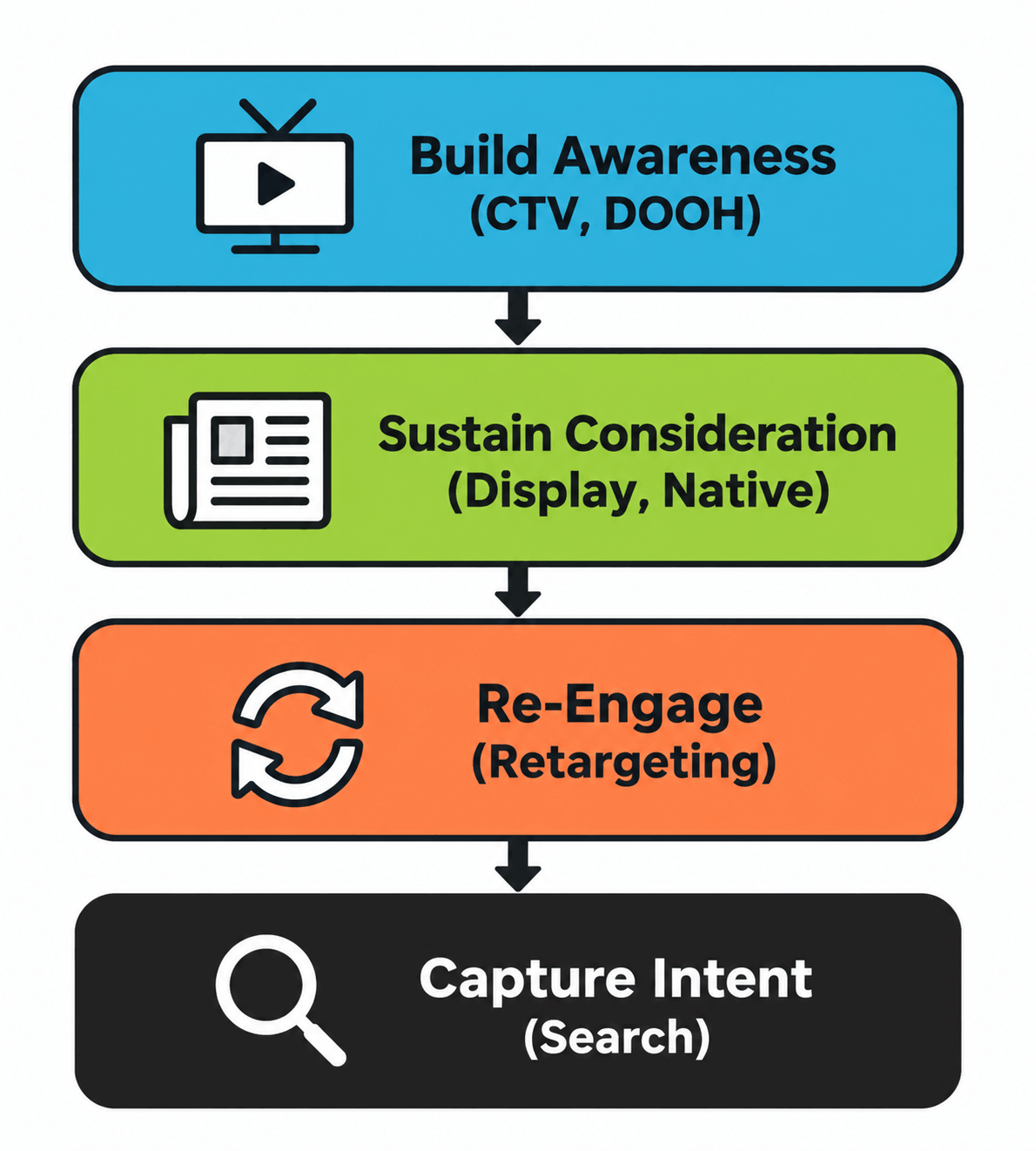
Programmatic formats produce the most measurable commercial outcomes when treated as an interconnected system rather than independent channels. A typical multi-format structure operates in layers: CTV and DOOH build brand awareness at scale, display and native sustain visibility during consideration, retargeting re-engages users who have already shown interest, and paid search captures the intent that upper-funnel formats generated.
Identity resolution is what keeps these formats connected as third-party cookies disappear. Unified ID 2.0 (UID2), developed by the IAB Tech Lab and widely supported across The Trade Desk's ecosystem, enables privacy-compliant cross-format audience matching. LiveRamp's RampID connects first-party CRM data to programmatic buying across formats.
Contextual Targeting APIs provide content-signal-based targeting that does not rely on user identity at all. Without identity resolution infrastructure, cross-format frequency capping, audience suppression, and sequential messaging break down.
The measurement implication is significant. Running each format independently and evaluating it on last-click attribution will systematically undervalue awareness formats like CTV, DOOH, and audio — their contribution happens earlier in the journey and is credited to whichever channel the user converted through.
Multi-touch attribution (MTA), incrementality testing, and Marketing Mix Modelling (MMM) provide more accurate measurement of how formats contribute to the pipeline across the full journey.
How Do Programmatic Formats Scale Differently for B2B vs. B2C?
Format effectiveness varies significantly depending on whether the campaign is targeting a business buyer with a long evaluation cycle or a consumer making a faster individual decision.
In managing mid-market programmatic budgets across B2B and B2C accounts, the most common mistake we see is applying B2C attribution windows (30 days) to B2B campaigns that run 90–180 day sales cycles — making upper-funnel formats appear underperforming when they are generating genuine pipeline activity.
The practical implication: B2B programmatic requires longer attribution windows, CRM integration, and account-level measurement. B2C can often rely on platform-reported last-click data for lower-funnel formats but still benefits from multi-touch attribution for awareness spend.
What Do Realistic Programmatic Benchmarks Look Like?
Benchmarks vary significantly by audience quality, vertical, average contract value, and campaign structure. Use these as directional ranges rather than guarantees.
What Are the Limitations of Each Programmatic Format?
Each format operates with real-world constraints that affect performance in ways not visible in platform-reported metrics.
Display suffers from viewability variance and inventory quality inconsistency. According to the ANA's Programmatic Media Supply Chain Transparency Study, invalid traffic on open web programmatic ranges from 10–25% of served impressions. Third-party verification through IAS or DoubleVerify is not optional at a meaningful scale.
Video and CTV face attribution fragmentation. View-through attribution — used by most video platforms — credits the ad with a conversion that occurred after the user saw but did not click the ad. This methodology is structurally prone to over-attribution, particularly for retargeting campaigns where the user was likely to convert regardless of the video exposure. Platform-reported ROAS for video campaigns should be cross-referenced against CRM revenue data before scaling.
Audio programmatic lacks the measurement infrastructure to function as a direct-response channel. It generates brand familiarity but produces limited directly attributable conversion events, making it difficult to justify within performance-focused budget structures without supplementary brand lift measurement.
Native advertising requires content quality to maintain its engagement advantage. Promotional content that reads like an advertisement loses the contextual relevance that makes native effective. At scale, maintaining content quality across multiple publishers requires creative investment that organisations frequently underestimate.
DOOH cannot be measured through direct digital attribution. The measurement methodologies available are probabilistic and require minimum campaign sizes to produce reliable results, which limits their accessibility for smaller budgets.
Privacy restrictions affect all formats to varying degrees. Signal loss — the reduction of data tracking capabilities caused by iOS tracking restrictions, third-party cookie deprecation, and Privacy Sandbox frameworks — has reduced the accuracy of audience targeting and conversion attribution across display, video, and native. Identity resolution solutions, including UID2, LiveRamp RampID, and contextual targeting APIs, have become the most reliable alternatives as third-party signal quality continues to decline.
How Do You Choose the Right Programmatic Format?
Format selection should follow the campaign objective and the measurability of that objective — not platform familiarity or default spending patterns.
For immediate conversion objectives, display retargeting and paid search capture existing intent most efficiently. For awareness and brand consideration, CTV, video, and DOOH reach audiences at scale in high-attention environments. For demand generation and consideration-stage content engagement, native performs well in B2B and high-consideration B2C categories. Audio extends reach into environments where visual formats cannot operate.
Three decisions clarify format selection for most teams:
- Start with the conversion event. If the conversion is directly observable and attributable, formats closer to the bottom of the funnel — display retargeting, search — produce more reliable performance data at lower budget thresholds.
- Add upper-funnel formats when bottom-funnel efficiency plateaus. CTV and video build the audience pool that retargeting and search draw from.
- Validate format contribution through incrementality testing before scaling. Last-click attribution will undervalue awareness formats and produce budget allocation decisions that over-invest in capture and under-invest in generation.
For most SMEs and mid-market businesses, the practical entry point is display retargeting combined with one prospecting format matched to the target audience's primary consumption environment. Adding formats without the measurement infrastructure to distinguish their contribution adds complexity without clarity.
Conclusion
Programmatic advertising formats are not interchangeable. Display, video, CTV, audio, native, and DOOH each reach audiences differently, operate at different funnel stages, and require different measurement approaches to evaluate accurately.
Effective programmatic strategies treat formats as components of a connected system. Awareness formats build the audience. Consideration formats sustain engagement during evaluation. Conversion formats capture the intent that earlier touchpoints generated. Each stage produces data that improves the performance of the others, and measurement frameworks that evaluate formats in isolation will consistently misallocate budget toward capture at the expense of generation.
Format selection is a commercial decision, not a technical one. It starts with the objective, accounts for what can actually be measured, and scales based on evidence rather than platform-reported performance.
FAQs
What are the main types of programmatic advertising?
The six primary formats are display, video, connected TV, audio, native, and digital out-of-home. Each operates in different environments, suits different funnel stages, and requires different measurement approaches.
Which programmatic format has the best ROI?
It depends on the objective. Display retargeting and paid search produce the strongest direct-response ROI. CTV and video deliver better ROI for awareness objectives where brand recall and reach matter more than immediate conversion.
What is the difference between programmatic display and native advertising?
Display places banner units in dedicated ad slots and interrupts the content experience. Native matches the editorial format of surrounding content — though both are legally required to carry a "Sponsored" or "Ad" label. Native generates higher engagement but requires longer attribution windows.
How much budget do you need for programmatic advertising?
Display and native can produce meaningful data from $3,000–$5,000 per month per campaign line. CTV and DOOH require higher minimums for brand lift measurement. Budgets below these thresholds generate impressions but insufficient data for reliable optimisation.
Does programmatic work without third-party cookies?
Yes — but precision depends on first-party CRM data, identity resolution solutions like UID2 and LiveRamp RampID, contextual targeting APIs, and server-side tracking rather than cross-site behavioural signals.
Which format works best for B2B advertising?
Display and native work well for awareness and consideration campaigns with longer evaluation cycles. LinkedIn-based programmatic offers the most precise professional audience targeting. CTV is growing for reaching executive audiences. All B2B formats require 90–180-day attribution windows and CRM integration.
Related Content
Read These Next
High Converting Landing Page: The 5 Anatomy Secrets of Million-Dollar Pages