.png)


AI in Programmatic Advertising: How Machine Learning is Revolutionizing Ad Tech
.png)

.png)

Snapshot
AI in programmatic advertising uses machine learning to automate bidding decisions, audience modeling, and campaign optimization in real time. Platforms like The Trade Desk, Google DV360, and Meta apply AI to evaluate impressions, adjust spend, and predict conversion probability — but performance depends on the quality of data and signals fed into the system, not automation alone.
Introduction
Programmatic advertising has always been automated. What has changed is the depth of decision-making happening inside that automation. AI and machine learning have moved from supplementary features to core operating infrastructure across the major demand-side platforms, influencing how impressions are valued, how audiences are scored, how creative is rotated, and how budgets are reallocated across channels in real time.
According to eMarketer, U.S. programmatic buying is projected to exceed $200 billion in 2026, and the platforms running those auctions are making optimization decisions at a speed and volume no human trading desk can match. Global AI spending across industries was estimated at approximately $1.5 trillion in 2025, with projections exceeding $2 trillion in 2026, reflecting the accelerating integration of AI decision systems across the economy — ad tech included.
The practical implication for C-level executives and marketing decision-makers is not that AI makes programmatic campaigns automatic or foolproof. It is that the quality of the decisions those systems make depends almost entirely on the inputs they receive: conversion signal quality, campaign structure stability, and the accuracy of the outcome the system is optimizing toward. Get those right, and machine learning compounds performance advantages over time. Get them wrong, and the system scales spend in the wrong direction faster and with less visibility than a manually managed campaign would.
Privacy changes have added a structural constraint to this environment. Third-party cookie deprecation, iOS tracking restrictions, and Privacy Sandbox frameworks have reduced the reliable data signals available to ad platforms, forcing machine learning models to operate with incomplete information by default. The platforms that were already investing in first-party data activation, contextual modeling, and probabilistic identity resolution are better positioned in this environment than those that depended primarily on cross-site behavioral tracking.
What This Guide Covers
This guide explains how AI and machine learning function inside programmatic advertising systems and what that means for campaign performance in practice. It covers:
- How machine learning operates inside a demand-side platform
- Which AI-driven functions have the most direct impact on campaign results
- How AI interacts with privacy changes and signal loss
- What realistic performance improvements look like and what drives them
- Where AI-optimized systems break down in practice
- How to structure campaigns so machine learning can work effectively
- When to scale AI-driven campaigns and when to pause
How Does Machine Learning Work Inside a Programmatic Platform?
Machine learning in programmatic advertising is the set of algorithms inside demand-side platforms that continuously test micro-decisions — bids, pacing, audience selection, frequency, creative rotation — and reallocate spend toward better outcomes based on what the data shows.
The model works by ingesting conversion signals, user behavior, inventory data, and campaign constraints, then building predictive models about which impressions are most likely to achieve the campaign goal. The system does not follow a fixed rule set. It learns from prior outcomes and updates its predictions continuously — which means the quality of learning depends directly on the volume and relevance of the signals it receives.
In a practical campaign context, this means three inputs determine how well the machine learning model performs.
- The first is conversion signal quality: whether the platform can observe outcomes that actually reflect business value, rather than proxy events like clicks or page views.
- The second is campaign structure stability: whether the system has a consistent enough environment to distinguish signal from noise without being interrupted by frequent changes that reset the learning process.
- The third is time and volume: whether the campaign accumulates enough conversion events within a defined period for the model to find a reliable signal at all.
Disrupt any of these three, and learning slows or stops. A technically sophisticated platform cannot compensate for poor signal inputs or structural instability at the campaign level.
The Trade Desk's Koa AI system is one of the more visible implementations of this architecture. Koa analyzes campaign inputs, identifies patterns in performance data, generates audience and channel recommendations, and adjusts bids in real time to hit pacing goals. It does not run campaigns autonomously — the decisions around structure, conversion events, and constraints are still human inputs that determine whether Koa has a clean enough signal to work with. That distinction matters: AI within programmatic platforms is an optimization layer, not a replacement for campaign strategy.
What AI Functions Have the Most Direct Impact on Campaign Performance?
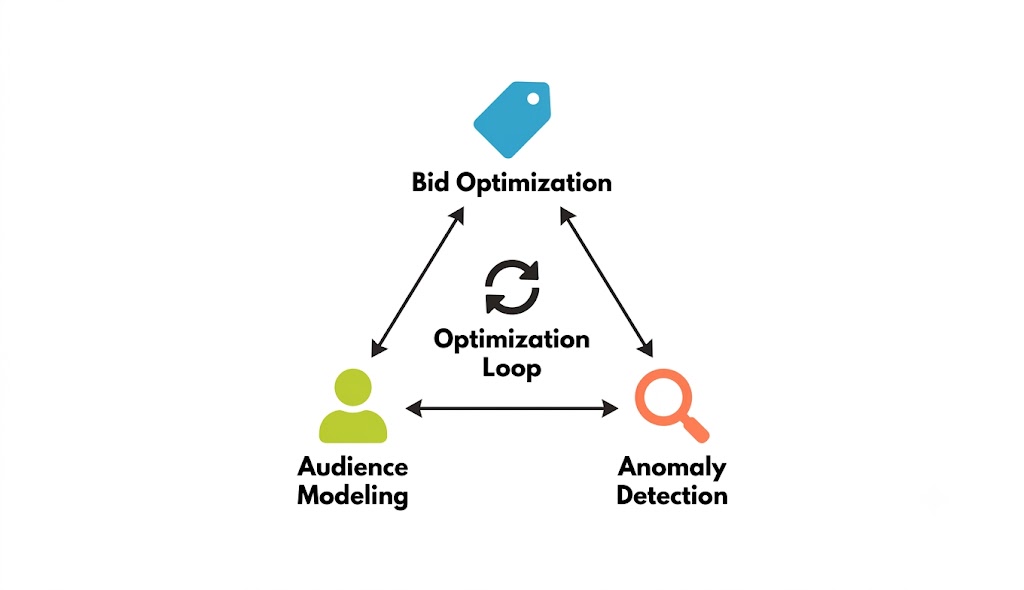
The most measurable AI contributions in programmatic advertising are bid optimization, audience modeling, and anomaly detection. These three functions affect spend efficiency, targeting precision, and delivery quality in ways that are visible in campaign data, and they work as an interconnected system rather than independent features.
Bid optimization is where AI changes the economics of ad buying most directly. In first-price auction environments — now the dominant structure across most programmatic inventory — buyers need to bid enough to win impressions without systematically overpaying.
Bid shading uses machine learning to analyze historical clearing prices and estimate where the likely winning price sits, adjusting bids dynamically rather than applying a fixed CPM across all inventory. The Trade Desk describes this as the system helping buyers win impressions at more optimal prices and reduce wasted spend. The practical effect is a reduction in average CPM paid relative to the maximum bid set, which improves return on ad spend at scale.
Audience modeling extends this further. Rather than buying against a fixed audience definition and expecting consistent performance, machine learning continuously evaluates which combinations of user signals, contextual factors, and behavioral patterns correlate with better conversion outcomes — dropping underperforming segments and adding stronger ones in real time. This is operationally different from traditional audience targeting, which applies a fixed definition and evaluates performance at the end of a flight. The AI-driven approach treats audience selection as a dynamic optimization variable rather than a campaign input set at launch.
Anomaly detection is the least visible of the three, but operationally important at meaningful spend levels. Machine learning identifies unusual patterns in delivery — CPM spikes, suspicious traffic quality, unstable conversion rates, or delivery swings that suggest fraud or misconfiguration — before they compound into material budget waste. Bid optimization determines which inventory the campaign wins. Audience modeling determines which users the platform targets within that inventory. Anomaly detection protects the quality of the signals feeding back into both.
How Does AI Interact with Privacy Changes and Signal Loss?
Privacy restrictions have reduced the quality and completeness of the data signals that machine learning models depend on, forcing platforms to operate with more modeled and probabilistic data than before.
Third-party cookie deprecation, iOS App Tracking Transparency, and Privacy Sandbox frameworks have collectively reduced the share of deterministic data — directly observed, user-level tracking signals — available to programmatic platforms. The result is a hybrid addressability environment where some inventory remains fully trackable and much of it does not. Machine learning models running across that environment are working with incomplete information by default.
The distinction between deterministic and modeled data matters practically. Deterministic data comes from confirmed user actions: a logged-in user completing a purchase, a first-party email match from a CRM, or a server-side conversion event. Modeled data uses statistical inference to estimate behavior and conversion credit when direct signals are unavailable. Modeled data is less reliable, particularly for smaller campaigns with limited conversion volume or niche audiences where the model has fewer patterns to learn from.
Platforms have responded to signal loss in several ways:
- Contextual AI uses content signals, page environment, and topic classification rather than user-level identifiers to score impression relevance — becoming more central to targeting logic as behavioral signals weaken
- Identity resolution networks such as LiveRamp's RampID and the IAB Tech Lab's Unified ID 2.0 (UID2) standard provide privacy-compliant alternatives to cookie-based cross-site tracking, enabling audience matching without relying on identifiers that are increasingly unavailable
- First-party data clean rooms allow advertiser and publisher data to be matched without either party exposing raw user records, providing a structure for activating CRM audiences against platform inventory without direct data sharing
The operational implication is that campaigns depending primarily on platform-managed targeting with third-party data are likely to see performance variability increase as signal quality declines. Campaigns with strong first-party CRM data, clean room infrastructure, and server-side conversion tracking are better positioned because the AI has more reliable signals to optimize against.
What Do Realistic AI-Driven Performance Improvements Look Like?
Performance improvements from AI-driven programmatic are real but conditional. They depend on the quality of the campaign setup, the volume of conversion data available, and whether the outcomes being measured reflect actual business value.
The clearest benchmarks come from bid optimization. Bid shading and AI-driven pacing adjustments commonly produce CPM reductions of 10% to 25% relative to first-price ceiling bids across open exchange inventory, according to DSP-reported ranges from The Trade Desk and similar platforms. The actual improvement varies by vertical, competition level, and inventory type — premium and private marketplace inventory shows smaller spreads than open exchange.
Audience modeling improvements are harder to isolate because they interact with creative performance and conversion tracking quality. In well-structured campaigns with adequate conversion volume — typically a minimum of 30 to 50 conversions per optimization unit per week — AI-driven audience optimization tends to reduce cost per acquisition by 15% to 30% over a 60 to 90-day learning window compared to static audience definitions. Campaigns below minimum conversion thresholds may show no measurable improvement or active regression as the model misinterprets noise as signal.
Attribution is a structural limitation that affects how accurately these improvements can be measured. Programmatic platforms report performance using their own attribution logic, which tends to over-credit their inventory for conversions that had multiple contributing touchpoints.
View-through attribution — crediting the platform for a conversion that occurred after the user was served but did not click an ad — is particularly prone to over-attribution in retargeting environments where users were likely to convert regardless of ad exposure.
Platform-reported ROAS should be cross-referenced against CRM revenue data before scaling spend, since blended acquisition costs frequently diverge from platform-reported figures by 20% to 40%, depending on attribution model and offline revenue integration.
Common Challenges of AI-Optimized Programmatic SEO
AI-driven programmatic campaigns fail in predictable ways, and most failures trace back to how the campaign is structured and what the machine learning system is being trained to optimize toward, rather than the capability of the platform itself.
The most common structural error is optimizing toward the wrong conversion event. Programmatic platforms optimize toward whatever conversion event they can observe. If the campaign is set to optimize for form fills or content downloads, the algorithm finds users who complete forms and download content — not necessarily users who progress to a qualified pipeline or revenue. The model learns the proxy outcome, not the business outcome. Passing sales-qualified opportunity events or CRM stage progressions back to the DSP produces a significantly better optimization signal than top-of-funnel form completions, but requires the CRM integration infrastructure to support it. Salesforce Data Cloud and HubSpot Operations Hub both support native event integrations that enable this.
Fragmentation across too many campaign units creates a related problem. Machine learning models need sufficient conversion volume per optimization unit to find a signal. A campaign split into many small line items — by audience, creative variant, placement type, and geography simultaneously — spreads conversion events too thinly for the model to learn reliably from any single unit. The result is extended learning periods, budget instability, and inconsistent delivery. Consolidating optimization units so each can accumulate at least 30 to 50 weekly conversion events typically produces faster and more stable learning than highly granular structures.
Frequent structural changes interrupt the process further. When major variables — bidding strategy, audience definition, budget level, conversion event — are changed before the model has stabilized, the learning clock resets. Teams that make frequent adjustments based on early performance data often prevent the AI from ever reaching a stable optimization state. Changes should be introduced one at a time, with a defined evaluation window, rather than in response to week-one variance.
Signal loss from privacy restrictions amplifies all of these problems. As third-party tracking signals decline, the margin for error in conversion signal quality decreases, and campaigns that were borderline viable under stronger tracking conditions may fall below minimum learning thresholds in a modeled-data environment. Over-automation without oversight adds a separate layer of risk. AI systems do not understand brand safety, category context, or strategic business shifts. Fully automated campaigns without regular human review can drift into poor-quality inventory or continue optimizing toward an outcome that no longer reflects current commercial priorities. The Trade Desk's own documentation notes that its AI works best when guided by human expertise, not when traders hand over every decision without oversight.
How Should Campaigns Be Structured for AI to Work Effectively?
Campaign structure is the primary variable that determines whether machine learning operates as designed or fights against constraints that prevent it from learning.
The foundational principle is that optimization units — individual campaign line items or ad groups — should be defined by whether they can accumulate enough conversion volume for the model to find a signal, not by how the advertiser wants to label or segment the reporting. An optimization unit that cannot reach 30 to 50 weekly conversions is a structural problem, not a targeting refinement.
Three structural decisions affect AI performance directly:
- Conversion event selection: the event passed to the platform should reflect actual business value, not the action that is easiest to track. For B2B advertisers, this means integrating CRM pipeline events rather than relying on form fills. For e-commerce advertisers, it means passing purchase revenue rather than add-to-cart events.
- Change cadence: major campaign variables should be changed one at a time, with evaluation windows long enough for the model to show the effect before the next change is introduced. A minimum of two to three weeks between major changes is a reasonable baseline for most campaign types.
- Budget threshold: optimization units should have enough budget to accumulate minimum conversion volumes within the platform's learning window — typically 7 to 14 days on most DSPs — or they should be consolidated with similar units.
Attribution window length is a related consideration that is frequently misconfigured. Standard 30-day or 90-day attribution windows are insufficient for B2B campaigns with 6 to 18-month sales cycles. A campaign impression that contributed to a deal closing nine months later will never appear in a 30-day attribution report, causing upper-funnel programmatic spend to appear underperforming when it may be generating pipeline that the window does not capture.
When Should AI-Driven Programmatic Spend Be Scaled?
Scale when conversion signal quality is stable, the optimization unit structure is functioning, and CRM or revenue data confirms that platform-reported performance reflects actual business outcomes. Do not scale based on platform-reported ROAS alone.
Before increasing spend on an AI-optimized campaign, confirm three conditions:
First, the conversion event being passed to the DSP correlates with actual business value — not a proxy event the platform has learned to find efficiently, but that does not produce a qualified pipeline or revenue.
Second, each optimization unit is reaching minimum conversion thresholds within the learning window without constant manual intervention.
Third, a cross-reference of platform-reported results against CRM pipeline or revenue data shows that the two are directionally consistent within an acceptable variance range.
Pause or restructure campaigns when:
- Platform-reported results diverge significantly from CRM revenue data over a sustained period
- Cost per acquisition is declining in the platform, while cost per qualified opportunity or revenue is rising
- The campaign has been running for more than 90 days without reaching learning thresholds on primary conversion events
- Audience frequency is rising without a corresponding increase in engagement or downstream pipeline activity
AI-optimized programmatic is not a channel that produces stable results immediately. Most well-structured campaigns require a 60 to 90-day window to move through the initial learning phase before performance stabilizes. Evaluating campaign viability before that window closes — and making structural changes in response to early variance — is one of the most common reasons AI-driven campaigns underperform.
What Are the Limitations of AI in Programmatic Advertising?
AI does not eliminate the structural limitations of programmatic advertising. It amplifies them in both directions — accelerating performance when conditions are right and accelerating waste when they are not.
The most significant operational limitation is platform bias in attribution. DSPs and ad platforms have a financial incentive to attribute conversions to their own inventory. Machine learning models trained on platform-reported conversion data will optimize toward impressions that the platform can observe and claim, which do not always align with the impressions that are actually driving business outcomes. This is a structural feature of how platforms are built, not a correctable configuration issue.
Signal loss from privacy restrictions creates a second structural constraint that machine learning cannot fully compensate for. As deterministic data becomes less available and modeled data takes its place, the confidence interval around optimization decisions widens. Smaller campaigns and niche audiences with limited conversion volume are affected most because the model has fewer patterns to work from when direct tracking signals are unavailable.
Infrastructure and data quality requirements mean that AI-driven programmatic delivers uneven results across different organizational types. Enterprise advertisers with Salesforce Data Cloud integration, clean room infrastructure, and dedicated programmatic operations teams can feed machine learning models with the clean, high-volume signals required for stable optimization. SMEs and mid-market businesses without that infrastructure may not be able to meet minimum conversion volume thresholds across their campaign structures, particularly in B2B verticals with long sales cycles and small addressable account lists.
Generative AI tools that accelerate creative production introduce a related challenge. Higher production velocity creates more creative variants, which can fragment conversion volume across too many test combinations for the machine learning model to find a reliable signal from any single asset. Creative iteration speed is only an advantage if the campaign structure can absorb the additional variables cleanly, which requires discipline around test design and evaluation windows that many teams underestimate.
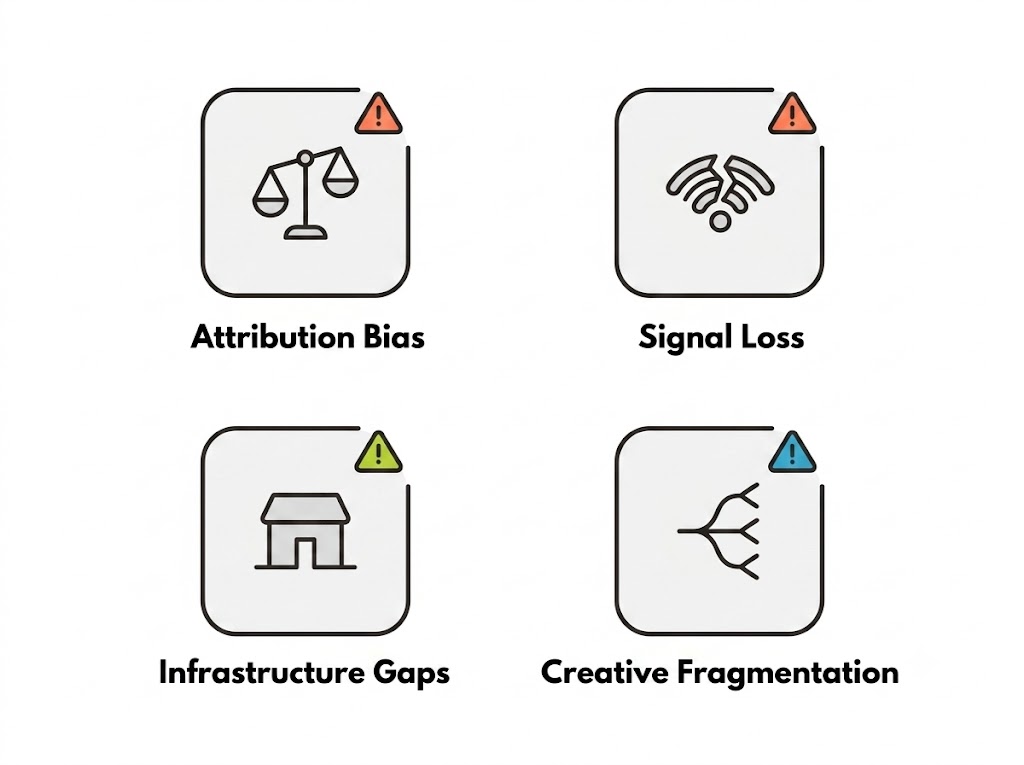
In practice, the four limitations that most consistently affect AI-driven programmatic performance are:
- Platform attribution bias over-crediting channel-reported conversions relative to CRM revenue
- Signal loss reducing model accuracy as deterministic tracking data declines
- Infrastructure gaps preventing SMEs and mid-market teams from meeting minimum conversion volume thresholds
- Creative fragmentation from high-velocity GenAI production outpacing what the optimization model can learn from
FAQs
What is AI in programmatic advertising?
AI in programmatic advertising refers to the machine learning systems embedded in demand-side platforms that automate bidding, audience selection, pacing, and optimization decisions. Platforms including The Trade Desk, Google DV360, and Amazon DSP use AI to evaluate impression value and adjust spend in real time based on conversion signals and campaign constraints.
Does AI in programmatic advertising guarantee better performance?
No. AI improves performance when campaigns are structured correctly, conversion signals are high quality, and sufficient volume exists for the model to learn from. Campaigns with poor signal quality, over-fragmented structure, or proxy conversion events often perform worse under AI optimization than under manual management because the system scales spend confidently toward the wrong outcome.
How does machine learning affect bidding in programmatic advertising?
Machine learning analyzes historical auction data and real-time signals to estimate the optimal bid for each impression — high enough to win without systematically overpaying. This process, called bid shading in first-price auction environments, commonly reduces average CPM paid by 10% to 25% compared to ceiling bids, though actual results vary by inventory type and competition level.
How have privacy changes affected AI in programmatic?
Privacy restrictions have reduced the share of deterministic tracking signals available to machine learning models, forcing platforms to rely more on modeled and probabilistic data. First-party CRM data, contextual targeting, identity resolution networks like LiveRamp and UID2, and data clean rooms have become the primary infrastructure for maintaining AI optimization quality as third-party signals decline.
What conversion events should be passed to programmatic AI systems?
Conversion events should reflect actual business value rather than easily tracked proxy actions. For B2B advertisers, this means passing CRM pipeline events such as sales-qualified opportunities rather than form fills. For e-commerce advertisers, it means passing purchase revenue rather than add-to-cart events. Platforms including Salesforce Data Cloud and HubSpot Operations Hub support the CRM integrations required to enable this.
When should AI-driven programmatic campaigns be paused?
Pause or restructure when platform-reported results diverge from CRM revenue data over a sustained period, when cost per qualified opportunity is rising despite declining cost per lead, or when campaign learning thresholds are not being reached after 90 days of consistent exposure. These signals indicate structural problems that additional spend will not resolve.
Conclusion
AI and machine learning have changed how programmatic advertising operates at the optimization layer — automating bid decisions, audience scoring, pacing, and delivery at a speed and granularity that manual trading cannot match. The practical value of that capability depends on the quality of the inputs the system receives: conversion signal accuracy, campaign structure stability, first-party data infrastructure, and attribution windows calibrated to the actual sales cycle.
The shift toward modeled data and privacy-compliant identity resolution has made those inputs more consequential, not less. As deterministic tracking signals continue to decline, the quality of an organization's first-party data, CRM integration, and clean room infrastructure will increasingly determine how well machine learning can operate on its behalf — regardless of which platform is running the campaign. AI amplifies what is already working in a campaign system. It does not compensate for what is missing.
Read These Next
AI Marketing Automation: How to 10x Your Output with Machine Learning