.png)

B2C Marketing Automation: 7 Retail Workflows That Drive Immediate Impulse Sales
.png)

.png)

B2C marketing automation utilizes behavioral, real-time data triggers (like cart abandonment or browse history) to deliver personalized, time-sensitive messaging across email, SMS, and push channels. By minimizing the time between consumer intent and action, it captures immediate impulse sales, achieving cart recovery and back-in-stock conversion rates.
How B2C Automation Differs from B2B Automation
B2C marketing automation operates on fundamentally different logic than B2B. The purchase decision is made by one person, often within minutes or hours. Triggers are behavioral and emotional rather than firmographic. Volume is orders of magnitude larger, making manual personalization impossible. Platforms like Klaviyo, Attentive, or HubSpot integrated with Shopify backend infrastructure can serve both models, but the logic, timing, and measurement are structurally different.
How Do the 7 Workflows Function as a System?
The seven workflows below are most effective when connected rather than deployed independently. Each captures behavioral data that improves the targeting logic of the others.
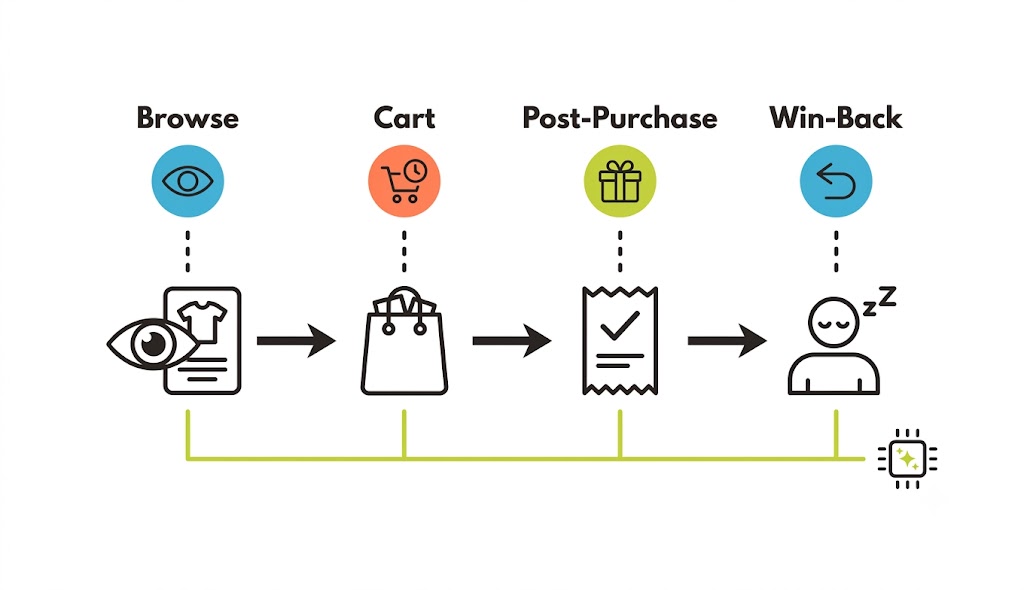
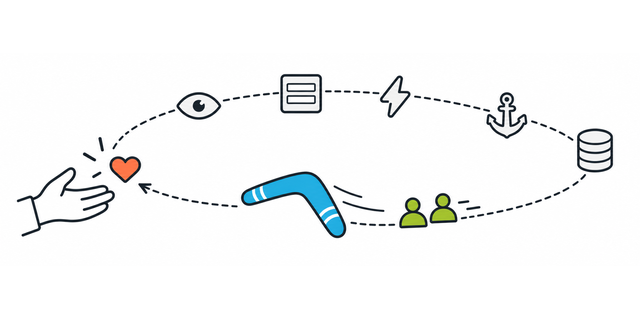
A consumer who browses without purchasing enters the browse abandonment workflow. If they add to cart and leave, cart abandonment takes over. If they purchase, post-purchase and cross-sell workflows activate. If they go inactive, win-back fires. Their engagement history feeds the AI personalization layer, which continuously refines which products, offers, and timing produce the highest conversion rate for that individual.
Platforms that treat each workflow as an isolated campaign break this chain and produce generic messaging at exactly the moments when specificity matters most.
Workflow 1: Abandoned Cart Recovery
Abandoned cart automation triggers a sequence of messages to customers who added items to their cart but did not complete the purchase. It is the highest-ROI workflow in B2C retail automation, with recovery rates of 5 to 15% depending on sequence timing, channel mix, and offer strategy.
Average cart abandonment rates sit between 65 and 75% across retail categories. The causes range from unexpected shipping costs and forced account creation to distraction and price comparison. An email sent within one hour of abandonment recovers significantly more revenue than one sent after 24 hours — purchase intent is still active and the product is still in working memory.
Recommended sequence structure:
- Message 1 (within 30–60 minutes): Email reminder with product image and direct cart link. For customers with SMS opt-in on platforms like Attentive or Klaviyo SMS, send a simultaneous text message with a short link back to the cart.
- Message 2 (24 hours later): Email with social proof — reviews, ratings, or a "selling fast" signal if inventory is low.
- Message 3 (72 hours later): Email with a time-limited incentive (free shipping or a small discount). Follow with an SMS nudge for opted-in contacts who opened but did not click.
For markets with strict consent requirements, including Australia and most APAC jurisdictions, SMS recovery should only target customers who have opted into marketing communications at the point of data collection.
Workflow 2: Browse Abandonment
Browse abandonment automation triggers messages to visitors who viewed product pages but did not add to cart. It operates with lower purchase intent than cart abandonment — conversion rates are lower but incremental volume can be significant at scale.
Messages should be framed around helpfulness rather than urgency. AI-driven recommendation engines like Nosto or Dynamic Yield integrated with Shopify Plus or Salesforce Commerce Cloud improve performance by surfacing relevant alternatives rather than simply showing the exact item viewed. A visitor who spent three minutes on a $200 jacket may convert better on a similar jacket at a lower price point than on a direct reminder.
Browse abandonment sequences should be one to two messages maximum. More than two messages to a visitor who never added to cart accelerates list fatigue without proportional revenue recovery.
Workflow 3: Welcome Series and New Customer Onboarding
A welcome series should deliver the brand's highest-value content, establish purchase incentive, and build enough familiarity that the new contact converts within their first purchase window. The first 72 hours after sign-up represent the highest engagement window in a contact's lifecycle. Conversion rates from welcome sequences are typically 3 to 5 times higher than standard promotional emails.
Recommended sequence structure:
- Email 1 (immediate): Deliver the promised incentive and confirm what the contact can expect from future communications.
- SMS 1 (within 1 hour, for opted-in contacts): Short welcome message with a direct link to the incentive or a featured product. Platforms like Attentive and Klaviyo SMS support this triggered send natively within the welcome flow.
- Email 2 (24 hours later): Introduce the brand's most popular products or categories with social proof — reviews, ratings, or bestseller labels.
- Email 3 (48–72 hours later): Present a time-sensitive conversion offer with a clear expiration, paired with a push notification for customers who have installed the mobile app.
For retail brands with mobile apps, welcome sequences should include an app download prompt with an incentive tied to the first in-app purchase. App customers purchase more frequently and have higher lifetime value than browser-only customers across most retail categories, making early app adoption a high-value activation objective.
Workflow 4: Post-Purchase Upsell and Cross-Sell
Post-purchase automation turns a completed sale into the starting point for the next one. It uses purchase history data to trigger product recommendations, complementary item suggestions, and replenishment reminders matched to typical usage cycles.
According to Bain and Company research on customer loyalty, repeat customers convert on targeted offers at significantly higher rates than new visitors — though the specific rate varies by category, brand familiarity, and offer relevance. A customer who just purchased a coffee machine needs a message about compatible capsules or a descaling kit, sent three to five days after delivery, not a generic "you might also like" broadcast.
Replenishment reminders sent five to seven days before a consumable product typically runs out convert at significantly higher rates than generic promotional emails — the message is expected, relevant, and timely.
Workflow 5: Win-Back Automation for Lapsed Customers
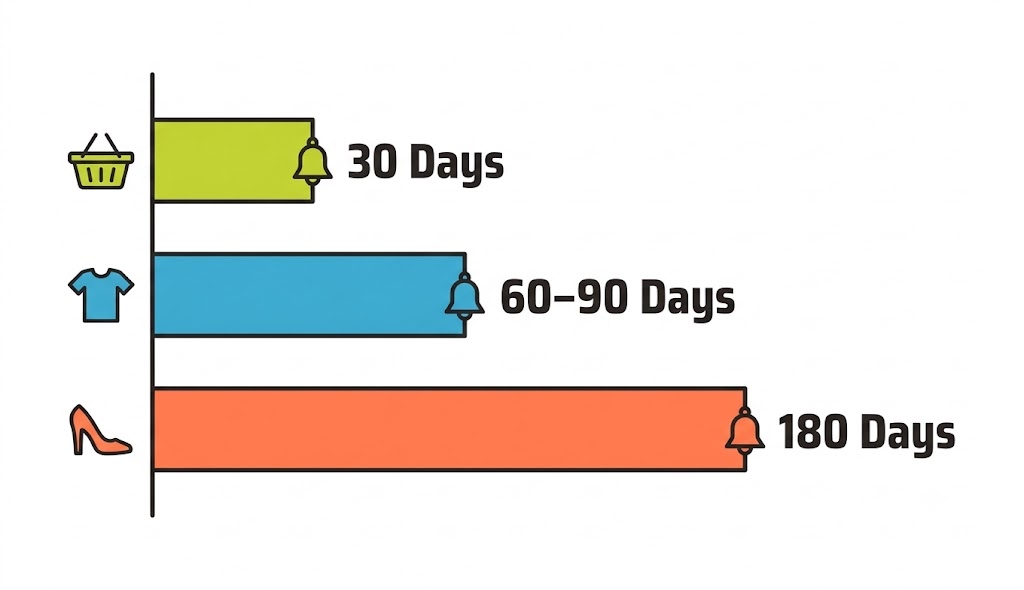
Win-back automation targets customers who have not purchased within a defined inactivity window. This window is strictly vertical-dependent: 30 days for grocery, 60 to 90 days for fashion and apparel, and up to 180 days for premium footwear or luxury goods. A uniform 90-day window applied across all categories will trigger sequences too early for slow-cycle verticals or too late for high-frequency ones.
Automation that does not account for individual purchase frequency triggers sequences unnecessarily, increasing unsubscribe rates and reducing deliverability.
Recommended sequence:
- Message 1: Personalized reminder of what the customer previously purchased.
- Message 2 (5–7 days later, if no engagement): Time-limited incentive.
Contacts who do not respond within 14 days should move to a suppression list.
Workflow 6: Price Drop and Back-in-Stock Alerts
Price drop and back-in-stock alerts are among the highest-converting automated messages in retail because they are requested by the customer and delivered the moment the purchase barrier is removed. Conversion rates for back-in-stock alerts typically range from 15 to 25%, compared to 1 to 3% for standard promotional emails.
The mechanism requires real-time inventory webhooks and API syncing between your e-commerce platform (such as Shopify Plus or Adobe Commerce) and your automation platform (such as Klaviyo or HubSpot). The automation monitors inventory and price changes and fires the message the moment the trigger condition is met.
A customer who opted into a back-in-stock alert has demonstrated explicit purchase intent. The message completes a transaction they already decided to make — which is why conversion rates are substantially higher than standard behavioral triggers. Systems where inventory data updates with a 24-hour lag will fire alerts after the product has already sold out again, eroding the trust the opt-in was designed to build.
Workflow 7: Loyalty and VIP Tier Progression
Automated loyalty workflows trigger personalized communications when customers approach or cross tier thresholds. Loyalty program members purchase 12 to 18% more frequently than non-members and generate 2 to 3 times higher lifetime value across most retail categories.
The most effective messages are sent when a customer is close to a tier upgrade, not after they have already crossed it. "You are $40 away from Gold status" creates forward momentum. "You have reached Gold status" confirms a milestone but does not drive the next purchase.
Points expiration reminders with curated product recommendations drive higher conversion than generic reminders — urgency combined with personalization produces the intent-plus-action combination that impulse automation is designed to create.
Challenges in B2C Automation Workflows
Most B2C automation failures originate in data quality problems, consent management gaps, or over-messaging rather than in the automation logic itself.
- Fragmented customer data. Automation that pulls from disconnected data sources produces inconsistent personalization. A customer who purchased in-store but is treated as a new contact in the email platform receives a welcome sequence for a product category they already own. Data unification across channels — connecting Shopify purchase history, Klaviyo email engagement, and Attentive SMS data into a single customer profile — is the foundational requirement for personalization to work as intended.
- Consent management failures. Privacy regulations in Australia, the EU, and across APAC require explicit, documented consent for marketing communications. Suppression lists must be accurate, opt-outs must be processed within the legally required window, and consent records must be stored and auditable.
- Signal loss from privacy restrictions. Browser-side tracking limitations, app tracking opt-outs, and iOS privacy settings reduce the behavioral signals available to automation platforms. Server-side tracking — where user data is sent directly from the website's server to the marketing platform, bypassing the user's browser — and first-party data collection maintain workflow accuracy as third-party signal quality continues to decline. Platforms like Segment or RudderStack handle the data pipeline infrastructure that makes this technically feasible for mid-market and enterprise retailers.
- Over-messaging. Sending too many automated messages too quickly is the most common cause of list degradation in B2C automation. Without frequency capping and sequence prioritization logic, automation platforms will send all active workflows simultaneously. Global frequency rules that cap total contact frequency across all active workflows are a non-optional element of any retail automation system.
- Attribution gaps. The email platform credits the recovery email. The retargeting platform credits the display ad. The SMS platform credits the text message. All three fired within the same 24-hour window. Platform-reported revenue across these channels will sum to more than the actual transaction value. CRM-verified revenue attribution — not platform-reported figures — is the only accurate measure of which workflows are contributing to commercial outcomes.
When Should You Scale B2C Automation Investment?
Scale when each active workflow is generating measurable incremental revenue above the cost of the platform and the effort required to maintain it. The practical readiness test is whether the core data infrastructure is functioning correctly: customer profiles are unified, consent is documented, and attribution is being cross-referenced against CRM revenue rather than relying solely on platform-reported figures.
Adding more workflows before the existing ones are generating clean, measurable results creates complexity without proportional revenue gain. The sequencing that produces the most reliable returns is cart abandonment first, then welcome series, then post-purchase, then win-back, then the remaining workflows as data and operational maturity support them.
Conclusion
B2C retail automation produces its strongest results when the seven workflows are connected into a system where behavioral data flows continuously between stages. The individual workflows are well-understood. The challenge is building the data infrastructure, consent management, and frequency logic that allow them to function as a coherent system rather than seven isolated campaigns.
The retailers generating consistent incremental revenue are not necessarily using the most sophisticated platforms. They are the ones with unified customer data, frequency controls that prevent over-messaging, and performance measured against CRM-verified revenue rather than platform-reported attribution.
Frequently Asked Questions
What is B2C marketing automation?
Software that triggers personalized messages based on individual customer behavior — browsing, cart activity, purchase history — without manual execution for each contact.
Which workflow has the highest ROI?
Abandoned cart recovery. It targets customers with demonstrated purchase intent and achieves recovery rates of 5 to 15% with a well-structured three-message sequence.
How is B2C automation different from B2B?
B2C operates on individual behavioral signals, short purchase cycles, and high contact volumes across email, SMS, and push. B2B targets buying committees over long sales cycles, primarily through email and CRM sequences.
What data does B2C automation require?
Unified customer profiles combining purchase history, browse behavior, email engagement, and consent records. Fragmented data produces irrelevant messages that increase unsubscribes rather than conversions.
How many workflows should a retail brand run simultaneously?
Start with cart abandonment and welcome series. Add post-purchase and win-back once those are producing measurable results. Global frequency capping is required before running more than three simultaneously.
Does B2C automation work for small retailers?
Yes. Klaviyo and Mailchimp provide cart abandonment, welcome series, and post-purchase automation at accessible price points. Unified customer data and documented consent are the non-negotiable foundations regardless of business size.
Related Content
Read These Next
Marketing Funnel Automation: The 2026 Guide to Building a Self-Optimizing Funnel