.png)
Marketing Funnel Automation: The 2026 Guide to Building a Self-Optimizing Funnel
.png)

.png)

A self-optimizing marketing funnel is an integrated, AI-driven automation architecture that continuously tests, scores, and updates conversion pathways across the full customer lifecycle without manual intervention. By connecting real-time behavioral data streams directly to execution layers, the system automatically adapts segmentation, messaging, and routing parameters based on prospect intent signals.
How Marketing Funnel Automation Has Evolved
Marketing funnels were once managed manually at every stage. Campaign teams built awareness through broad advertising, nurtured leads through fixed email schedules, and handed off contacts to sales based on time elapsed rather than demonstrated intent. The process was slow, inconsistent, and difficult to improve systematically because each stage operated in isolation.
The shift toward automated funnels began with basic email drip sequences and CRM lead scoring. AI-driven content distribution, behavioral trigger automation, predictive lead scoring, and modeled attribution have since replaced most of the fixed-rule logic that characterized earlier platforms.
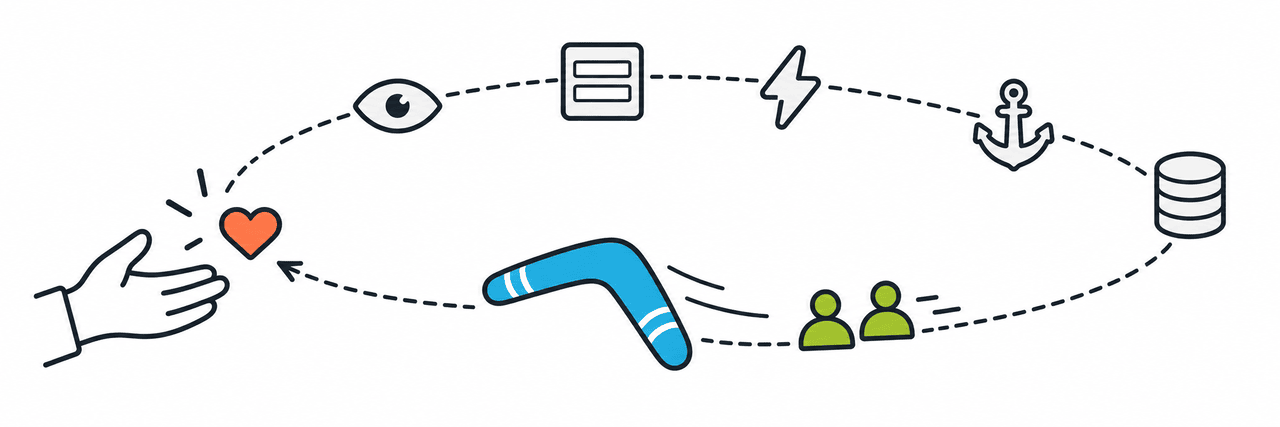
The structural change that matters most is the move from linear to cyclical funnel models. Traditional funnels pushed prospects from awareness to action in one direction. Growth marketing funnels in 2026 are end-to-end systems covering the full customer lifecycle: awareness, acquisition, activation, retention, revenue, and referral. According to Catch Digital's 2026 analysis, 79% of high-growth companies now use advanced funnel mapping techniques to optimize each stage, treating the funnel as a continuous feedback loop rather than a one-way path.
What Does a Self-Optimizing Funnel Actually Look Like?
A self-optimizing funnel connects six stages into a system where each stage generates data that improves the performance of every other stage. It produces results because the components are integrated, not because any single component is sophisticated.
The six stages are awareness, acquisition, activation, retention, revenue, and referral. Each is covered in detail below. What matters structurally is that no stage operates in isolation: a contact who engages with a mid-funnel email gets a different next experience than one who clicked but did not open. An account that visits the pricing page three times in one week triggers a sales notification rather than another nurture email.
.png)
AI can automatically test different landing page versions or adjust email send times based on when individual users are most likely to engage, without breaking the sequence or requiring manual intervention at each decision point. This is what distinguishes a self-optimizing funnel from a standard drip campaign.
How Do the Funnel Stages Work Together Operationally?
The practical mechanics of funnel automation depend on three connected layers: the data layer, the logic layer, and the execution layer. Each layer must function correctly for the system to self-optimize. These three layers run concurrently behind every one of the six marketing stages described below.
The data layer aggregates behavioral signals from every touchpoint: ad platform impressions, website visits, email engagement, CRM interactions, and product usage events. Without clean, unified data flowing into a Customer Data Platform (CDP) like Segment or RudderStack, the logic layer cannot make accurate decisions. Fragmented data is the most common root cause of funnel automation failure.
Self-optimization requires server-side tracking infrastructure to bypass standard browser-side pixel blocks. As privacy regulations reduce the reliability of cookie-based tracking, server-side setups that send conversion signals directly from the brand's own infrastructure become the baseline requirement. This includes syncing data warehouses like Snowflake or BigQuery directly to CRMs like HubSpot and Salesforce to maintain a unified behavioral record across the funnel.
The logic layer translates behavioral signals into decisions. Machine learning vector scoring and predictive algorithmic lead modeling assess which contacts are ready for sales engagement. Segmentation rules determine which nurture sequence a contact enters. In modern automation platforms, this logic is AI-assisted, with models continuously updating scores and segment assignments based on new engagement data rather than requiring manual rule updates.
The execution layer delivers the right experience at the right time: the email, the retargeting ad, the sales notification, the in-app prompt, or the pricing page variant. The execution layer is where most teams invest first, building email sequences and ad campaigns without first establishing the data and logic layers that make execution intelligent. Building execution before data infrastructure is the most common and most costly sequencing error in funnel automation.
What Are the Core Stages of an Automated Funnel and What Does Each Require?
Each stage of the funnel has distinct automation requirements and distinct measurement metrics. Understanding what each stage needs prevents teams from applying the wrong tools or measuring the wrong outcomes.
Awareness
The goal is reach and recognition among a defined audience. Automation handles content distribution, paid media scheduling, and audience expansion through lookalike and interest-based targeting. The relevant metric is qualified traffic: visitors who match the ICP and demonstrate initial engagement. Awareness automation without audience definition produces volume without pipeline contribution.
Acquisition
The goal is to convert anonymous visitors into known contacts. Automation handles lead capture form logic, conditional content offers, and CRM data routing. The relevant metric is landing page conversion rate: typically 2 to 8% for organic traffic and 8 to 20% for targeted paid traffic directed to a specific offer. Acquisition automation without offer specificity produces form submissions from contacts who will not progress through the funnel.
Activation
The goal is to deliver value quickly enough that the contact develops a reason to continue engaging. Automation handles onboarding sequences, product tour triggers, and early-stage educational content. The relevant metric is Time-to-First-Value (TTFV): how long it takes a new contact or trial user to experience the core benefit. Research consistently shows that contacts who reach activation within the first session or first 24 hours have substantially higher 30-day retention rates than those who do not.
Retention
The goal is to reduce churn before it occurs. Automation monitors engagement frequency, product usage patterns, and communication response rates to identify at-risk contacts and trigger re-engagement before they go dark. The relevant metric is churn rate. Reducing churn from 2% to 1.5% can expand baseline customer lifetime value by up to 33%, assuming all other revenue variables remain constant (SaaS Hero, 2026). Retention automation without behavioral monitoring triggers re-engagement too late to be effective.
Revenue
The goal is to expand commercial value from existing customers. Automation surfaces upsell and cross-sell triggers based on usage thresholds, tenure, and product engagement signals. The relevant metric is net revenue retention (NRR). Businesses with NRR above 110% grow revenue even with flat new customer acquisition, making revenue stage automation one of the highest-ROI funnel investments.
Referral
The goal is to generate organic pipeline from satisfied customers. Automation triggers referral requests at high-satisfaction moments rather than fixed schedules. The relevant metric is referral-generated pipeline as a percentage of total new pipeline. Referral automation without activation and retention in place produces requests to customers who have not yet experienced enough value to advocate credibly.
.png)
What Are Realistic Funnel Performance Benchmarks?
Benchmarks vary by industry, deal complexity, average contract value, and funnel maturity. The ranges below provide directional reference points rather than universal targets.
The visitor-to-customer rate is the most cited top-level benchmark. A well-automated funnel converting 1% of total visitors to customers is performing at the mid-range for most B2B and service businesses. Below 0.5% indicates a structural gap, most commonly in acquisition offer relevance or activation speed. Above 2% typically reflects strong ICP targeting, a short sales cycle, or both.
When Should You Scale Funnel Automation Investment?
Scale when each active funnel stage is converting at a measurable baseline and the constraint is volume rather than conversion quality. Adding traffic to a funnel with weak acquisition or activation converts more visitors at the same poor rate, producing more unqualified contacts at higher cost.
The readiness test is the same regardless of business size: acquisition converting above 2% of landing page visitors, activation delivering first value within the expected window, retention churn within industry range, and CRM receiving and routing leads accurately. If all four conditions are met, scaling traffic will produce proportional pipeline growth.
Pause or restructure when platform-reported pipeline diverges significantly from CRM-verified revenue over a sustained period. This is almost always an attribution problem rather than a channel performance problem, and increasing spend before resolving it makes the measurement gap larger.
What Disrupts Marketing Funnel Automation in Real-World Environments?
Funnel automation fails in predictable ways, and most failures originate in data infrastructure or logic layer gaps rather than in the execution tools themselves.
- Siloed data between funnel stages. When the email platform, ad platform, CRM, and product analytics system do not share data, the funnel stages operate independently rather than as a system. A contact who visits the pricing page twice is invisible to the email automation system if website behavior is not flowing into the CRM. The result is that the system sends the next scheduled email rather than the high-intent response the contact's behavior warranted.
- Behavioral signals not driving logic. Time-based sequences treat all contacts as if they are progressing at the same rate. A contact who opens every email and clicks every link is receiving the same nurture cadence as one who has not engaged in three weeks. Behavioral triggers resolve this, but they require the data layer to be functioning correctly.
- Attribution windows too short for the sales cycle. A B2B funnel with a six-to-nine-month average sales cycle produces almost no attributable revenue within a 30-day or 90-day reporting window. Teams that evaluate upper-funnel automation against short attribution windows consistently undervalue awareness and activation investments and cut them before they influence the pipeline.
- Over-automation of high-intent signals. A prospect who books a demo from a nurture email should receive a human call within hours, not enter another automated sequence. When intent signals are high, human engagement closes deals at higher rates than automated follow-up.
- Privacy and consent fragmentation. GDPR, Australia's Privacy Act, and equivalent APAC frameworks affect how contacts can be tracked, what data can be stored, and how long behavioral records can be retained. Funnels built without consent management infrastructure require retroactive fixes that disrupt automation logic and create data gaps in lead scoring models.
- Technical debt accumulating in automation logic. Rapid funnel iteration without documentation creates fragile systems where a single upstream change breaks downstream sequences. Teams that deploy new automation faster than they document existing automation eventually cannot modify the system without causing unintended consequences.
.png)
How Should Businesses Evaluate Marketing Funnel Automation Readiness?
The most common implementation mistake is purchasing automation software before the foundational elements are in place. A marketing automation platform without a defined ICP is more likely to produce inefficient pipeline metrics and inconsistent results rather than a predictable return on investment.
Three questions determine readiness. Is the ICP defined specifically enough to build distinct messaging for each funnel stage? Is there a validated acquisition offer that converts a defined audience at a measurable rate? Is the CRM configured to receive lead data, track engagement history, and notify the sales team when qualification thresholds are met?
If the answer to any of these is no, the priority is resolving the gap rather than adding automation capability. A well-defined offer on a simple landing page, connected to a basic CRM with a five-email nurture sequence, will outperform a sophisticated automation platform built on a weak acquisition layer and an undefined audience.
Conclusion
A self-optimizing marketing funnel is not defined by the sophistication of its tools. It is defined by how effectively each stage generates data that improves every other stage. Awareness informs acquisition targeting. Activation data improves retention logic. Retention signals identify expansion opportunities.
The funnels that produce consistent, scalable pipelines are built on clean data infrastructure, behavioral logic that responds to intent rather than schedules, and attribution windows that match the actual length of the sales cycle. Getting those structural conditions right before scaling traffic or adding tooling is where funnel performance is actually determined.
Frequently Asked Questions
What is marketing funnel automation?
Marketing funnel automation uses software and AI-driven logic to manage lead progression across funnel stages automatically, based on behavioral signals rather than manual decisions or fixed time schedules.
What is a self-optimizing funnel?
A self-optimizing funnel uses AI and behavioral data to continuously adjust scoring, segmentation, messaging, and timing without requiring manual rule updates at each stage.
How long does it take to build a functioning automated funnel?
A basic funnel covering acquisition, nurture, and CRM handoff can be operational in two to four weeks. Full-funnel automation covering all six stages typically takes two to four months to build and stabilize.
What is the most important metric for funnel performance?
Cost per sales-qualified opportunity. It connects marketing activity to commercial outcomes rather than intermediate metrics like cost per lead, which do not reflect whether contacts are progressing toward revenue.
Why does funnel automation fail most often?
Siloed data between platforms, attribution windows shorter than the actual sales cycle, and over-automation of high-intent signals. All three are structural problems, not tool limitations.
Does funnel automation work for small businesses?
Yes. A validated offer, a simple landing page, a five-email nurture sequence, and a CRM with basic lead routing will produce measurable results before a full automation platform investment is justified.
Related Content
Read These Next
B2C Marketing Automation: 7 Retail Workflows That Drive Immediate Impulse Sales