.png)

Content Marketing Automation: How to Scale Content Without Scaling Your Team
.png)

.png)

Content marketing automation uses software and AI tools to handle the repetitive, time-consuming work behind content: writing briefs, scheduling posts, tracking performance, and distributing across channels, so the same team can produce more without working longer hours. When set up correctly, it cuts execution time by at least 40% while keeping human judgment in place for strategy and brand decisions.
Introduction
Most marketing teams eventually hit the same wall. The number of channels grows. The demand for content increases. But the team stays the same size — and the only way to keep up is to move faster, cut corners, or both.
Content marketing automation exists to break that pattern. It is not about replacing writers or removing editorial judgment from the process. It is about removing the work that does not require judgment in the first place: creating the same brief format 30 times a month, manually copying content from one platform to another, pulling performance numbers from three different tools to build a report that could generate itself.
When that operational work is handled by software, the team's time shifts toward decisions that actually require people — what to write, what angle to take, what the brand should say, and why.
The tools to do this are no longer out of reach for smaller teams. Platforms like Jasper and Writer handle AI-assisted drafting with brand voice training. Zapier and Make.com connect different software tools so content moves between them automatically. HubSpot ties content performance directly to sales pipeline data. A five-person marketing team today has access to infrastructure that would have required a fifteen-person team five years ago.
What This Guide Covers
- What content marketing automation includes and what it does not replace
- How the different parts work together
- Where automation saves the most time and money
- Realistic numbers and what they depend on
- When to automate and when to keep humans in the loop
- What goes wrong and how to avoid it
What Is Content Marketing Automation?
Content marketing automation is the use of software tools to handle repeatable tasks across the content process — from planning and drafting to publishing and reporting — without someone doing each step manually.
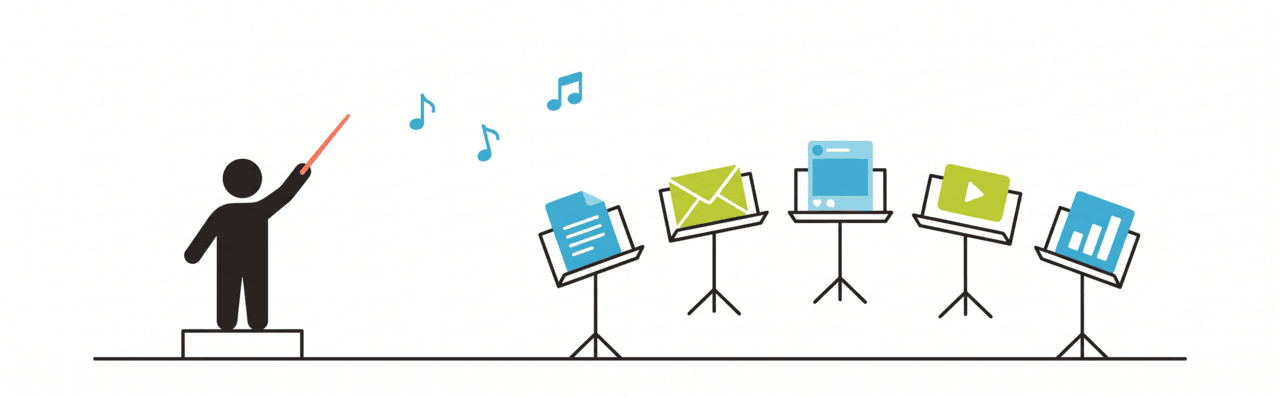
It works across three areas: production support (writing briefs, structuring outlines, suggesting edits), distribution (scheduling posts, formatting content for different channels, republishing), and performance tracking (monitoring traffic, flagging what is working, generating reports). Each area reduces a different kind of manual work. Together they change how a content team spends its time.
The most important thing to understand about automation is what it cannot replace. A tool can generate a content brief from a keyword. It cannot decide whether that keyword fits where the business is trying to go. A scheduling platform can publish at the best time. It cannot judge whether the content is ready to go live. Automation handles the execution. People handle the judgment.
How Does It All Work Together?
The real value of content automation comes from connecting the parts, not running them separately.
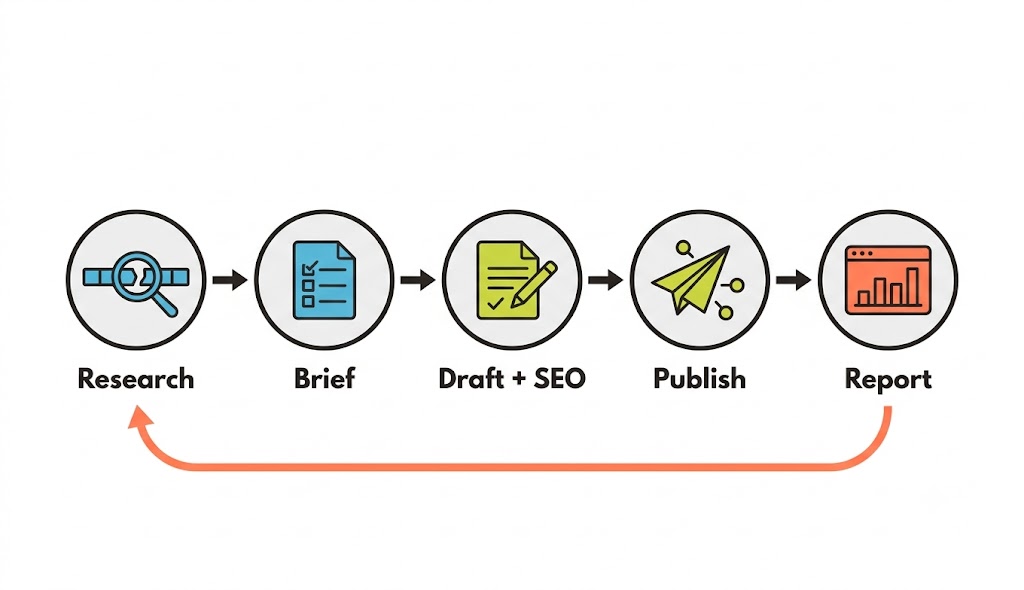
A typical workflow looks like this: a keyword research tool identifies gaps in existing content and feeds that information into a planning layer. The planning layer generates a brief, which goes to a writer or an AI drafting tool. The draft gets reviewed and runs through an SEO check — a tool that flags missing keywords, weak headings, or internal linking opportunities — before it is ready to publish. From there, a scheduling tool pushes it to the right channels at the right time. After it goes live, a reporting dashboard tracks how it performs, and that data informs the next round of content planning.
When each of these steps is handled separately, time gets lost at every transition. A writer waits for SEO feedback. A social media manager manually reformats a blog post for LinkedIn. A manager spends two hours pulling numbers from different dashboards to build a weekly report. Each of those gaps is time that automation eliminates.
The efficiency comes from removing the gaps. The performance improvement comes from using what each step produces to make the next step smarter.
Where Does Automation Save the Most Time?
The highest-return automation opportunities sit at the beginning of the content process. Getting the brief right before writing starts saves more time than fixing a finished draft.
Writing Briefs and Outlines
Creating a structured brief — with the target keyword, recommended headings, competitor references, and word count — used to take 45 to 90 minutes per piece. With a trained template and an AI tool, it drops to under ten minutes. Jasper, for example, supports brand voice training so brief output stays consistent regardless of who generates it.
Checking Content Before It Publishes
Tools that review a draft for keyword coverage, heading structure, readability, and links to other pages on the site reduce the time between "draft complete" and "ready to publish." The writer gets specific, actionable feedback without waiting for a manual review from an SEO specialist.
Publishing Across Multiple Channels
A single piece of content often needs to appear in several places — a blog post, a LinkedIn update, an email newsletter. Doing that manually means logging into each platform separately and reformatting the content each time. Tools like Zapier and Make.com automate that movement, publishing the right version to each channel from a single workflow.
Weekly Performance Reports
A standard weekly content report — traffic, rankings, engagement, what is improving, what is not — can take two hours to compile manually. Automated dashboards pull that data together and distribute it without anyone having to touch it. HubSpot goes further by connecting content performance to sales pipeline data, so teams can see which content is actually contributing to revenue, not just generating traffic.
Getting More From Existing Content
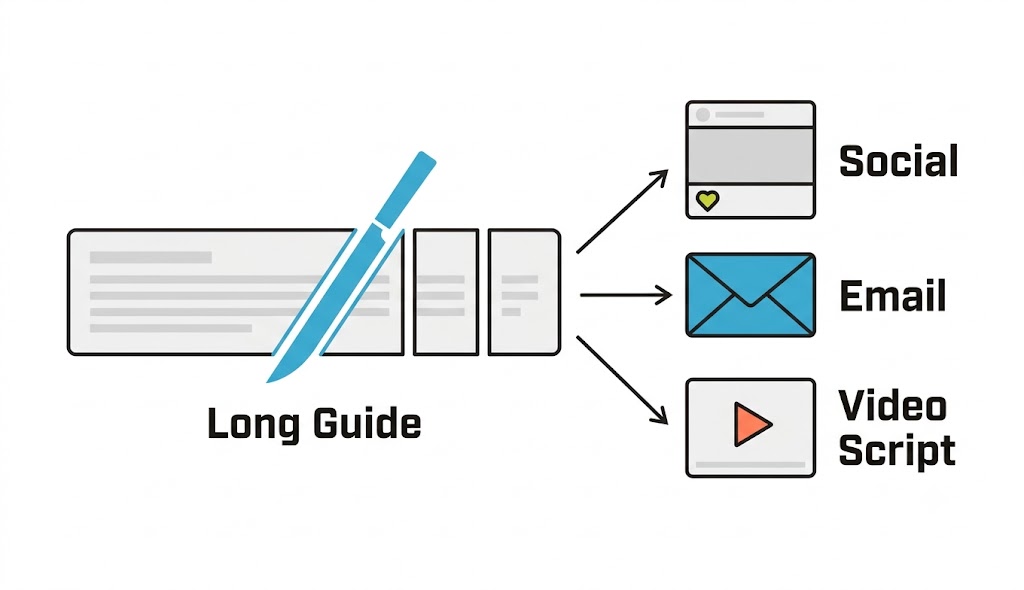
Long-form content — a detailed guide, a research report, a recorded webinar — can be broken down into shorter assets: social posts, email snippets, short video scripts. AI tools do this extraction work quickly, extending the value of a single content investment without additional production time.
The work that should stay with people is the work that requires judgment: deciding what the brand should say, reviewing accuracy, maintaining voice, and making strategic calls about what topics to prioritize.
What Gets Automated vs What Stays With People
What Results Should You Realistically Expect?
Numbers vary depending on team size, how much of the workflow is already documented, and how consistently the tools are used. The ranges below reflect what teams typically see, not what is guaranteed.
Publishing output. Teams that automate brief generation, SEO review, and scheduling typically increase how much they publish by 30 to 60% within six months — without adding headcount. The range depends on how manual the process was before.
Time saved per piece. Across planning, optimization, and distribution, most teams save three to eight hours per piece of content. The higher end tends to apply to teams that were doing everything manually across many disconnected tools.
Organic traffic growth. Content programs that publish more consistently and use automated SEO feedback tend to see 20 to 50% growth in search traffic over twelve months. This depends heavily on how competitive the topic area is and how strong the existing content base is. Automation makes the process more consistent — it does not improve the quality of the content itself.
Cost per piece. For teams using AI drafting tools alongside human editing, the cost to produce a finished piece typically drops by 25 to 45% compared to fully manual production. The range reflects how much editing time the AI output requires before it is ready to publish.
These are directional benchmarks, not targets. A team producing highly technical or regulated content will sit at the lower end. A team producing high-volume, more standardized content will approach the upper range.
When Should You Automate and When Should You Not?
Most content workflows are a mix of tasks that should be automated and tasks that should not. The right balance depends on how clear the decision logic is and how much context the task requires.
A useful rule of thumb: automate tasks where the inputs are consistent, the logic is repeatable, and the output can be checked efficiently. Keep humans in the loop for anything that requires organizational context, relationship knowledge, or strategic judgment.
The most common sequencing mistake is automating distribution before fixing the production workflow. That results in publishing more content, more efficiently, that is no better than before. The right order is: start with planning and brief generation, then move to optimization, then distribution.
What Goes Wrong With Content Automation
Automation scales whatever is already in place. If the underlying process is inconsistent, automation makes inconsistency faster. If performance data is fragmented, automated reports surface incomplete information.
Disconnected data. Automation tools depend on clean, accessible data. When analytics sit in separate platforms that do not share information, optimization suggestions are based on partial signals. This is the most common constraint teams underestimate before implementing.
Brand voice degrading over time. AI drafting tools need regular calibration to stay consistent with how the brand writes and communicates. Teams that set them up once and do not revisit the training see the largest drop in output quality over time.
Measuring the wrong thing. Automated attribution — tracking which content led to a sale — works well when the path from content to purchase is short and direct. It works poorly for longer sales cycles where content builds familiarity over multiple touchpoints before a decision is made. Teams that rely on automated attribution alone will consistently undervalue content that is doing important work earlier in the buying process.
Too many tools. Adding more automation platforms without consolidating existing ones creates more coordination work, not less. A content workflow running across eight to ten platforms generates more management overhead than one running across three to four — regardless of how capable each individual tool is.
Automating content that should not be automated. Thought leadership pieces, content on sensitive topics, and anything representing the organization's public position requires human authorship and sign-off. Automating this category creates more risk than it saves time.
Conclusion
Content marketing automation is an operational decision before it is a technology decision. The tools are available, accessible, and no longer limited to large teams with large budgets. The question is whether the workflow, data quality, and editorial standards are solid enough to get value from them.
Teams that automate the execution work and keep human judgment at the strategic layer produce more, publish more consistently, and make faster decisions based on performance data. The constraint is almost never the tools. It is the sequencing, the data foundation, and the discipline to keep people involved where they need to be.
The limit on content output is no longer the size of the team. It is the quality of the operating model behind it.
Frequently Asked Questions
What is the difference between content marketing automation and AI content generation?
Content marketing automation covers the full process — planning, distribution, optimization, and reporting. AI content generation is one part of that, specifically used for drafting and structuring content.
How much does it cost?
Entry-level tools start at a few hundred dollars per month. A full stack covering planning, content management, distribution, and analytics typically runs several thousand per month for mid-sized teams.
Can small teams benefit?
Yes — often more than large ones. Automating briefs, SEO review, and scheduling gives a small team back a meaningful share of their weekly hours, which compounds quickly when the team is already stretched.
Does automation lower content quality?
It can, if the human review layer is removed. Automation improves volume and consistency. Quality still depends on the people calibrating, reviewing, and directing the process.
How long before results show up?
Operational time savings are usually visible within four to eight weeks. Improvements in search traffic from more consistent publishing typically take three to six months to register.
What should be automated first?
Brief generation and SEO review. Both sit at the beginning of the process, so improving them makes every piece of content that follows better.
Related Content
Read These Next
B2C Marketing Automation: 7 Retail Workflows That Drive Immediate Impulse Sales