Conversion Rate Optimization for Lead Generation: 7 Tactics That Fill Your Pipeline Faster



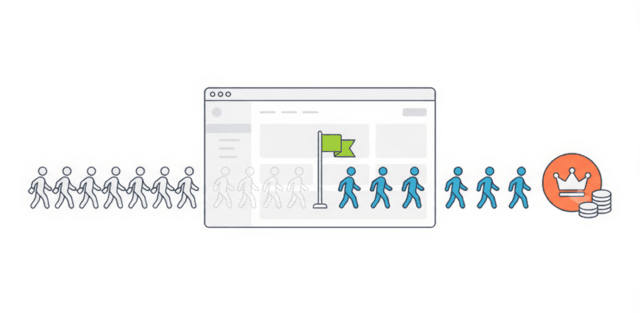
Conversion rate optimization for lead generation is the process of improving the percentage of website visitors, ad clicks, and content consumers who submit their contact information and qualify as pipeline opportunities. It combines landing page design, behavioral targeting, lead scoring, and nurture sequencing into a connected system that generates more qualified leads from existing traffic without increasing acquisition spend.
Introduction
Most lead generation programs have a conversion problem before they have a traffic problem. Businesses running paid search, content marketing, and social campaigns are generating visitor volume. What they lack is a system that converts a meaningful percentage of that volume into qualified opportunities.
Conversion rate optimization for lead generation addresses this at every stage of the funnel: how landing pages are structured, how offers match visitor intent, how behavioral signals qualify and route leads, and how nurture sequences move prospects from first contact to sales-readiness. Each element influences the others.
The environment has also become more complex. AI-driven ad platforms automate audience targeting in ways that make traffic quality less predictable. Privacy restrictions have reduced behavioral signal for retargeting and personalization. Attribution gaps between ad platforms, CRMs, and revenue outcomes make it difficult to identify which tactics are genuinely producing pipeline.
What This Guide Covers
This guide explains seven lead generation CRO tactics that improve pipeline quality and volume, with context on how each works and where each breaks down.
It covers:
- How landing page structure affects lead conversion rates
- How offer alignment drives higher-intent form submissions
- How behavioral qualification separates pipeline from noise
- How lead scoring connects marketing activity to sales readiness
- How nurture sequencing converts captured leads into opportunities
- How attribution affects CRO investment decisions
- When to scale and when to pause lead generation programs
How Lead Generation CRO Works as a System
Lead generation CRO is most effective when the seven tactics below are connected rather than deployed independently. Each tactic handles a different stage of the lead lifecycle, and performance in each stage affects the stages that follow.
Traffic enters through paid search, organic content, social, or referral channels, each arriving with different intent levels. Landing pages qualify that intent through structure and offer. Behavioral tracking identifies which visitors are engaging meaningfully. Lead scoring assigns qualification weights to captured leads. Nurture sequences convert captured leads into opportunities. Sales handoff protocols route qualified leads at the right time. Attribution frameworks determine which tactics are producing commercial value.
Weakness in any stage reduces performance across the whole. A well-structured landing page feeding into a poor nurture sequence produces high capture rates and low conversion to opportunity.
Tactic 1: Align Landing Page Structure to Visitor Intent
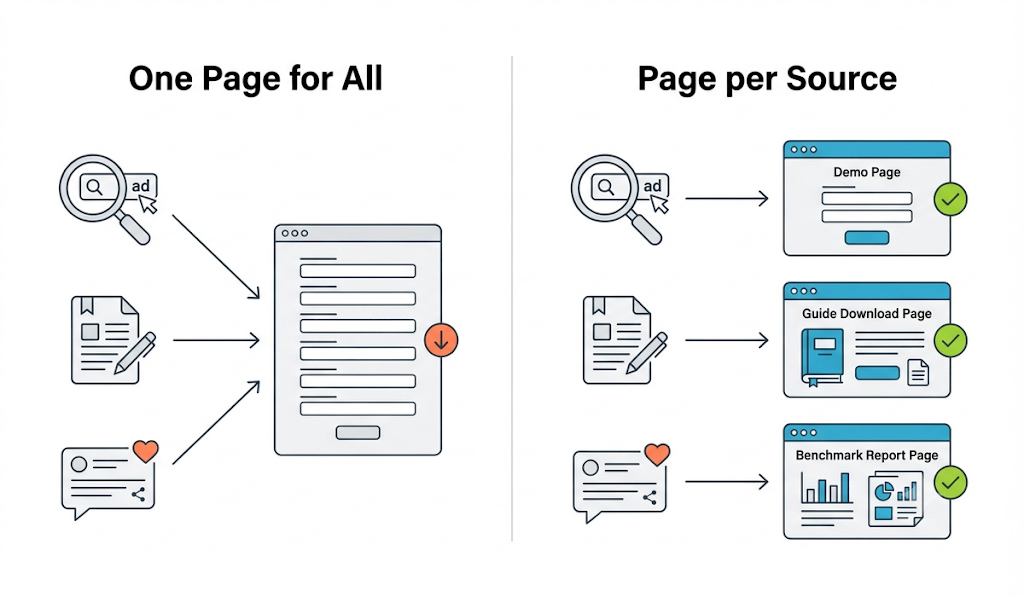
Landing page conversion rates improve when the page content matches the specific intent of the traffic source driving visitors to it. A visitor arriving from a high-intent paid search query expects a more direct commercial message than one arriving from a broad awareness blog post.
Most B2B landing pages underperform because they are built to serve all traffic types simultaneously. Segmenting landing pages by traffic source, audience segment, and funnel stage consistently produces higher conversion rates than directing all traffic to a single generic page.
Realistic benchmarks vary by traffic source and offer type, and reported figures differ across datasets depending on what counts as a "conversion." Paid search directed to a high-intent, narrow keyword match typically converts at 5 to 12%, reaching up to 20% for branded search terms — a 20% rate on generic, unbranded B2B queries would be an outlier. Organic traffic to a content download converts at roughly 3 to 8%, broadly consistent with industry benchmark data placing B2B landing page conversion in the 2–8% range depending on offer type. Display or social traffic to a top-of-funnel offer converts at 1 to 4%, in line with reported benchmarks showing paid social and display consistently underperforming search and email on lead-focused landing pages.
The most common structural failure is asking for more information than the offer warrants. HubSpot's analysis of tens of thousands of landing pages found a consistent negative correlation between form field count and conversion rate, and reducing form fields to the minimum required for qualification typically improves conversion by 15 to 30% in B2B contexts — independent benchmark data likewise shows conversion rates dropping consistently as form field count climbs past three to five fields.
Tactic 2: Match the Offer to the Buyer's Stage
The content offer on a lead generation page determines which types of prospects engage. A detailed technical whitepaper attracts prospects already evaluating solutions. A general introductory guide attracts prospects still defining their problem. Misaligning offers to buyer stage produces leads that are either too early to progress quickly or too advanced to engage with what is offered.
High-converting lead generation programs maintain offers mapped to each buying stage. Top-of-funnel offers (guides, benchmarking reports, research) generate volume but require more nurture before leads are sales-ready. Bottom-of-funnel offers (product demos, ROI calculators, free assessments) generate lower volume but produce leads with higher intent and shorter sales cycles.
The practical decision is whether to prioritize pipeline volume or velocity. Most B2B programs benefit from maintaining both, with routing logic that separates them into different nurture tracks based on the offer type that generated the first conversion.
Tactic 3: Use Behavioral Signals to Pre-Qualify Leads Before Form Submission
Behavioral pre-qualification uses on-site engagement data to identify visitors demonstrating high purchase intent before they submit a lead form. These signals include multiple visits to product or pricing pages, extended session duration on solution-focused content, and repeated engagement with bottom-of-funnel resources.
Identifying high-intent visitors before form submission allows businesses to present different offers or more direct CTAs. This increases the probability that the first conversion is a high-value action rather than a low-friction download.
Connecting website behavioral data to CRM systems through platforms like HubSpot or Salesforce enables sales teams to see which companies are engaging before a form is submitted. This unmasking of anonymous traffic — commonly called de-anonymization or visitor identification — is typically achieved through IP reverse-lookup scripts that match a visitor's network to a known company, dedicated de-anonymization software such as 6sense, Clearbit, or Demandbase, or first-party cookie tracking scripts embedded directly in the CMS. These tools allow sales teams to act on buying signals from known accounts without waiting for inbound submissions.
Note: Behavioral triggers must respect regional compliance frameworks (GDPR/CCPA). Implement an explicit cookie consent banner that suppresses behavioral logging until the user opts in, and confirm that any de-anonymization vendor's data sourcing complies with applicable consent requirements in each region you operate in.
The constraint is data completeness. Cookie deprecation and privacy restrictions reduce behavioral signal coverage, particularly for new visitors. Server-side tracking improves reliability in privacy-restricted environments but does not eliminate the gap entirely.
Once these pre-qualification behavioral signals are captured, they feed directly into your lead scoring framework.
Tactic 4: Implement Behavioral Lead Scoring to Separate Pipeline from Noise
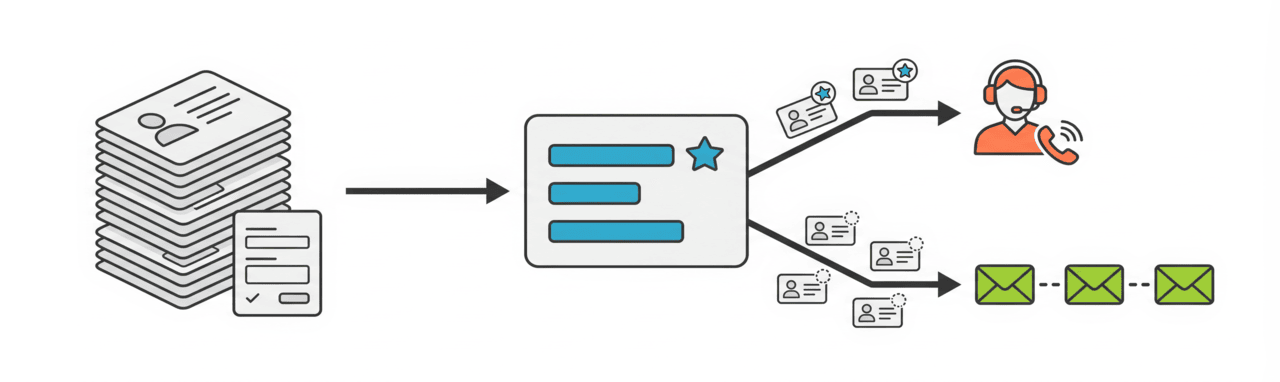
Lead scoring assigns qualification weights to captured leads based on behavioral history, demographic attributes, and engagement patterns. It separates leads likely to progress through the sales process from those unlikely to convert regardless of nurture investment.
Without lead scoring, sales teams receive all captured leads simultaneously and must manually assess which warrant immediate follow-up. This slows response times to the leads most likely to convert and increases cost per qualified opportunity.
A functional B2B lead scoring model tracks three categories: demographic fit (company size, industry, job title aligned to the ICP), behavioral engagement (page visits, email opens, content downloads, pricing page views), and recency (how recently activity occurred, with recent signals weighted more heavily).
Platforms like HubSpot, Salesforce, and Marketo support behavioral lead scoring natively. The most common implementation failure is building a scoring model and not revisiting it. Quarterly audits against actual pipeline outcomes are a maintenance requirement.
A validated score is only useful once it triggers action. That action happens downstream, in how nurture sequences respond to the behavioral and scoring signals captured here.
Tactic 5: Build Nurture Sequences That Respond to Behavior, Not Just Time
Nurture sequences that deliver content on a fixed schedule regardless of engagement produce lower conversion rates than sequences that adapt based on behavioral signals. A lead opening every email and visiting the pricing page three times in one week is behaving very differently from one that has not opened an email in 30 days.
Behavior-based nurture sequences accelerate high-engagement leads toward sales conversations. They also re-engage or suppress dormant leads rather than continuing to send them the same content on the same schedule.
The most effective B2B nurture sequences follow a graduated intent model. Early-stage sequences deliver educational content. Mid-stage sequences introduce solution frameworks and social proof. Late-stage sequences create urgency through time-sensitive offers or direct invitations to a sales conversation.
Connecting CRM platforms such as Salesforce or HubSpot with Customer Data Platforms such as Segment or Tealium creates a shared behavioral data foundation. This allows nurture sequences to respond to signals from across the full customer journey, not just email engagement.
Note: Behavioral triggers must respect regional compliance frameworks (GDPR/CCPA). Apple's Link Tracking Protection (LTP) also strips tracking parameters from links opened in Mail and Messages on Apple devices, which can break click-based personalization in nurture emails. Build sequences that can still function on open and page-visit signals alone, and confirm consent status before logging cross-session behavioral data.
Once a lead has been nurtured to sales-readiness, the next point of failure is usually operational: how quickly sales actually follows up.
Tactic 6: Reduce Sales Handoff Friction Through Qualification-Triggered Routing
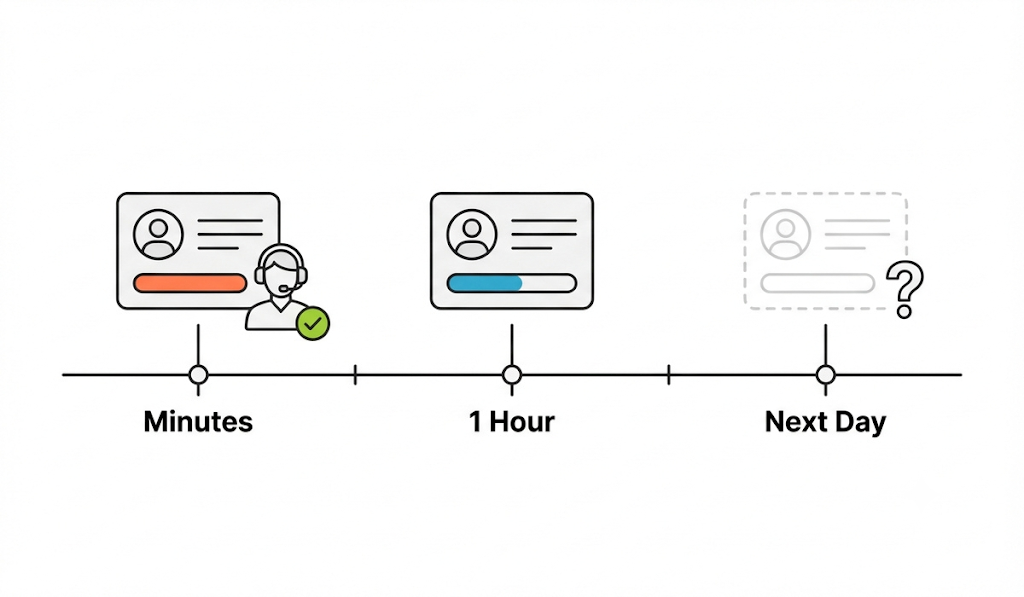
The gap between a lead reaching sales-readiness and a sales conversation occurring is one of the most significant conversion losses in B2B lead generation. Leads that reach a qualification threshold and wait days for follow-up convert at substantially lower rates than those contacted soon after demonstrating high intent.
Automation-triggered routing connects lead scoring thresholds to immediate sales notifications and CRM task creation. When a lead crosses a defined score, a notification reaches the assigned representative within minutes rather than the next business day.
Response within the first hour of a high-intent signal tends to produce better contact and qualification rates than slower response, though the exact magnitude varies by industry, lead source, and how "response" is measured. The pattern is well documented: the Lead Response Management Study, later cited by Harvard Business Review's "The Short Life of Online Sales Leads," analyzed roughly 15,000 leads and over 100,000 call attempts and found that qualification odds drop sharply as response time moves from minutes to hours. It is one of the more reliably documented variables in B2B lead conversion, though it should be read as a strong directional finding rather than a guaranteed outcome for every program. The original Lead Response Management Study data set is publicly available for teams that want to review the underlying methodology rather than relying on secondary write-ups.
The constraint is operational. Routing automation only works when CRM data is accurate, lead ownership is clearly defined, and representatives have the capacity to act on triggered notifications promptly.
Tactic 7: Measure Pipeline Contribution, Not Lead Volume
Most lead generation programs are measured on form submissions, cost per lead, and lead volume by channel. These metrics are easy to collect and easy to report, but they are poor proxies for what the program is actually designed to produce: qualified opportunities that sales teams can close.
Measuring pipeline contribution requires connecting marketing activity data to CRM pipeline data and tracking leads from first touch through to closed revenue. This reveals which lead sources, offer types, and nurture sequences produce actual pipeline, rather than which ones produce the highest form submission volume.
The distinction matters because volume and quality frequently diverge. A content download campaign may generate three times the lead volume of a product demo campaign at half the cost per lead, while the demo campaign produces five times the qualified pipeline. Optimizing for cost per lead in this scenario allocates budget away from the tactic that is producing commercial value.
Attribution gaps affect every stage of this measurement chain. Ad platforms attribute conversions to themselves. CRM systems may not capture all marketing touchpoints. Last-click attribution over-credits the final interaction before form submission and under-credits earlier content and campaign touchpoints that created the intent. Multi-touch attribution models produce more accurate channel assessments but require consistent UTM tagging, CRM integration, and attribution window configuration to be reliable.
When to Scale Lead Generation CRO Investment
Scale CRO investment when foundational elements are producing measurable pipeline at consistent cost and the constraint is volume rather than conversion quality. Investing in more traffic before conversion and qualification systems are optimized produces more raw leads at the same poor qualification rate.
Common Failure Modes in Lead Generation CRO
Most lead generation CRO programs underperform due to structural problems rather than execution failures.
Optimizing for form submissions rather than qualified pipeline is the most prevalent issue. Form volume is easy to improve by reducing friction or increasing traffic spend. Neither produces better pipeline. The relevant metric is always qualified opportunity creation.
Lead scoring models that are never validated against actual outcomes create false confidence. A model classifying 30% of contacts as marketing-qualified is only useful if those contacts actually progress through the sales process. Models not periodically recalibrated against CRM data drift from reality over time.
Nurture sequences that treat all leads identically regardless of engagement level waste the behavioral data already collected. The sequence should respond to what the lead does, not proceed on a fixed schedule.
Attribution fragmentation produces incorrect channel performance data. When paid search, content, email, and social each report their own conversions independently, the sum exceeds actual pipeline creation, leading to budget decisions that over-invest in high-attribution channels.
Conclusion
Lead generation CRO is a system problem before it is a tactical problem. Landing page structure, offer alignment, behavioral qualification, lead scoring, nurture sequencing, sales routing, and pipeline measurement compound in performance only when connected.
The most useful starting point is measuring current performance at each stage: what percentage of visitors convert to leads, what percentage of leads qualify as pipeline, and what percentage of qualified pipeline closes to revenue. The stage with the largest drop-off is where CRO investment will produce the highest return.
More leads are not the answer if the conversion and qualification system cannot handle additional volume effectively.
FAQs
What is a good lead conversion rate for B2B?
Paid search to lead conversion rates typically range from 5 to 15% for B2B offers with strong intent alignment. Organic traffic converts at 2 to 8% depending on offer type and funnel stage. These ranges vary significantly by industry, audience, and offer quality, and reported benchmarks differ meaningfully by dataset depending on how "conversion" is defined and which lead sources are included.
What is the difference between a lead and a qualified lead?
A lead is any contact who has submitted their information. A qualified lead has been assessed against demographic and behavioral criteria and determined to match the characteristics of a likely buyer. The distinction determines which contacts sales teams should prioritize.
How does lead scoring improve conversion rates?
Lead scoring routes high-intent contacts to sales faster and suppresses low-intent contacts from consuming sales capacity. It improves conversion rates by concentrating follow-up effort on the leads statistically most likely to close, rather than distributing attention equally across all captured contacts.
Why do lead generation programs produce volume without pipeline?
The most common cause is optimizing for form submission metrics rather than qualified opportunity creation. Campaigns and landing pages designed to maximize lead volume often attract low-intent visitors who submit forms but do not intend to purchase.
How do you measure the ROI of lead generation CRO?
Track pipeline influenced and closed revenue by source, not cost per lead. Connect marketing activity data to CRM opportunity records and measure the cost per qualified opportunity and cost per closed deal by channel and tactic. These metrics reflect commercial value rather than activity volume.
Read These Next
10 Best Conversion Rate Optimization Tools to Increase Revenue in 2026