.png)
%20Desktop.png)
%20Mobile.png)
Conversion Rate Optimization (CRO) - The Complete Guide for 2026
.png)

.png)

Conversion Rate Optimization (CRO) in 2026 is the data-driven process of increasing the percentage of website visitors who take a desired action. By combining Conversion Intelligence, real-time AI personalization, and user behavior analytics, CRO systematically eliminates mobile user experience friction to maximize profitability from existing digital marketing traffic.
Key Takeaways
- CRO in 2026 leverages Conversion Intelligence to counter rising customer acquisition costs and resolve high website traffic that fails to convert into sales.
- Optimization trends focus on automated personalization using multi-agent AI systems, Contextual Bandits, and physical layouts optimized for mobile thumb interaction.
- Evolving privacy laws and browser updates require privacy-first data collection. This means collecting only necessary data, explaining its use, obtaining clear consent when required, and protecting it. First-party and zero-party data can support personalization while preserving consumer trust.
- The standard CRO lifecycle requires identifying leaks via funnel analysis, forming data-backed hypotheses, and running full-cycle A/B tests.
- Optimizing headings for benefit clarity, minimizing form fields, and increasing button contrast directly reduces user interaction friction and anxiety.
Why Conversion Rate Optimization Matters in 2026
In 2026, conversion rate optimization is vital to combat rising customer acquisition costs and fix the paradox of high website traffic failing to generate sales. It mitigates mobile user experience friction and customer churn (the rate at which customers stop buying from a business or cancel subscriptions) by maximizing value from current digital marketing traffic.
- Paid search remains expensive after years of increases, even though overall 2026 averages have stabilized. In 2026, WordStream by LocaliQ analyzed more than 13,000 campaigns and reported a $5.42 average cost per click. Average cost per lead was $66.69.
- High traffic does not guarantee strong sales. Dynamic Yield’s 2026 rolling ecommerce benchmark reports a 2.66% global conversion rate—although results vary by industry, device, region, and conversion goal.
- Low conversion rates also happen when the physical layout of a webpage fails to guide visitors cleanly from interest to action.
- Improving the overall website experience fixes these funnel leaks. Enhancing the conversion process directly cuts customer acquisition costs and maximizes profitability from current traffic sources.
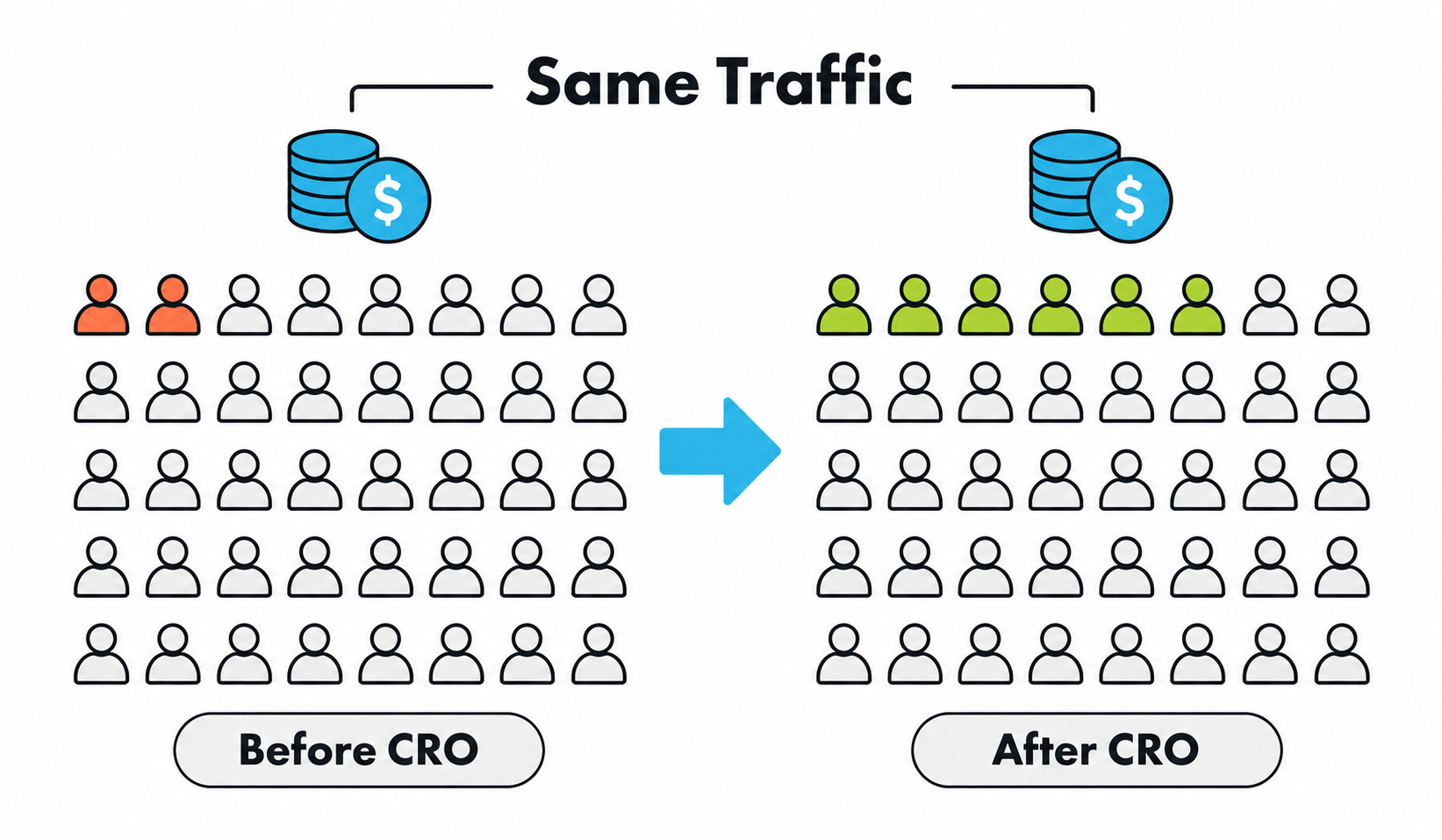
To mitigate website leaks effectively, growth teams automate with Conversion Intelligence, combining search data, website analytics, and visitor behavior to understand exactly what a user wants. Instead of generic customer journeys, this automation approach uses detailed tracking, such as heatmaps, thumb-stops, and when users abandon carts, to identify user friction for leaving a webpage. This then supports personalized content and page layouts that cater to individual customer needs, fix and identify leaks automatically, and improve overall traffic by mitigating friction.
Key Trends Shaping Conversion Optimization in 2026
Key 2026 trends include automated personalization through multi-agent AI systems. They also include real-time context routing through Contextual Bandits, such as showing a rainy-day promotion to a user browsing from a stormy city versus a clear-day offer to another. These systems learn which offer performs best for each visitor’s current situation.
Optimization also prioritizes privacy-first data collection and Core Web Vitals. The primary metrics are Interaction to Next Paint (INP), Largest Contentful Paint (LCP), and Cumulative Layout Shift (CLS).
Artificial Intelligence and Automated Personalization
Static websites that present identical content to every visitor are less competitive in personalized customer journeys.
Modern optimization can use multi-agent AI systems, with each agent handling a defined task. One agent analyzes behavioral data and identifies friction. Another draft copy or image variations. A third adjusts layouts or CSS within approved design rules. A final agent checks performance, brand standards, and risk.
Clear task separation can reduce handoff errors. Teams should still validate every output before deployment. These systems can then adjust text, images, and layouts using location, device, and prior behavior.
Mobile-First Layouts and Friction Removal
Marketers should track all three Core Web Vitals. Largest Contentful Paint measures loading performance and should occur within 2.5 seconds. Interaction to Next Paint measures responsiveness and should remain below 200 milliseconds.
Cumulative Layout Shift measures visual stability, and Google recommends a score below 0.1.
Privacy-Conscious Data Tracking
A common question growth teams face in 2026 is: How do you keep personalizing user experiences when browsers block background tracking? The answer lies in transitioning from hidden cookies to zero-party and first-party data.
Web browsers and privacy laws increasingly limit background tracking. Privacy-first CRO starts with transparency, data minimization, and secure handling. Teams should collect only the data needed for a defined purpose. They should explain how that data supports measurement or personalization.
- First-Party Data: Information a business gathers directly from visitor interactions on its own website, such as page clicks and purchases.
- Zero-Party Data: Information a customer intentionally and directly shares with a brand, including survey answers or specified product preferences.
These practices must follow applicable privacy rules. In the European Economic Area, GDPR requires lawful, fair, and transparent processing. It also emphasizes purpose limitation, data minimization, and appropriate security. Consent must be informed and specific when an organization relies on it.
The Standard Conversion Rate Optimization Process
The optimization lifecycle uses behavior analytics platforms, including Hotjar or Microsoft Clarity, to identify friction. Teams review heatmaps and session recordings. They then form hypotheses, run A/B tests, evaluate primary metrics, and repeat the cycle.
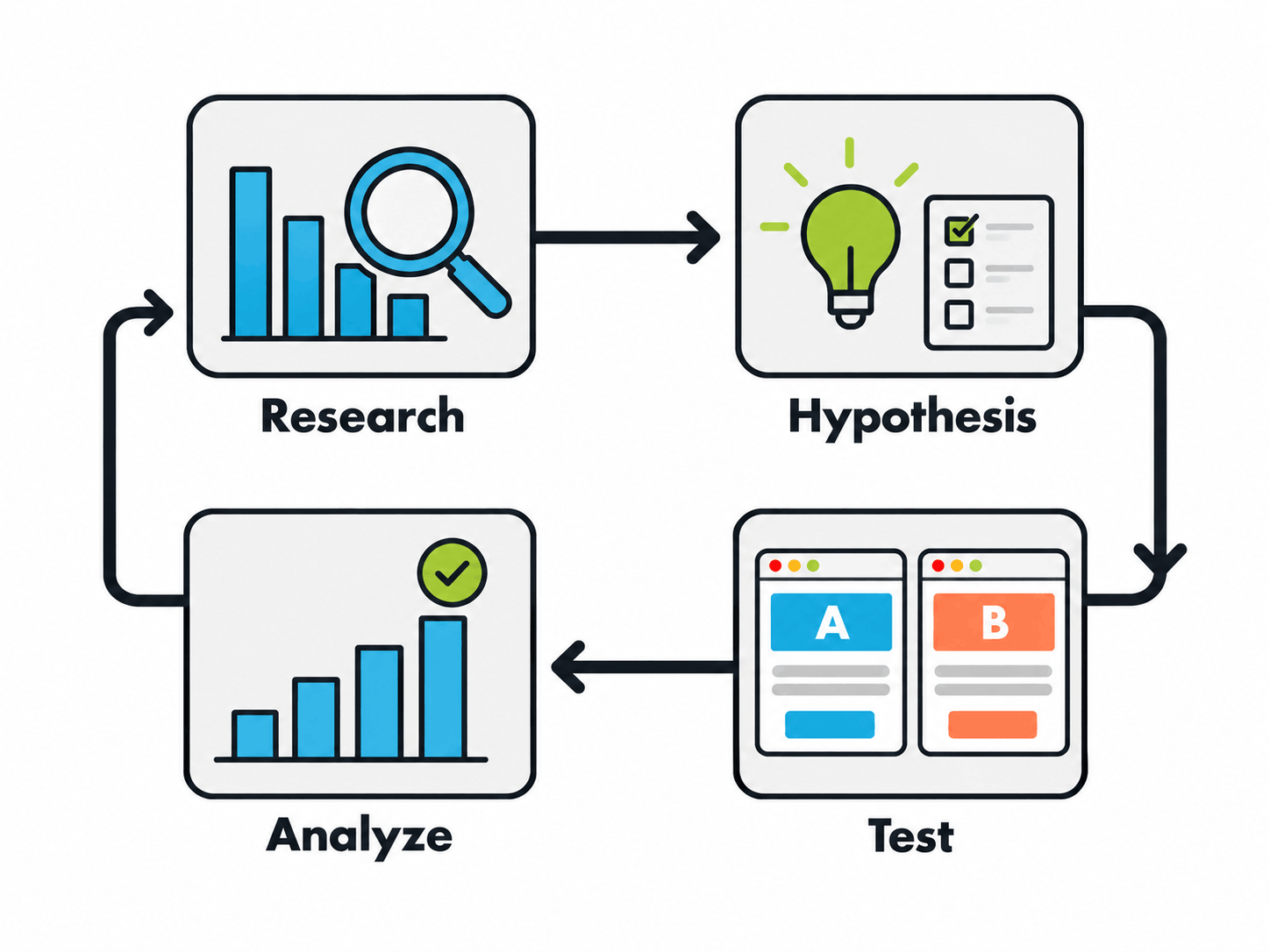
Step 1: Research and Funnel Analysis
Finding where visitors leave the sales journey is the foundation of optimization. Quantitative tools track baseline behavioral metrics like bounce rates and exit pages. Qualitative tools provide a deeper look into user frustration.
Hotjar and Microsoft Clarity provide heatmaps and session recordings. Heatmaps show where visitors click or scroll. Session recordings can reveal hesitation, layout confusion, or technical bugs.
Step 2: Creating a Testing Hypothesis
A strong hypothesis is a clear prediction grounded in gathered data. It connects a specific user problem to a layout change and a measurable metric outcome.
Growth teams prioritize test ideas by grading them based on existing evidence, the ease of building the variation, and the expected impact on the core business goal.
The primary focus always anchors on user motivation and message clarity.
Strategic analysts also utilize compliance and evaluation heuristics as primary diagnostic tools to weigh how motivation, value proposition, incentives, friction, and anxiety shape the final transaction path.
Step 3: Running A/B Tests and Experiments
A/B testing is a controlled method that shows separate versions of a page to website visitors. Version A is the original control page, while Version B acts as the challenger with one specific modification. Random traffic allocation ensures a fair comparison between the options.
Teams can run experiments with platforms such as Optimizely, VWO, or LaunchDarkly. The appropriate platform depends on whether testing is client-side, server-side, or controlled through feature flags.
Step 4: Analyzing Results and Making Changes
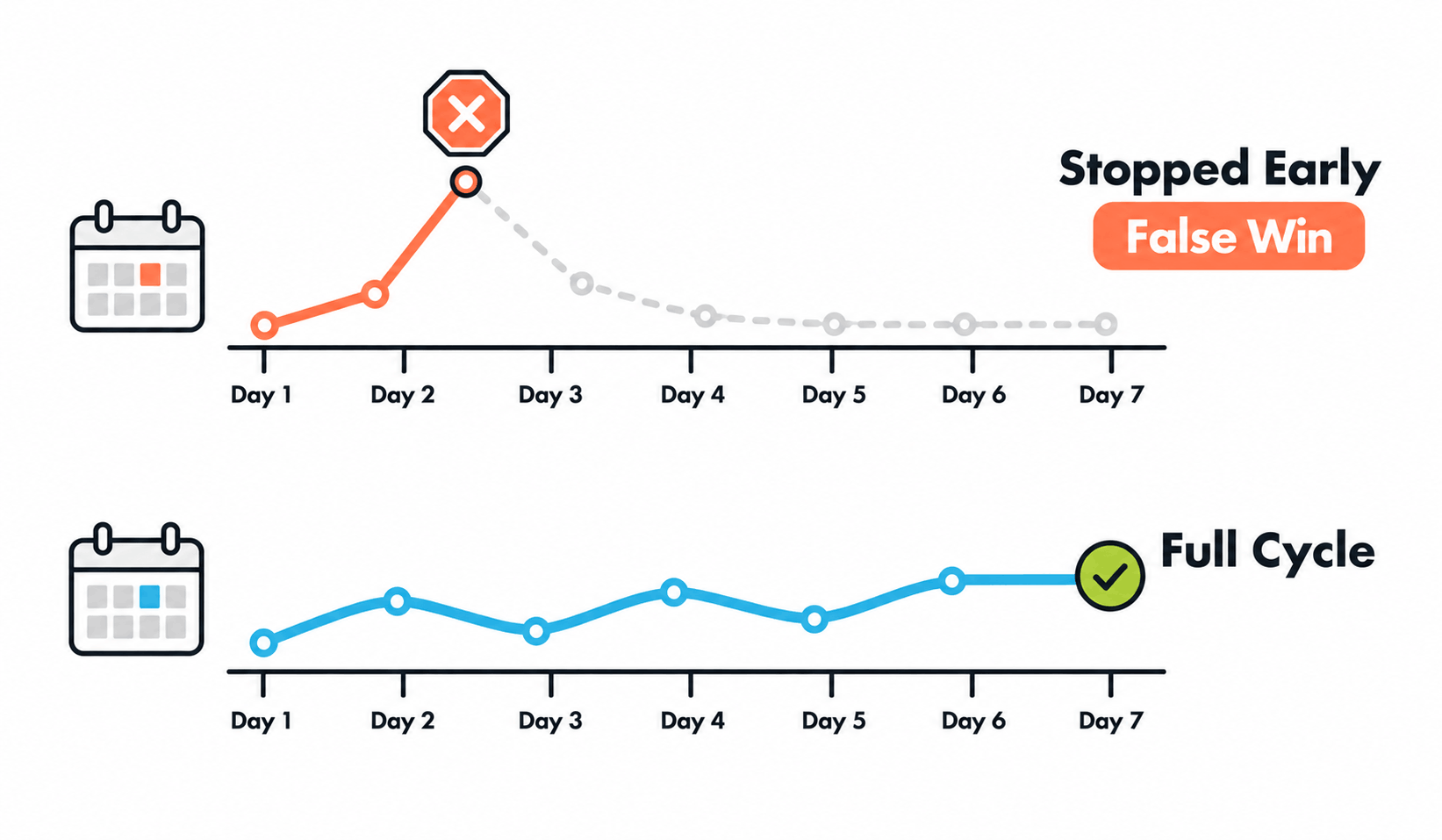
Experiments must run across full business cycles to capture both weekday and weekend consumer habits.
Platforms such as Optimizely, VWO, or LaunchDarkly help teams analyze results and manage controlled rollouts. The platform does not replace statistical judgment. Teams must predefine primary metrics, sample requirements, and stopping rules.
Crucial Website Elements to Target for Optimization
Maximizing website performance requires targeting benefit-led headings, minimal form fields with inline validation, and high-contrast call-to-action buttons. Integrating verified social proof, trust badges, and mobile-responsive layouts further removes transaction anxiety and interaction friction.
Text copy, input boxes, and action buttons require systematic evaluation to eliminate hesitation. The table below outlines the primary targets for optimization.
Clear Headings and Simple Messaging
Text messaging must be simple and easily understood within seconds. Marketers test headings focused on features against headings focused on customer benefits to see what keeps readers engaged. Replacing vague marketing copy with specific, factual details builds immediate credibility.
Short Forms and Easy Entry Fields
Long forms containing unnecessary fields often create friction. Removing non-essential input boxes has historically improved completion rates. Teams must test whether shorter forms maintain lead quality.
When extensive data collection is necessary, teams can divide the form into distinct stages. A multi-step format can make the process feel less overwhelming.
Action Buttons and Clear Commands
Generic words like "Submit" or "Register" are uninspiring and resemble paperwork. High-converting buttons utilize specific language outlining the exact benefit or value waiting on the other side of the click.
Shifting button phrasing from a standard command to first-person possession shifts the perspective so the user takes mental ownership of the benefit.
Additionally, buttons require vibrant, contrasting colors to ensure the conversion path is visually unmistakable. Loud, high-contrast choices reduce the visual search time required to find the next step.
Trust Badges and Social Proof
In an era of skepticism, websites must actively work to lower user fear. Written testimonials, video clips, and security logos directly combat transaction anxiety.
Displaying verified reviews near the decision-making area builds immediate authority. Aligning trust signals with search engine guidelines establishes authority for human readers and search crawlers alike.
True conversion rate optimization focuses entirely on uncovering user psychology and removing barriers, not forcing an unwanted action.
Common Obstacles in Conversion Optimization
Primary barriers include cluttered website designs that cause navigation confusion and distort user focus. Additionally, data peeking and prematurely halting a frequentist test before reaching target sample sizes introduce false positives and invalidate results.
Designing Overly Complicated Pages
Cluttered layouts and non-essential visual links distract website visitors. If the path to conversion is difficult to locate without navigation assistance, visitors will abandon the page. Clean designs utilizing ample blank space protect user focus.
Ending Tests Too Quickly
Stopping an experiment prematurely at the first sign of a positive trend creates false conclusions. Repeatedly checking data and halting a test before reaching the necessary sample size skews results. Growth teams must stick to strict, predefined stopping rules to ensure data integrity.
Areas of Uncertainty in Modern Conversion Optimization
Ongoing ambiguities involve the long-term predictive accuracy of autonomous artificial intelligence systems during volatile consumer shifts. Stricter data privacy regulations and browser updates create tracking limitations by blocking persistent cookies over extended user journeys.
Predictive Accuracy of Artificial Intelligence
AI can sort customer data, draft copy variations, and generate layouts. Its predictive accuracy remains uncertain during sudden cultural or market shifts. Unexpected human behavior can also weaken previously reliable patterns.
Organizations can manage this risk through a Human-in-the-Loop framework. Humans set strategy, review outputs, and approve high-impact changes. Automation handles repeatable execution within defined guardrails.
Long-Term Impact of Evolving Privacy Laws
Privacy laws and browser updates continue to limit persistent tracking. This makes long-term customer journey analysis less reliable. Teams should retest pages as technology and consent conditions change.
Organizations operating in Europe must account for GDPR requirements. They can apply the zero-party data approach through preference centers, onboarding questions, surveys, and product finders. This supports personalization without depending on hidden background tracking.
Final Thoughts
To succeed with CRO, organizations can implement the following actionable next steps:
- Growth teams can analyze user journeys with heatmaps and session recordings to pinpoint exact areas of layout confusion or technical bugs.
- Webmasters should optimize elements by shortening forms, using high-contrast buttons, and placing verified customer reviews near decision areas.
- Analysts must establish predefined stopping rules for experiments to prevent data peeking and avoid false conclusions.
- Organizations can transition toward zero-party data collection to power personalization safely under strict privacy laws.
- Strategic leaders should adopt a Human-in-the-Loop framework to manage automated AI systems during unpredictable consumer shifts.
Frequently Asked Questions (FAQs)
What is zero-party data and why is it important?
It is information customers intentionally share, such as survey answers. It allows brands to personalize web experiences legally amid strict browser tracking restrictions.
Why must A/B tests run for full business cycles?
Full cycles capture both weekday and weekend consumer habits, ensuring results represent true statistical wins rather than random anomalies.
How do organizations handle AI predictive uncertainty?
Organizations utilize a Human-in-the-Loop framework, relying on human strategic oversight to manage automated execution during volatile market shifts.
Related Content
Read These Next

B2B Conversion Rate Optimization Strategy for Complex Sales Funnels