How to Build Automated Growth Hacking Tools in 2026



Automated growth hacking is the process of building a digital machine that finds, engages, and retains customers using AI-integrated software. By connecting specialized tools into a growth stack, businesses replace manual marketing tasks with automated experiments to achieve rapid, data-driven scaling at a lower cost than traditional methods.
Key Takeaways
In 2026, growth hacking uses AI and integrated software to handle repetitive marketing tasks automatically. While traditional marketing builds brands slowly with large budgets, growth hacking uses low-cost experiments to grow fast.
- Success comes from building a modular growth stack, selecting specialized tools instead of expensive, all-in-one systems.
- Growth tools provide small teams with a competitive advantage to compete with large corporations by automating lead generation and data entry.
- High-value growth requires an AI-human hybrid approach to avoid account flagging and protect brand reputation from “AI slop.”
- AI prospecting agents are automated software systems that use live data to identify leads, find contact information, and send personalized messages.
- Success in 2026 relies on deep customer personalization rather than mass emails
- Automation requires regular upkeep, including weekly scoring audits and quarterly updates to customer profiles.
- Real-world cases show that AI-driven outreach can triple reply rates and cut sales cycles in half.
Traditional Marketing vs. Growth Hacking
While traditional marketing focuses on long-term brand building with large budgets, growth hacking uses low-cost experiments to grow fast in a short time.
The following table compares the two approaches:
The Growth Hacker’s Role
A growth hacker looks for every way to increase company sales. They work on search engine optimization, social media selling, and website design. They often specialize in data analysis or social media automation. Their job is to be proactive in finding new channels to maximize sales.
What are the Best Growth Hacking Tools for 2026?
The growth stack is a collection of software tools that work together to support business growth and automate repetitive tasks. A growth stack typically includes tools for lead generation, behavioral analytics, and workflow automation. In 2026, many businesses use a modular approach, selecting tools for specific needs rather than investing in large, expensive enterprise suites. This helps control costs and makes it easier to adapt the stack as business needs change.
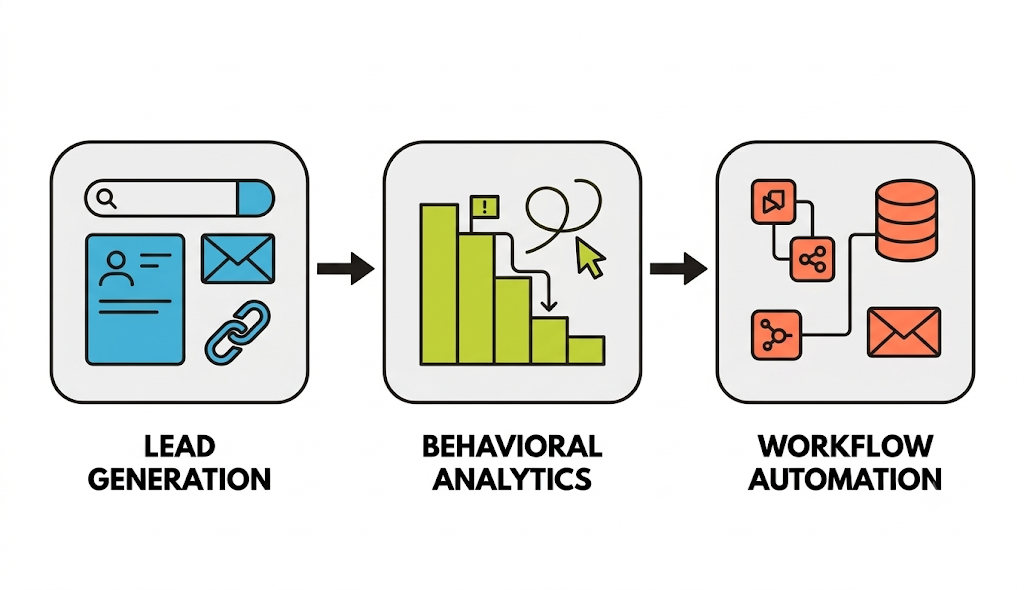
Building a growth stack removes human error and handles repetitive tasks that would otherwise take hours for employees to do manually.
I. Lead Generation: Finding New Customers Automatically
Lead generation tools act as a 24/7 digital sales team, finding prospect leads and starting conversations without manual effort.
These platforms provide the foundation for growth, but modern success requires moving beyond simple lists toward real-time lead analysis.
Pro Tip: Use intent-based autonomous research to spot leads through real signals like fresh funding or hiring spikes. Instead of using static templates, these agents scan recent social activity and company news to create highly personalized outreach. This ensures your first contact is timely, relevant, and driven by actual needs.
A study by the company Noble in 2025 shows why lead gen automation is a competitive necessity. By using Apollo’s API to generate tailored introductions, Noble achieved a 10% conversion rate. Their automated agents now process 10,000 personalized contacts monthly, allowing a small team to compete with large corporations. This shows that in 2026, tools are about using data to be more relevant. Automation allows you to have both quantity and quality
II. Consumer Behavioral Analytics: Understanding What Your Users Do
Behavioral analytics tools record how people interact with your website or app. Instead of assuming why people aren't buying, these tools show exactly the step where users quit.
What are expected Consumer Behavior shifts in 2026?
To scale effectively, growth hackers must analyze why users behave in certain ways to capture demand.
According to Salsify 2026 Consumer Research, 67% of users now research online before buying in person. Analytics must then bridge this gap between digital discovery and physical sales. Furthermore, Salesforce reports that 74% of consumers in 2026 will switch brands for better perceived value. To combat this, behavioral tools must identify early signals of losing loyalty—such as declining app logins or reduced email engagement—to trigger automated "win-back" offers before the user leaves.
Privacy and Zero-Party Data
In 2026, zero-party data, information a customer willingly and intentionally shares, is the primary driver of personalized marketing. This shift is a direct response to latest browser privacy rules like Total Cookie Protection, which make traditional tracking pixels unreliable. This is essential for customers because they are increasingly skeptical of AI and protective of their privacy. Consumers will only share data if they receive immediate utility in return.
This transition is also a regulatory necessity. Strict enforcement of frameworks like GDPR (Europe), CCPA/CPRA (USA), and the Digital Markets Act (DMA) has effectively criminalized non-consensual shadow tracking.
To maintain and activate this data at scale, growth hackers use a Customer Data Platform (CDP). This central system ensures that a user’s shared preferences instantly update your ads in real time, across the following tools:
- Conversational Chatbots: Friendly bots that gather small pieces of info over time by adjusting questions based on user responses.
- Diagnostic Quizzes: These help users solve a specific problem while giving you data.
- Gamified Communities: Online forums that offer rewards, like points or badges, to users who share their specific business challenges or ideas.
- Video Conversion Tracking: Analytics that specifically measure how fast a user moves from watching a video to checking out, allowing you to optimize for high-speed mobile commerce.
III. Workflow Automation: How To Integrate Your Tools
Workflow automation tools ensure that when one app finds a lead, the data moves instantly to your database without manual entry.
Automation has moved beyond simple "if this, then that" rules to agentic workflows. Unlike traditional automation that follows a rigid path, AI agents can reason through a goal. For example, a growth agent doesn't just send an email; it can independently browse a lead's recent LinkedIn activity, cross-reference it with their company's latest quarterly report, and determine the best time and tone for outreach. By using these autonomous loops, growth teams can execute complex research and multi-step campaigns that previously required dozens of manual hours.
What tools should I prioritize and how do I maintain consistent growth?
Growth hacking is about speed, but long-term success requires maintaining your systems. In 2026, the priority is ensuring automated tools do not break as you get more data. A machine that finds thousands of leads is useless if your team cannot manage the follow-up or if the software costs too much.
How to set growth priorities
In 2026, you cannot automate every task at once. Setting priorities ensures you focus on what actually drives revenue. With digital acquisition costs surging 222% since 2021, smart growth hackers now prioritize high-retention workflows and Human-in-the-loop systems to ensure AI-driven outreach stays personal and maintains a high brand reputation.
- Focus on the Bowtie Funnel to reach a 120% Net Revenue Retention (NRR) target. Since repeat customers spend 67% more than new leads, you should prioritize automated triggers that encourage post-purchase expansion rather than just the initial checkout.
- Use Human-in-the-loop (HITL) workflows for high-value enterprise leads to ensure AI-generated outreach doesn't damage your reputation. This hybrid approach allows you to use automation for volume while keeping humans in charge of complex, high-stakes communication.
- Audit your growth stack every six months to remove overlapping tools. If a piece of software costs more than the profit it generates or performs the same job as another tool, it should be removed to keep your system efficient.
- Target "leaks" in your sales funnel by using analytics to find the exact step where most users quit. Fixing these bottlenecks is a higher priority than spending money on new leads because it improves the ROI of all your existing traffic.
IV. The Risk of Over-Automation
Over-automation can put business accounts at risk in 2026. Platforms may flag activity that appears bot-driven, such as sending messages too quickly or using repetitive templates. This can lead to reduced profile visibility or emails being filtered as spam. Using appropriate sending limits, relevant personalization, and human review can help reduce these risks.
Human-in-the-loop (HITL) workflows combine AI automation with human oversight, particularly for high-value leads. AI can handle large volumes of prospect data and prepare outreach messages, while a person reviews the content before it is sent.
This review helps maintain the brand’s voice, catch generic or inaccurate messaging, and address complex situations that require human judgment. Rather than relying on automation alone, teams can use HITL workflows to balance efficiency with relevant, thoughtful communication.
AI-powered prospecting is one application of this approach. It helps businesses research potential customers, identify relevant signals, and prioritize leads while retaining human oversight over important outreach decisions.
How AI-Powered Prospecting Agents Automate Growth Hacking
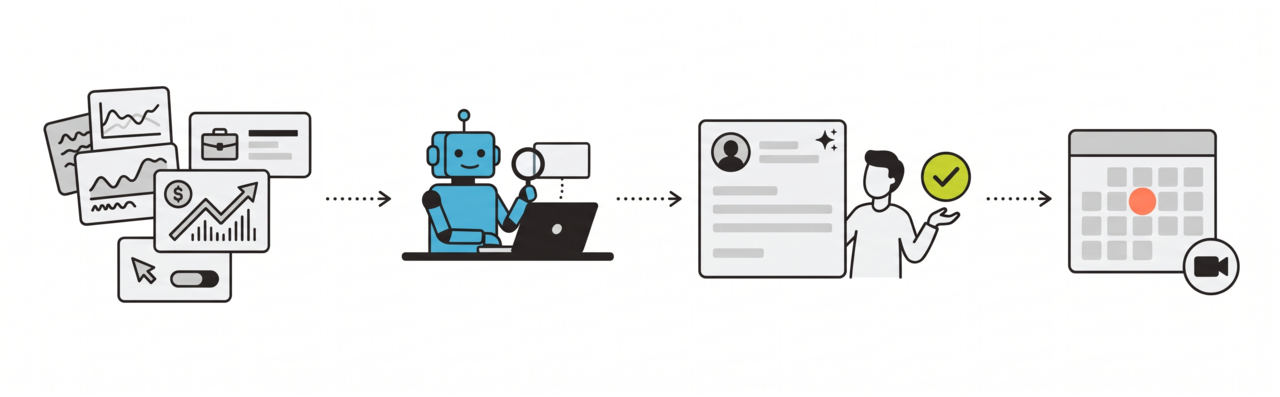
In 2026, building an automated growth hacking tool requires an AI-powered prospecting agent. An AI-powered prospecting agent is an autonomous software system that uses real-time intent signals, such as hiring trends, financial filings, and behavioral data, to automate the sales cycle.
By integrating LLMs with a modular growth stack, these agents perform deep lead research, generate hyper-personalized outreach, and manage multi-channel routing, often tripling reply rates while reducing sales cycles by 50%.
AI-powered prospecting agents take growth hacking automation a step further by connecting lead generation, customer data, and outreach workflows. Instead of relying only on predefined rules, these agents can analyze real-time intent signals, research potential customers, and prepare personalized messages based on their findings.
Understanding Intent Signals in 2026
An intent signal is a digital clue that shows a company is ready to buy a product. These signals are more advanced than just website visits. They include:
- Buying Signals: New contracts signed or specific software being installed.
- Hiring Trends: A company hiring for a new role that requires your specific solution.
- Behavioral Data: A prospect visiting your pricing page or attending a specific webinar.
AI-Powered vs. Manual Prospecting Agents
Manual prospecting is slow because humans must find leads and write emails one by one. AI agents replace these repetitive tasks with workflows that can run 24 hours a day with higher accuracy and much less effort.
Efficiency and Speed
In a manual setup, a salesperson might take minutes to research one lead. An AI agent can research thousands of leads in seconds utilizing databases. This speed is critical in 2026 to prevent a lead from losing interest or going to a faster competitor.
While AI can work around the clock, users must manage API rate limits (the speed at which software talks to other tools) and anti-spam detection on platforms like LinkedIn. Ignoring these limits can result in blocked accounts.
Real-World Case Studies of Growth Hacking Tools
Growth hacking tools help companies scale by using automation to reach thousands of leads every month. These case studies show how different businesses used AI to increase their sales meetings and reduce the time it takes to close deals.
- Noble: Scaling Content Outreach
Noble in 2025 saw a 10% conversion rate to sale after the company used growth hacking tools to find decision-makers at target publications by connecting an AI to the Apollo API. The AI agents analyzed articles to create custom email introductions and handled 10,000 contacts monthly, tripling their reply rates versus manual efforts.
- Sandler: Reducing the Sales Cycle
Sandler increased sales-qualified leads by 4x and caused click-through rates to rise by 25% after focusing on personalizing marketing content to match the industry and pain points of their prospects using HubSpot Breeze. AI sent case studies to hesitant buyers, cutting the sales cycle from 90 days to 45 days.
- Atera: Eliminating Knowledge Bottlenecks
Atera in 2025 reduced response time by up to 60% after implementing sales agents to help employees find information quickly across different time zones using Unleash AI. The system utilized existing data to give role-specific answers to staff and prospects.
- Apidae: High-Conversion Multi-Channel Outreach
Apidae combined email and LinkedIn messages with custom icebreakers for highly targeted companies, leading to a 40% conversion rate.
- Fastweb + Vodafone: Rapid Escalation for Customer Success
Fastweb + Vodafone in 2025 reached a 90% correctness rate, an 82% resolution rate, and a Customer Effort Score of 5.2 out of 7 with their consumer-facing AI system on LangChain. They used automation to filter inputs and route them to specialized Use Case agents that execute API calls for actions like offer activations or payments directly in the chat
- TMNZ: Increased Monthly Productivity
Tax Management New Zealand (TMNZ) achieved 400 hours of productivity gains per month through automation. They used a self-hosted n8n enterprise to ensure strict privacy and control for tax compliance, integrating the model with a growth stack that eased workflows for tasks like invoice processing, data enrichment, and market research.
Growth hacking tools should be used to bridge the gap between high-volume outreach and specific needs. By automating the research and the first contact, companies can focus their human energy on closing deals rather than finding them.
How to Build Automated Prospecting Agents in 2026
Building these tools requires a step-by-step process to turn customer data into automated actions. First, define your target customer. Then, program the AI to identify signals that show a lead is ready to talk.
Step 1: Model the Ideal Customer Profile (ICP)
Turn customer traits into data points like company size, industry, and software used. This includes:
- Company size, location, and industry.
- The software and tools the company already uses.
- Actions like visiting your pricing page or hiring for a specific role.
Step 2: Centralize Intent Data
Create a single list that collects signals, including from your website, webinar attendees, and new job postings at target companies. Standardizing this data allows the growth hacking tools to read it consistently and trigger actions.
Step 3: Automate Research
Program the AI model to build a file for every account, searching through public websites and internal CRM data. This ensures the outreach is based on data-driven insights
Step 4: Generate Contextual Messaging
Have the AI model draft short personalization hooks that connect research facts to the specific business outcome your company can provide. This makes the lead feel like you understand their specific situation.
Step 5: Personalize Routing and Channel Selection
Let the AI identify the best channel, such as email or LinkedIn, based on the intent of leads, then implement the channel according to what worked best for similar people in the past.
How to Maintain Growth Hacking Tools for Continued Success
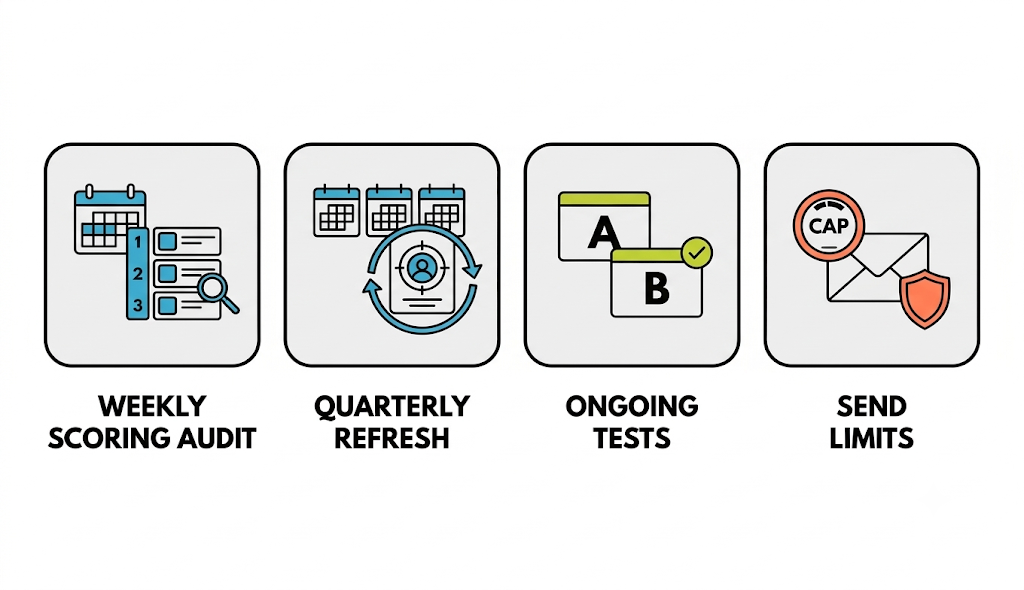
Automation is not a task you finish once. It requires regular updates to stay effective. Regular data quality checks and targeting updates are essential to match market changes, preventing AI models from sending irrelevant messaging.
- Refresh Models Quarterly
Review which customers actually bought your product and update your targeting rules. - Audit Lead Scoring Weekly
Check the leads the AI ranks highly to ensure they are actually good prospects, keeping your data clean and your sales team focused on the right people. - Continuous A/B Testing
Use the AI model to test different message versions for small groups of leads and automatically use the top performers. - Enforce Governance and Compliance
Keep your accounts healthy by setting limits on automation:- Limit daily emails to prevent being marked as spam.
- Ensure you do not contact the same person too many times in a month.
- Regularly check automated messages to ensure they continue to align with the brand.
For instance, effective January 1, 2026, new CCPA regulations require businesses to provide "pre-use notices" for Automated Decision-Making Technology (ADMT) and offer a visible right to opt out of automated profiling.
Final Thoughts
Building automated growth hacking tools is no longer optional for businesses that want to scale in 2026. By shifting from manual research to AI-powered agents, you can reach more prospects with higher accuracy while spending less effort. The most successful companies use these tools to bridge the gap between high-volume outreach and the specific, personal needs of every individual lead.
Next Steps:
- Define your ICP: List the specific company sizes, industries, and software types that make someone a perfect customer.
- Centralize your data: Create an intent ledger to collect lead signals from your website and social media in one place.
- Start small: Pick one channel, like email, and use AI to write personalized sentences for your top leads.
Frequently Asked Questions (FAQs)
What exactly is an AI prospecting agent?
It is a software tool that automates the sales process. It scans the internet for "buying signals," such as a company hiring for a new role, and automatically contacts the right person with a custom message.
How often do I need to update my automation settings?
You should check your data quality every week. Every three months, you must review who is actually buying your product and update your targeting rules to match those successful patterns.
Do I still need a sales team if I use automated growth hacking tools?
Yes. Automated growth hacking tools handle the boring parts like research and first contact. This allows your human team to focus their energy on the most important part: closing the actual deals.
How do businesses avoid being banned for using automation?
To avoid shadowbanning, companies use Human-in-the-Loop (HITL) workflows where a person reviews AI-generated content before it is sent, ensuring the timing and tone appear authentic rather than bot-like.
Read These Next
Mobile Conversion Rate Optimization: 7 Tactics to Fix the Mobile Funnel Gap