.png)
.png)
%20(1).png)
Benefits of Programmatic Advertising: 5 Reasons Your Brand Needs Programmatic in 2026
.png)

.png)

Programmatic advertising is essential in 2026 to manage media fragmentation across CTV, Retail Media, and mobile. It provides five key benefits: automated cross-channel scaling, AI-driven targeting precision using first-party data, real-time bid optimization, unified cross-channel measurement, and reduced operational overhead by centralizing fragmented buying workflows into a single DSP.
Introduction
Programmatic advertising has shifted from a specialized media-buying method into the default operating model for digital advertising. Most display, video, connected TV (CTV), and increasingly retail media inventory now transact through automated auctions managed by algorithms rather than manual negotiations.
This shift matters because the advertising environment has become more fragmented and less observable at the same time. Consumer attention is spread across devices, streaming platforms, apps, retail ecosystems, and publisher networks. Meanwhile, third-party cookie deprecation, modeled attribution (the practice of estimating conversion credit using statistical inference when direct tracking data is unavailable), and privacy-first tracking frameworks have reduced visibility into how users move across channels before converting.
Programmatic systems help manage that complexity by automating bidding, audience selection, budget allocation, and optimization decisions in real time. According to industry projections from StackAdapt and other market research firms, global programmatic advertising spend is expected to continue growing through 2026 as advertisers prioritize measurable performance and scalable cross-channel buying.
The practical question for decision-makers is no longer whether programmatic matters. The more relevant question is what operational advantages it creates compared to traditional media buying and where those advantages break down in real-world conditions.
What This Guide Covers
This guide explains the operational and commercial advantages of programmatic advertising in modern digital media environments.
It covers:
- Why programmatic buying scales more efficiently than manual buying
- How programmatic improves targeting and audience precision
- Why automation changes campaign optimization speed
- How measurement and attribution improve through centralized buying
- Where programmatic creates operational efficiency for internal teams
- What limitations still affect programmatic performance
- How to evaluate whether programmatic is commercially viable for your business
1. Programmatic Advertising Scales Faster Across Channels
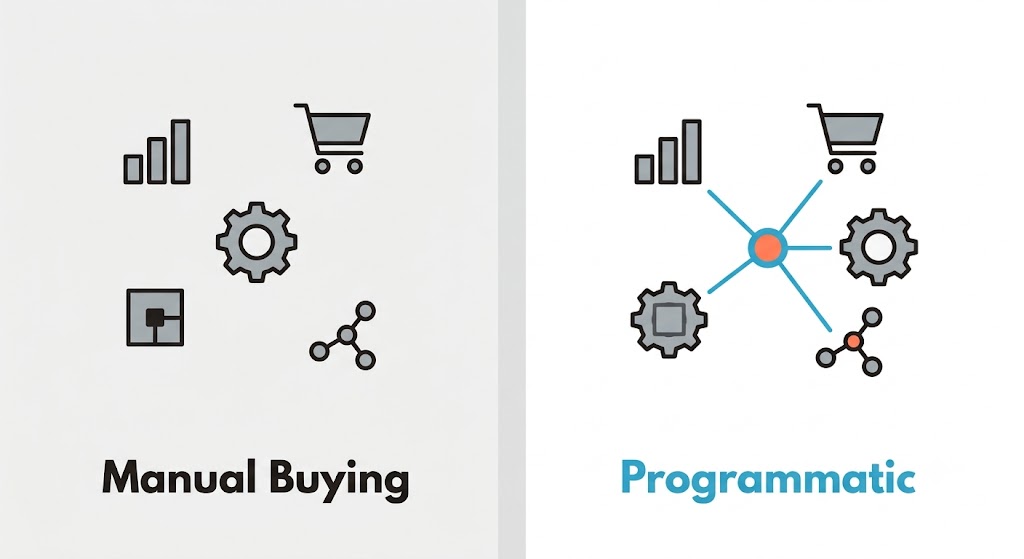
Programmatic advertising scales efficiently because inventory access, bidding, targeting, and reporting operate through interconnected systems rather than manual transactions with individual publishers.
Traditional media buying requires separate negotiations, insertion orders, trafficking workflows, and reporting structures for each publisher or platform. Programmatic consolidates those functions inside a Demand-Side Platform (DSP) — such as The Trade Desk or Google's Display & Video 360 (DV360) — allowing campaigns to access inventory across thousands of websites, apps, streaming services, and exchanges simultaneously.
The efficiency advantage becomes more significant as channel fragmentation increases. A campaign running across display, video, connected TV, retail media, and mobile inventory manually would require multiple operational workflows and inconsistent reporting environments. Programmatic centralizes those systems into a single buying structure.
This matters operationally because optimization depends on how traffic, tracking, conversion data, and budget allocation interact together. A strong-performing audience segment identified in display inventory can influence bidding decisions in connected TV or retargeting campaigns. Budget shifts happen dynamically based on observed conversion probability rather than scheduled manual adjustments.
In our observation, operational efficiency is one of the most underestimated advantages of programmatic for SMEs and mid-market businesses. Teams frequently focus on CPM efficiency while overlooking the labor cost and reporting fragmentation created by managing disconnected buying environments manually.
Benchmark context: mid-market advertisers commonly reduce campaign management time by 20% to 40% after consolidating fragmented display and video buying into centralized programmatic workflows. The operational savings vary depending on campaign complexity, reporting requirements, and the number of active channels.
2. Programmatic Improves Targeting Precision
Programmatic improves targeting by combining audience signals, contextual data, behavioral patterns, and first-party data into real-time bidding decisions.
Traditional display buying targets placements. Programmatic targets users and environments simultaneously. The system evaluates whether an impression matches audience criteria, contextual relevance, conversion probability, and budget parameters before deciding whether to bid.
This creates significantly more precision than fixed publisher buys, particularly in fragmented media environments where audiences move across devices and channels continuously throughout the day.
The strongest targeting performance increasingly comes from first-party audience data integrated with CRM systems, customer lists, purchase behavior, and server-side tracking infrastructure. Third-party audience segments still exist, but their reliability has weakened as privacy restrictions reduce cross-site tracking visibility.
The targeting system itself is interconnected. Audience quality affects conversion rates. Conversion rates affect bidding efficiency. Bidding efficiency affects inventory access. Weak data in one layer reduces efficiency across the entire campaign structure.
Programmatic targeting commonly combines:
- First-party CRM audiences
- Contextual targeting
- Retargeting pools
- Geographic targeting
- Device targeting
- Daypart targeting (controlling delivery during specific times of day or days of the week when engagement or conversion likelihood is highest)
- Lookalike modeling
- Retail purchase signals
Privacy changes have also shifted how targeting works operationally. Google Privacy Sandbox's Topics API — which assigns users to broad interest categories without exposing individual browsing history — represents one of the primary cookieless targeting frameworks being tested and deployed in 2026. Alongside Privacy Sandbox, Universal IDs such as Unified ID 2.0 (UID2) provide an alternative identity layer based on hashed and encrypted email addresses that persist across publishers without relying on third-party cookies. Attention metrics — which measure active viewing time, scroll depth, and interaction signals rather than proxy metrics like impressions or clicks — are also gaining adoption in 2026 as a more reliable proxy for ad effectiveness in environments where traditional tracking is constrained.
These developments mean platforms increasingly rely on probabilistic signals rather than deterministic tracking. This makes clean first-party data infrastructure more valuable than broad third-party audience expansion.
Case data suggests that advertisers using recent, behaviorally relevant first-party audiences frequently outperform campaigns relying primarily on third-party audience overlays, although results still depend heavily on audience volume, purchase frequency, and tracking quality.
3. Programmatic Optimizes Campaigns in Real Time
Programmatic systems optimize campaigns continuously rather than periodically.
Manual campaign management typically works through scheduled adjustments. Media buyers review reports, identify performance trends, adjust bids, update placements, and redistribute budgets manually. Programmatic systems automate those decisions impression by impression in real time through signal-based bidding — a process where the DSP evaluates dozens of real-time signals simultaneously to determine bid price and delivery priority for each impression opportunity.
This speed matters because digital advertising environments fluctuate continuously. Audience behavior, inventory pricing, competitor bidding pressure, creative fatigue, and conversion probability can shift hourly.
AI-driven bidding systems on platforms such as The Trade Desk and DV360 evaluate:
- Device type
- Time of day
- User behavior
- Contextual relevance
- Historical conversion signals
- Inventory quality
- Geographic signals
- Frequency exposure
The algorithm uses those signals to determine whether an impression is worth bidding on and how aggressively budget should be allocated.
This does not mean automation performs perfectly in all conditions. Optimization quality depends entirely on signal quality and conversion tracking accuracy. Campaigns with incomplete tracking, low conversion volume, or unstable attribution environments often produce inconsistent optimization outcomes because the algorithm lacks reliable feedback loops.
In practical terms, automation performs best when:
- Conversion tracking is stable
- The campaign generates enough conversion volume for learning
- Creative assets are refreshed regularly
- Audience signals remain current
- Measurement infrastructure is reliable
Very low-volume B2B campaigns and niche regional campaigns can still perform better with tighter manual oversight because the algorithm may not receive enough conversion data to optimize safely.
Benchmark context: performance campaigns typically require at least 30 to 50 conversion events weekly per optimization event for algorithmic bidding systems to stabilize effectively.
4. Programmatic Creates Better Cross-Channel Measurement
Programmatic centralizes reporting and performance data across fragmented inventory environments.
Without centralized buying infrastructure, advertisers frequently operate across disconnected reporting systems with inconsistent attribution logic. Search, display, video, retail media, and connected TV platforms all measure conversions differently.
Programmatic platforms create a more unified measurement environment by consolidating impression delivery, audience exposure, frequency data, and conversion tracking into shared reporting systems.
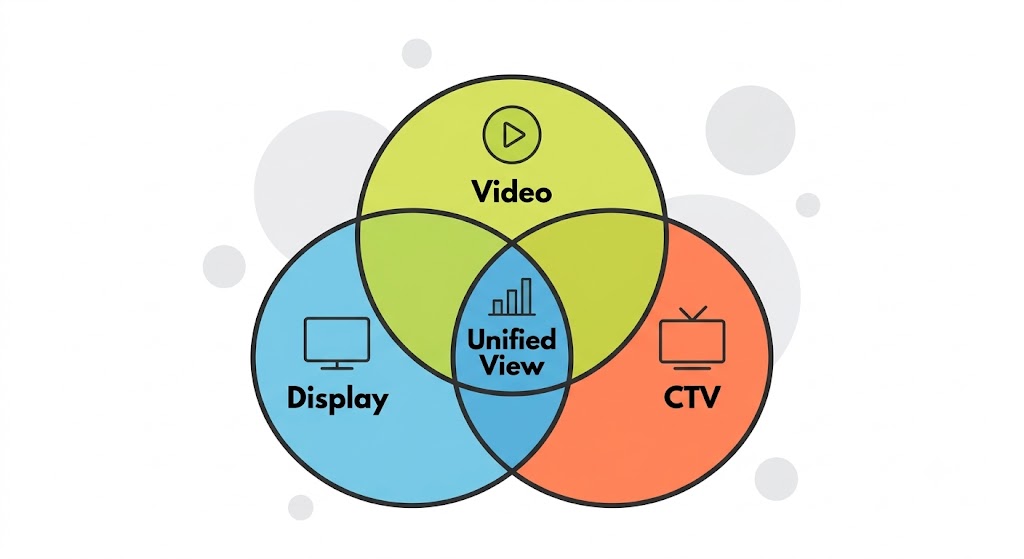
This improves visibility into:
- Cross-channel frequency exposure
- Audience overlap
- Conversion pathways
- Assisted conversions
- View-through activity
- Placement-level performance
- Incremental reach
The value is not perfect attribution accuracy. Perfect attribution no longer exists consistently in privacy-constrained environments.
Instead, programmatic improves directional decision-making by giving advertisers broader visibility into how channels influence each other operationally.
For example, connected TV campaigns may not generate direct last-click conversions efficiently, but they often improve branded search volume, retargeting performance, and lower-funnel conversion efficiency. Without integrated reporting environments, those relationships are difficult to observe.
Privacy regulations including GDPR, CPRA, the Virginia Consumer Data Protection Act (VCDPA), the EU Digital Markets Act (DMA), Australia's Privacy Act, and evolving APAC privacy frameworks have also accelerated the shift toward modeled attribution and server-side tracking infrastructure.
In our recent campaign audits, one of the most common reporting failures is over-reliance on platform-reported Return on Ad Spend (ROAS) without validating performance against CRM revenue, incrementality testing, or blended acquisition cost.
Programmatic measurement works best when:
- CRM systems integrate with campaign data
- Offline conversion events are imported consistently
- First-party identifiers remain clean
- Conversion definitions align across platforms
- Attribution windows are standardized
5. Programmatic Reduces Operational Complexity
Programmatic reduces operational friction created by fragmented buying environments.
The operational advantage is not only automation. It is centralization.
Campaign setup, reporting, targeting, budget management, creative rotation, and inventory access operate through fewer systems. Internal teams spend less time managing trafficking workflows and more time evaluating commercial performance.
This becomes increasingly important for organizations operating across multiple regions, brands, or business units where reporting consistency and governance matter operationally.
Programmatic also improves scalability for lean internal teams. SMEs and mid-market businesses frequently lack the operational capacity required to manage direct publisher relationships across dozens of fragmented media environments manually.
The practical operational improvements commonly include:
- Faster reporting consolidation
- Reduced manual trafficking
- Unified audience management
- Cross-channel budget visibility
- Centralized brand safety controls
- Faster creative testing cycles
Brand safety systems, fraud prevention tools, and inventory verification infrastructure also operate more efficiently inside centralized programmatic environments.
Third-party verification providers such as IAS, DoubleVerify, and Oracle Moat help advertisers reduce invalid traffic exposure, improve viewability standards, and identify made-for-advertising (MFA) inventory that inflates impression volume without meaningful engagement.
Commonly observed in the Australian market, low-cost open exchange inventory frequently produces inflated reach metrics but weak downstream commercial performance when verification standards are not actively maintained.
Programmatic automation improves efficiency, but it also increases the impact of mistakes. A misconfigured conversion event, an outdated audience segment, or an unchecked frequency cap can scale across campaigns before anyone notices — issues that manual buying may have caught sooner. Automation reduces repetitive work, but it makes accurate setup and monitoring far more important.
What Limitations Still Affect Programmatic Advertising?
Signal loss remains one of the largest operational constraints. Privacy Sandbox frameworks, third-party cookie deprecation, iOS tracking restrictions, and fragmented device usage reduce visibility into user journeys across websites, apps, and devices.
This creates attribution gaps where platforms rely increasingly on modeled attribution rather than directly observable behavior. Cookieless solutions — including Universal IDs such as Unified ID 2.0, the Privacy Sandbox Topics API, and attention metrics — partially address the signal gap but introduce their own coverage limitations and require publisher and DSP adoption before they function reliably at scale.
Programmatic systems also inherit platform bias. DSPs, ad exchanges, and major advertising platforms — including The Trade Desk, DV360, and major Supply-Side Platforms (SSPs) — all benefit financially when advertisers spend more budget inside their ecosystems. Platform-reported attribution frequently overstates performance, particularly for view-through conversions and retargeting campaigns.
Inventory quality remains inconsistent as well. Open exchange inventory includes premium publishers, low-quality MFA sites, fraudulent traffic environments, and weak-viewability placements simultaneously.
Programmatic performance also depends heavily on:
- Conversion tracking accuracy
- Creative quality
- Audience freshness
- Frequency management
- Measurement consistency
- First-party data quality
Weakness in one area affects the entire system.
A campaign with excellent targeting but weak creative frequently underperforms. Strong creative with inaccurate conversion tracking creates misleading optimization signals. High-performing audiences eventually saturate if the frequency of exposure is unmanaged.
Performance is interconnected operationally. Programmatic systems optimize inputs they can observe. If the inputs are incomplete or misleading, the optimization output becomes unstable.
How Should Businesses Evaluate Whether Programmatic Is Worth It?
Programmatic becomes commercially viable when scale, data quality, and measurement infrastructure justify automation complexity.
For many SMEs and mid-market brands, the strongest starting point is not broad prospecting. Retargeting and first-party audience activation usually produce more stable early performance because the audience already demonstrates behavioral intent.
Good performance depends on context rather than universal benchmarks.
A healthy programmatic campaign often looks like:
- Stable or improving CPA relative to customer value
- Consistent conversion volume
- Controlled frequency exposure
- Incremental lift across channels
- Reliable tracking infrastructure
- Sustainable blended acquisition cost
Decision-making should remain operationally grounded.
Scale campaigns when:
- Conversion tracking is reliable
- Frequency remains efficient
- CPA stays commercially sustainable
- Incremental volume continues improving
Pause or restructure campaigns when:
- Frequency rises without conversion growth
- Attribution becomes inconsistent
- Audience saturation appears
- CPA increases beyond sustainable margin thresholds
- Conversion quality deteriorates
The objective is not maximizing platform metrics. The objective is sustainable commercial performance across the full acquisition system.
Conclusion
Programmatic advertising has become the operational infrastructure behind modern digital media buying. Its advantages come from how inventory access, targeting, optimization, measurement, and reporting work together as interconnected systems rather than isolated campaign settings.
The technology improves scale, speed, and efficiency, but performance still depends on signal quality, tracking accuracy, creative relevance, and commercial discipline. Businesses that treat programmatic as a measurable operating system rather than a standalone channel generally produce more stable long-term performance across fragmented digital environments.
FAQs
What is the main benefit of programmatic advertising?
The primary advantage is operational efficiency at scale. Programmatic automates inventory buying, targeting, bidding, and optimization across fragmented digital channels while improving measurement visibility and audience precision.
Does programmatic advertising work for SMEs?
Yes. SMEs often benefit most from retargeting, first-party audience activation, and localized targeting before scaling broader prospecting campaigns.
Is programmatic advertising only for display ads?
No. Programmatic now includes display, video, connected TV, audio, retail media, mobile apps, and digital out-of-home inventory.
How much budget is needed for programmatic advertising?
Minimum effective budgets vary by market and objective, but performance-focused campaigns generally require enough conversion volume for algorithmic optimization. Many SMEs begin with monthly budgets between $3,000 and $10,000 before scaling.
Does programmatic advertising still work without third-party cookies?
Yes, but targeting and attribution increasingly rely on first-party data, contextual targeting, Universal IDs such as Unified ID 2.0, Privacy Sandbox Topics API, modeled conversions, and server-side tracking infrastructure rather than traditional cross-site tracking.
What causes programmatic campaigns to fail?
The most common causes are weak conversion tracking, poor creative quality, low-quality inventory, audience saturation, inaccurate attribution, and insufficient conversion data for optimization systems to learn effectively.
Related Content
Read These Next
B2C Marketing Automation: 7 Retail Workflows That Drive Immediate Impulse Sales