.png)
Landing Page Optimization Checklist: 11 Proven Ways to Increase Conversions
.png)

.png)

Landing Page Optimization (LPO) is the AI-driven process of aligning webpage elements with real-time user intent. It leverages Conversion Intelligence—the use of AI and historical data to predict and automate user actions—to increase ROI. By integrating technical speed ($LCP < 2.5s$) with Dynamic Text Replacement, LPO satisfies both search algorithms and transactional goals.
Key Takeaways
- Landing pages are shifting from static designs to AI-driven systems that respond to user behavior in real time
- Dynamic Text Replacement (DTR) helps match headlines to user intent
- Simplifying forms and improving CTA wording can significantly increase conversions
- Pages that load within 2.5 seconds often perform better (Google Core Web Vitals benchmark)
- Fast CRM syncing helps prevent leads from going cold
Article Overview
This article outlines an 11-point checklist for optimizing landing pages in 2026. It explains how AI, data, and automation work together to improve performance.
By focusing on speed, relevance, and real-time systems, businesses can improve lead generation and return on investment.
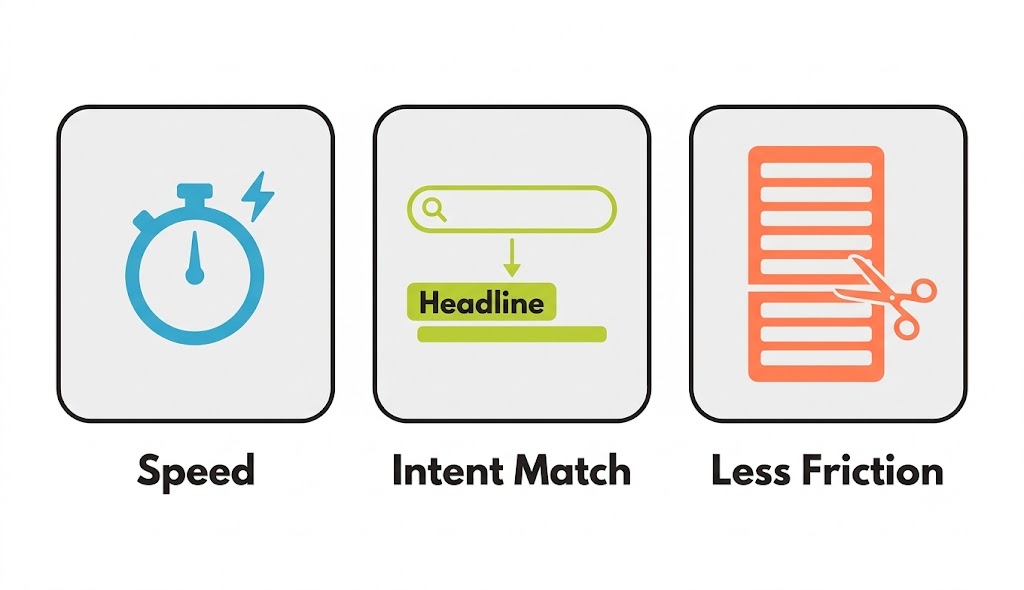
Quick Start: The 3 Highest-Impact Landing Page Fixes for 2026
If you are short on time, focus on these three areas that most affect conversion rate (the percentage of visitors who take action): page speed, intent matching, and friction reduction.
These directly determine whether users stay, engage, and convert.
1. Improve Page Speed (Speed = Trust)
In 2026, page loading speed directly determines whether users stay or leave.
Two key performance metrics to understand:
- Largest Contentful Paint (LCP): how quickly the main content (like a headline or image) appears on screen. This is the user's first impression of "The page is ready."
- Interaction to Next Paint (INP): how quickly the page responds when a user clicks, taps, or types. This is the user's impression of "The page works." High INP (laggy buttons) is the fastest way to lose trust in 2026.
If these are slow, users perceive your site as unreliable.
What to do:
- Compress images and reduce heavy scripts
- Use fast hosting or a content delivery network (CDN)
- Test your page using tools like Google PageSpeed Insights
2. Fix Intent Mismatch (The #1 Conversion Killer)
Landing pages often fail due to intent mismatch, when content doesn’t match user expectations.
For example:
- User searches for “free marketing template”
- Page asks them to book a sales call
Even if the design is good, the user will leave. This is why search intent (what the user wants) must align across your entire funnel.
What to do:
- Match your headline to your ad or search keyword
- Keep messaging consistent from click → landing page
- Focus on solving the exact problem the user came for
3. Reduce Friction in Forms and User Experience
Friction refers to anything that makes it harder for users to complete an action.
Common examples include:
- Long or complicated forms
- Slow-loading inputs
- Buttons that are hard to tap on mobile
- Pages that shift or “jump” while loading
These small issues add up and cause users to abandon the process.
In technical terms, issues such as Cumulative Layout Shift (CLS) (when elements move unexpectedly on the page) can undermine user trust and reduce completion rates.
What to do:
- Reduce forms to only essential fields
- Enable autofill and clear error messages
- Make buttons large and easy to tap on mobile
- Keep layouts stable while the page loads
What This Fix Achieves
By focusing on these three areas, you address the biggest conversion drivers:
- Relevance → users feel they’re in the right place
- Usability → users can complete actions easily
- Trust → users feel confident enough to convert
These improvements often deliver results faster than more advanced tactics like A/B testing or AI personalization.
Landing Page Optimization Checklist for 2026
This 11-point checklist covers technical speed, content relevance, and automated backend processes. Each step includes real-world applications to demonstrate how specific changes to a landing page can lead to measurable increases in sign-ups and sales.
1. Ensure Dynamic Intent Matching (Headlines)
Headline mismatch is one of the fastest ways to waste paid traffic, yet it remains one of the most common CRO mistakes. Dynamic Text Replacement (DTR) automatically matches page wording to user search terms, creating immediate relevance.
Case Study: Digital agency ConversionLab used DTR for the company Campaign Monitor. They changed specific verbs like design or create to match what the user typed into Google. This test led to a 31.4% increase in trial signups over 77 days.
2. Optimize CTA Micro-Copy for Value and Ownership
Call to Action (CTA) buttons should avoid generic words (e.g., submit, send, etc.) These words create friction because they suggest work rather than a benefit. Button text should clearly state the value users receive.
Case Study: The travel brand Going in 2025 changed its button copy from "Sign up for free" to "Trial for free". This small change led to a 104% month-over-month increase in trial starts. It also helped their paid advertising channels convert better than their organic channels for the first time.
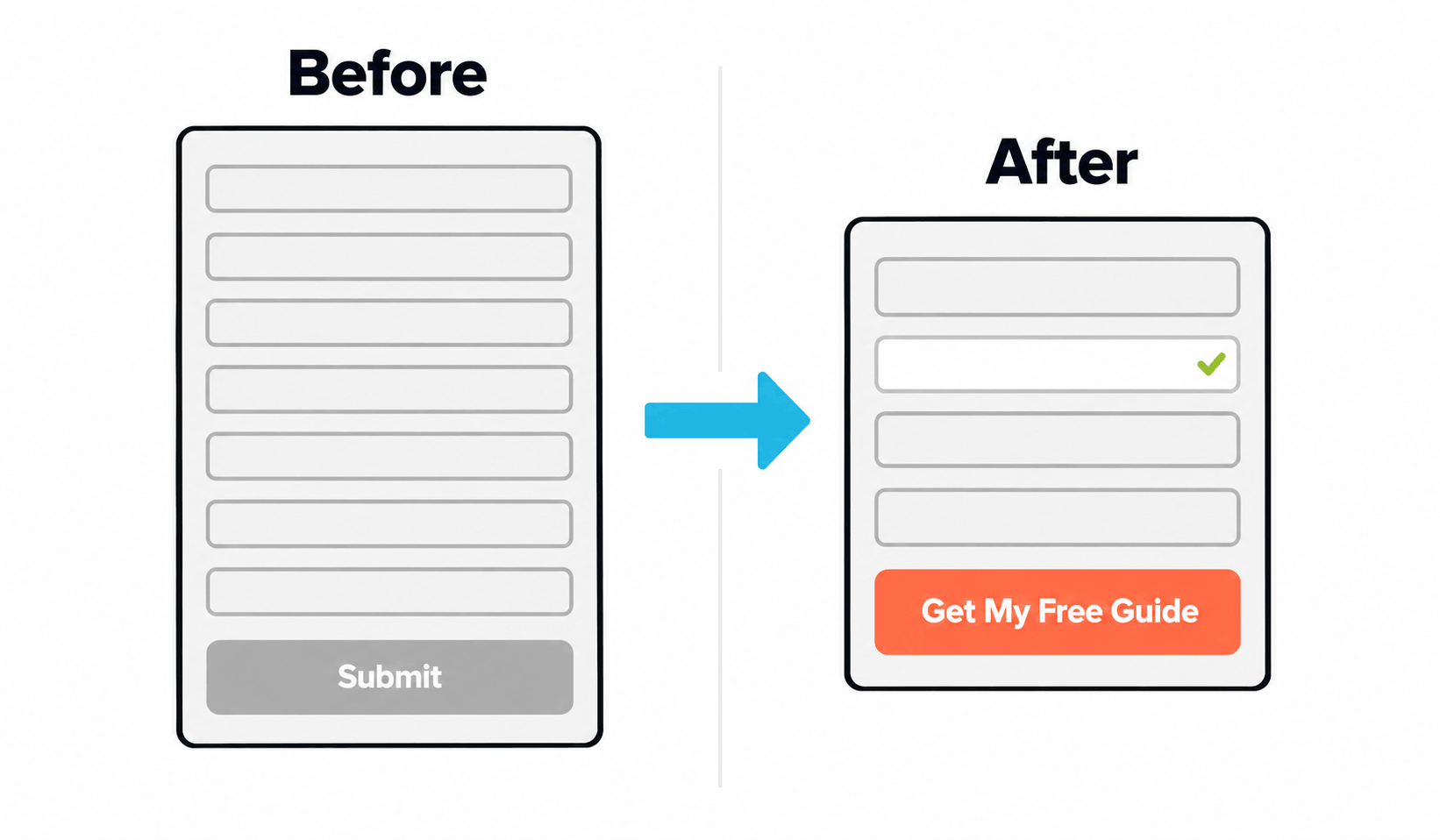
3. Radically Simplify Your Forms
Long forms cause users to abandon pages. Limiting form fields to a maximum of four keeps users engaged. Using smart validation also makes the process faster and easier.
Case Study: Fintech company PayU found that many potential customers were quitting the onboarding process. They removed non-essential fields, such as asking for both an email and a phone number. This change improved their checkout rate by 5.8%.
4. Deploy High-Value Lead Magnets
To collect information from new visitors, a page must offer lead magnets—useful resources like guides, calendars, or reports—in exchange for their information.
Case Study: The platform Later created landing pages for gated content, such as marketing guides. This strategy helped them collect over 100,000 leads, with an average conversion rate of approximately 60% across these pages.
5. Audit for Mobile-First Constraints
Meetanshi Consumer Behavior Trend in 2025 reports that nearly 69.6% of shoppers use smartphones to make purchases. Landing pages must be optimized for touch. Key elements like the headline and CTA button must fit within a vertical space of 600 to 800 pixels.
Case Study: Matchnode created mobile-specific pages for New Balance Chicago. They simplified the navigation menu and made product images larger for small screens. This doubled in-store sales while reducing ad spending by half.
6. Verify Lightning-Fast Technical Performance
Page load speed directly impacts whether a user stays or leaves, as defined by Google: a load time under 2.5 seconds and a processing time of 200 milliseconds.
Case Study: For instance, even with only a 0.1-second increase in site speed, a 2025 Deloitte study found that conversion increased by up to 10.1%.
7. Implement AI-Driven Traffic Routing
AI tools can route visitors to different page versions based on their personal data. The system uses device and location data to serve the highest-converting layout.
Case Study: Production company World of Wonder increased overall conversion rate by almost 20% with an AI tool that routes visitors to different landing page versions. Specifically, sign-ups for their streaming service rose by up to 30%.
8. Perfect Your Pop-Up Timing
Showing a pop-up window immediately after a page loads can annoy visitors. Users need time to engage before interruption. Timing pop-ups to appear after a user interacts with the page is more effective.
Case Study: Broomberg tested immediate pop-ups against delayed ones. The delayed version triggered only after user interaction, resulting in higher-quality email sign-ups compared to the immediate display.
9. Streamline the Checkout Flow and Visual Hierarchy
A checkout process should have as few steps as possible to prevent users from quitting. Important details like free shipping should be placed where users look first. A clear visual hierarchy guides the eye toward the final purchase button.
Case Study: Intertop switched from a multi-page checkout to a single-page guest checkout, resulting in more completed purchases.
Meanwhile, Zalora moved the word Free to the beginning of their shipping text, improving their checkout rate by over 10%.
10. Anchor the Page with Authentic Social Proof
Placing reviews and trust badges near the CTA improves credibility. These elements show new visitors that others have had positive experiences. Social proof reduces the hesitation a buyer might feel before clicking.
Case Study: Taylor Made Marketing in 2025 tested landing pages with local trust signals and specific messaging. By focusing on local credibility, they achieved steady growth in the number of qualified leads they generated.
11. Ensure Backend Agentic Automation
A landing page is only effective if the collected data is used quickly. Forms should send lead data instantly to your CRM. Lead Decay occurs when the value of a prospect diminishes rapidly the longer they wait for a response. Research indicates that responding to a lead within 5 minutes is 10x more effective than waiting just 30 minutes. By then, the "mental momentum" of the user has shifted, and they may have already clicked a competitor's ad.
Case Study: Veo used automation to connect social media lead forms to their CRM in real time, providing their sales team with immediate information on new prospects. The company achieved a 7.5% conversion rate and reduced the cost per lead by 20%.
Performance Metrics Summary for Landing Page Optimization
This table summarizes the performance gains achieved by various companies using modern landing page strategies. It provides specific metrics and the primary optimization tactics used to drive these results.
How Conversion Intelligence Improves LPO
Conversion intelligence uses AI and data to guide marketing decisions and improve user experiences. It replaces static pages with systems that adapt to user behavior in real time.
This allows pages to:
- Learn from user behavior
- Adjust content automatically
- Improve results over time
In 2026, successful pages combine design, automated personalization, and data to improve return on investment. The system analyzes visitor attributes, such as device type or location, to display the most effective page version.
Tools and Platforms for Landing Page Optimization (2026)
Effective CRO requires the right mix of testing, analytics, and personalization tools. In 2026, high-performing teams use integrated stacks for real-time testing and optimization at scale.
Below is a breakdown of commonly used CRO tools by category:
Effective CRO relies on connected systems where analytics inform tests and winning variations scale through personalization.
As optimization evolves toward conversion intelligence, teams increasingly combine these platforms with AI-driven decision systems to automate testing, routing, and user experience improvements.
AI, Data, and Personalization in 2026 LPO
Modern Landing Page Optimization (LPO) systems combine AI, customer data, and automation to improve results in real time. These systems connect landing pages directly to CRM platforms, allowing instant updates, smarter personalization, and faster follow-ups.
They use AI layers such as the OpenAI Realtime API for instant personalization and Google Gemini integration for advanced data analysis and automation within CRM systems.
This setup allows landing pages to:
- Adjust content instantly based on user behavior
- Sync lead data to CRM systems without delay
- Trigger automated follow-ups and personalized experiences
Core Technologies Powering LPO
- Zero-Party Data: Information users share directly, such as form inputs or preferences
- Vector-Based Personalization: Uses AI to group users by behavior and meaning to better match user intent
- LSI vs. Neural Matching: Uses related keywords to understand content, while neural matching uses AI to understand intent
When Landing Page Optimization Won’t Work (And How to Fix It)
Landing page optimization improves performance, but cannot fix poor traffic, weak offers, or low intent. In many cases, poor conversion rates are symptoms, not root causes.
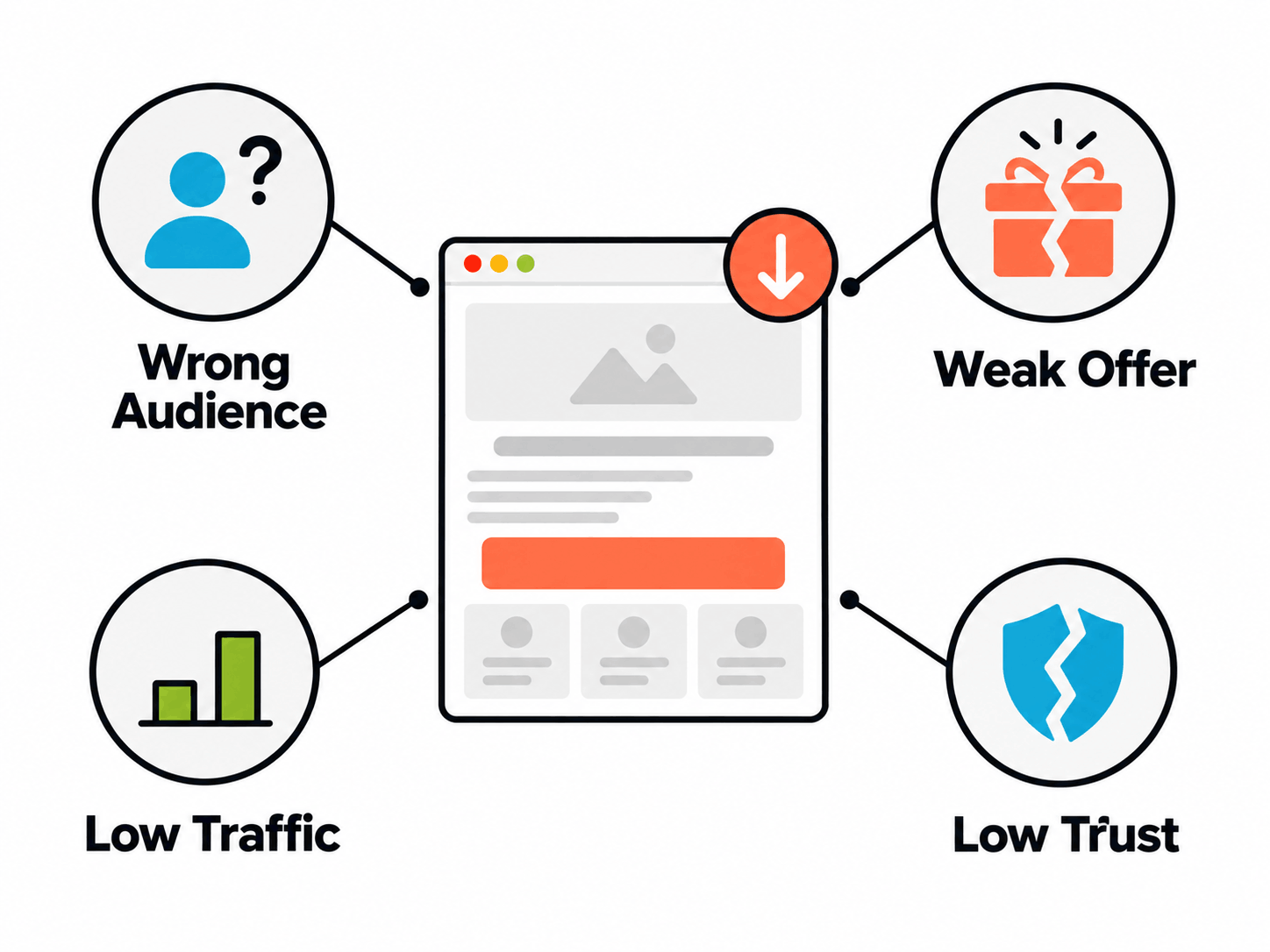
1. Wrong Audience (Intent Problem)
If your traffic is primarily informational (e.g., blog readers or broad keywords), users may not be ready to convert. This is known as the intent mismatch, where visitors lack transactional intent.
Fix: Target high-intent keywords and align campaigns with transactional queries.
2. Weak Value Proposition
Even a perfectly optimized page cannot compensate for a weak or unclear offer. MECLABS Conversion Heuristic in 2026 suggests that clarity of the value proposition is one of the strongest drivers of conversion probability.
Fix: Improve your core offer before optimizing design elements.
3. Low Traffic for Testing
Advanced techniques such as A/B testing, multivariate testing, and contextual bandits require sufficient data to produce meaningful results.
Fix: Focus on qualitative insights (e.g., session recordings, user interviews) before running experiments.
4. Lack of Consumer Trust
In 2026, users are more skeptical than ever. A lack of E-E-A-T signals (Experience, Expertise, Authoritativeness, Trustworthiness) leads to an immediate drop-off.
Fix: Add the following elements to your website:
- Verified testimonials
- Trust badges
- Transparent policies
Trust is often a bigger lever than design optimization.
Final Thoughts
To improve landing page performance, focus on these immediate actions:
- Ensure the page speed is under 2.5 seconds to meet Google standards.
- Replace generic buttons like Submit with benefit-driven phrases like "Trial for Free".
- Place customer reviews and trust badges near the primary CTA to reduce buyer hesitation with social proof.
- Connect forms to your CRM in real time so sales can respond immediately.
Frequently Asked Questions (FAQs)
1. What is a good conversion rate for landing pages in 2026?
Conversion rates vary by industry, but most fall between 2% and 5%. High-performing pages, especially in e-commerce or SaaS, can exceed 6–10%.
2. What is the difference between CRO and SEO?
SEO (Search Engine Optimization) focuses on driving traffic to your website, while CRO (Conversion Rate Optimization) focuses on converting that traffic into leads or customers.
In 2026, both are closely connected through user intent satisfaction, where engagement and conversion signals influence search rankings.
3. Why is my website getting traffic but not converting?
This is often caused by:
- Intent mismatch (wrong audience)
- Poor user experience (slow speed, friction)
- Weak value proposition
- Lack of trust signals
Fixing these issues often improves conversions more than increasing traffic.
4. How many fields should a high-converting form have?
In most cases, forms perform best with 3–4 essential fields. However, the ideal number depends on your goal: shorter forms increase completion rates, while longer forms may improve lead quality.
5. Do I need AI tools for landing page optimization?
Not always. AI-driven tools are most useful when you have:
- High traffic volume
- Multiple audience segments
- Ongoing experimentation needs
For smaller sites, basic A/B testing and user research can still deliver strong results.
Related Content
Read These Next
High Converting Landing Page: The 5 Anatomy Secrets of Million-Dollar Pages